
How Offline Programming and Digital Twins Are Revolutionizing ROI in Industrial Automation
The manufacturing sector is undergoing a seismic shift driven by the convergence of robotics, artificial intelligence, and advanced simulation tools. Among the most transformative innovations are offline programming and digital twin technologies, which are redefining how manufacturers achieve return on investment (ROI). By enabling virtual testing, predictive optimization, and real-time decision-making, these tools are accelerating cost savings, reducing downtime, and unlocking new levels of operational efficiency.
The Synergy of Offline Programming and Digital Twins
Offline programming allows engineers to design, test, and refine robotic workflows in a virtual environment, eliminating the need for costly physical trial-and-error on production floors. When paired with digital twins-dynamic, data-driven replicas of physical systems-this approach creates a feedback loop that optimizes every stage of manufacturing.
According to a 2025 case study, manufacturers integrating these technologies reported up to a 30% increase in production speed and a 75% reduction in weekly downtime. For example, General Motors' Spring Hill facility achieved a 25% reduction in unplanned downtime and a 20% increase in overall equipment effectiveness (OEE) by deploying digital twins for stamping press operations, according to a Simularge analysis. Similarly, a mid-sized factory using predictive maintenance powered by digital twins cut unplanned downtime by 67% (from 120 to 40 hours over six months) and reduced maintenance costs by 40%, according to a McKinsey report.
Measurable ROI Across Industries
The financial impact of these technologies is well-documented. Hexagon's Digital Twin Industry Report reveals that companies adopting digital twins report an average of 19% cost savings and 15% reductions in carbon emissions. Early adopters, such as Unilever, have seen $52 million in annual savings across eight factories through reduced material waste, energy consumption, and downtime, as noted in the same 2025 case study.
Offline programming further amplifies these gains. By simulating production scenarios virtually, manufacturers avoid costly errors and streamline workflows. A German multinational corporation, for instance, leveraged digital twins to align with Lean and Agile manufacturing strategies, reducing bottlenecks and improving resource efficiency, as described in an MDPI case study. Meanwhile, Hexagon's research highlights that 92% of manufacturers tracking ROI from digital twins report double-digit returns, with nearly 20% average cost savings, according to an Advanced Manufacturing article.
Strategic Advantages Beyond Cost Savings
Beyond immediate financial benefits, the integration of offline programming and digital twins fosters long-term strategic advantages. These include:
- Faster Time-to-Market: Eaton reduced product development time by 80% using digital engineering tools, according to an aPriori blog.
- Sustainability Gains: Carrier integrated carbon metrics into its digital twin models, enabling real-time cost and emissions reductions.
- Scalable Innovation: By simulating supply chain disruptions, manufacturers can proactively adjust logistics strategies, minimizing risks, as shown in a ScienceDirect paper.
The National Institute of Standards and Technology (NIST) estimates that full adoption of digital twins in U.S. manufacturing could unlock $37.9 billion in annual value, underscoring the technology's scalability.
Conclusion: A Compelling Investment Case
For investors, the case for robotics integration in manufacturing is clear. Offline programming and digital twins are not just incremental improvements-they are foundational shifts that address core challenges in efficiency, sustainability, and agility. As adoption accelerates, early movers like General MotorsGM--, Unilever, and Eaton are setting benchmarks for ROI, proving that these technologies are no longer optional but essential for competitive advantage.
The path forward lies in phased implementation, starting with high-impact use cases like predictive maintenance and process optimization. With the right strategy, manufacturers can transform their operations while delivering measurable financial returns-a win for both industry and investors.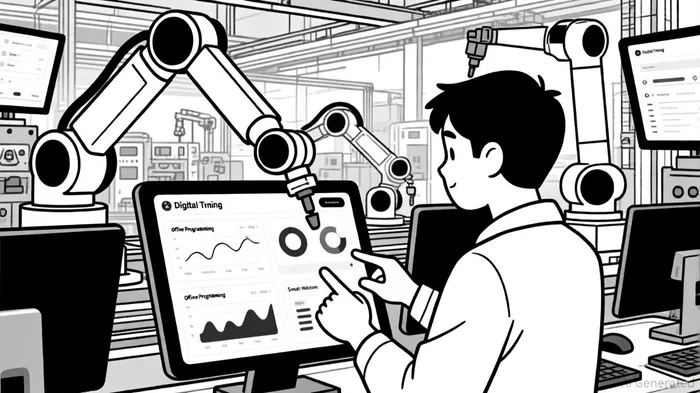





Comentarios
Aún no hay comentarios