
Ocugen Falls as Gene Therapy for Eye Disease Lags in Phase II Study
Shares of Ocugen OCGN declined 8.6% on Tuesday after the company announced 12-month data from the phase II ArMaDa study evaluating its novel modifier gene therapy, OCU410, for treating geographic atrophy (GA) secondary to dry age-related macular degeneration (dAMD).
What Did OCGN’s Data From the ArMaDa Study Show?
Data from the study showed that treatment with the optimal (medium) dose of OCU410 led to a 31% reduction in lesion growth versus the control arm. This is a treatment benefit compared to 15% and 22% reductions reported for currently approved therapies at 12 and 24 months, respectively.
Earlier this year, preliminary data from the phase II study showed that treatment with OCU410 led to 46% lesion growth reduction at 12 months across the medium- and high-dose groups. Importantly, the medium dose of OCU410 achieved a 54% lesion reduction compared to the control.
Despite the positive 12-month data, shares of OCGNOCGN-- were down in response to the news. This was probably due to the percentage of reduction in lesion growth being less compared to that announced at the time of preliminary phase II data.
Ocugen plans to begin a phase III registrational study on OCU410 in the third quarter of 2026. The medium dose is the optimal dose intended for phase III development.
OCGN’s Price Performance
In the past six months, shares of OcugenOCGN-- have rallied 31.5% compared with the industry’s increase of 13.5%.
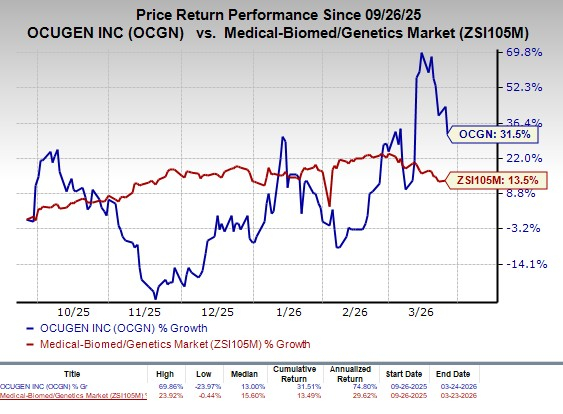
Image Source: Zacks Investment Research
There are about 2-3 million people with GA in the United States and Europe. In the United States, only one treatment is available, an anti-complement therapy, which requires repeated injections and targets just one part of the disease. Ocugen believes its therapy, OCU410, could address multiple aspects of GA and potentially change how the disease is treated. In Europe, no treatments for GA are currently approved.
OCGN’s Late-Stage Pipeline for Eye Diseases Holds Promise
Ocugen is making rapid progress in its gene therapy programs for retinal diseases, each with a distinct mechanism of action.
Besides OCU410, the company’s lead ocular programs include OCU400 in phase III development for retinitis pigmentosa and OCU410ST, which is in phase II/III evaluation for Stargardt disease.
Enrollment has been completed in the phase III liMeliGhT study on lead modifier gene therapy candidate, OCU400, to treat retinitis pigmentosa, a rare genetic disorder that can lead to vision loss and blindness. Top-line data from the phase III study is expected in the first quarter of 2027.
OCU410ST is being developed as a one-time gene therapy for treating Stargardt disease. The phase II/III GARDian3 pivotal confirmatory study for OCU410ST for Stargardt disease is ongoing. Interim data from the same is expected in the third quarter of 2026. Currently, there are no FDA-approved treatments available for Stargardt disease.
OCGN’s Zacks Rank & Stocks to Consider
Ocugen currently carries a Zacks Rank #3 (Hold).
Some better-ranked stocks in the biotech sector are Phathom Pharmaceuticals PHAT, ANI Pharmaceuticals ANIP and Replimune Group REPL, each carrying a Zacks Rank #2 (Buy). You can see the complete list of today’s Zacks #1 Rank (Strong Buy) stocks here.
Over the past 60 days, estimates for Phathom Pharmaceuticals’ 2026 earnings per share have increased from 23 cents to 28 cents, while the same for 2027 have increased from $2.22 to $2.25. PHAT’s shares have declined 14.6% in the past six months.
Phathom Pharmaceuticals’ earnings beat estimates in two of the trailing four quarters, while missing the same on the remaining two occasions, with the average surprise being 14.06%.
Over the past 60 days, estimates for ANI Pharmaceuticals’ 2026 earnings per share have increased from $8.28 to $8.99, while the same for 2027 have increased from $9.25 to $10.10. ANIP’s shares have fallen 21.2% in the past six months.
ANI Pharmaceuticals’ earnings beat estimates in each of the trailing four quarters, with the average surprise being 22.21%.
Over the past 60 days, estimates for Replimune’s 2026 loss per share have narrowed from $3.61 to $3.40, while the same for 2027 have narrowed from $2.58 to $2.46. REPL’s shares have rallied 68.8% in the past six months.
Replimune’s earnings beat estimates in one of the trailing four quarters and missed on the remaining three occasions, with the average negative surprise being 4.46%.
Radical New Technology Could Hand Investors Huge Gains
Quantum Computing is the next technological revolution, and it could be even more advanced than AI.
While some believed the technology was years away, it is already present and moving fast. Large hyperscalers, such as Microsoft, Google, Amazon, Oracle, and even Meta and Tesla, are scrambling to integrate quantum computing into their infrastructure.
Senior Stock Strategist Kevin Cook reveals 7 carefully selected stocks poised to dominate the quantum computing landscape in his report, Beyond AI: The Quantum Leap in Computing Power.
Kevin was among the early experts who recognized NVIDIA's enormous potential back in 2016. Now, he has keyed in on what could be "the next big thing" in quantum computing supremacy. Today, you have a rare chance to position your portfolio at the forefront of this opportunity.
See Top Quantum Stocks Now >>Want the latest recommendations from Zacks Investment Research? Today, you can download 7 Best Stocks for the Next 30 Days. Click to get this free report
ANI Pharmaceuticals, Inc. (ANIP): Free Stock Analysis Report
Replimune Group, Inc. (REPL): Free Stock Analysis Report
Ocugen, Inc. (OCGN): Free Stock Analysis Report
Phathom Pharmaceuticals, Inc. (PHAT): Free Stock Analysis Report
This article originally published on Zacks Investment Research (zacks.com).





Comentarios
Aún no hay comentarios