
Ocean Protocol's Strategic Realignment: Decentralized Data Ownership and AI Investment Opportunities
Ocean Protocol's Strategic Realignment: Decentralized Data Ownership and AI Investment Opportunities
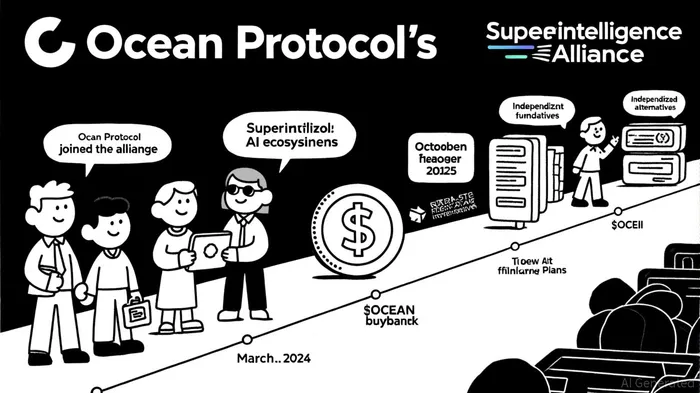
Ocean Protocol's recent strategic realignment-marked by its withdrawal from the Artificial Superintelligence Alliance (ASI Alliance)-has reignited debates about the future of decentralized data ownership and its role in shaping AI-driven investment opportunities. The foundation's decision, announced on October 9, 2025, underscores a broader tension between centralized AI ecosystems and decentralized alternatives, while also highlighting the financial and operational risks of token mergers in the blockchain space, according to the foundation's blog (Ocean Protocol Foundation withdraws from the Artificial Superintelligence Alliance).
The ASI Alliance: A Unified Vision for Decentralized AI
In March 2024, Ocean Protocol joined forces with Fetch.ai and SingularityNET to form the ASI Alliance, a $7.5 billion initiative aimed at advancing decentralized artificial superintelligence, as described in the June 13 merger. The alliance merged the three projects' tokens into a single $ASI token, creating a unified token economy to accelerate AI development. While the alliance emphasized collaboration-joint events, shared infrastructure, and a governing council led by Humayun Sheikh and Ben Goertzel-each foundation retained legal independence, including separate leadership and treasuries. This structure allowed Ocean Protocol to contribute its data-sharing expertise while maintaining operational flexibility.
However, the alliance's token merger introduced complexities. By June 2024, $FET tokens were rebranded as $ASI, with a 1:0.433226 conversion rate for $OCEAN holders, as reported by BitcoinHaber (Ocean Protocol Breaks Away from AI Alliance for New Ventures). While this created a larger, more liquid market, it also diluted Ocean Protocol's control over its tokenomics-a factor that would later drive its exit.
Strategic Exit: Autonomy Over Conformity
Ocean Protocol's withdrawal from the ASI Alliance in October 2025 was driven by a desire to reclaim financial sovereignty. The foundation said the move was necessitated by "the need for independent tokenomics and development funding strategies" (the foundation's blog). By July 2024, 81% of $OCEAN tokens had been converted to $FET, but the foundation now plans to redirect profits from commercialized Ocean-derived technologies toward $OCEAN buybacks and burns, aiming to reduce supply and increase token value (the BitcoinHaber report cited earlier).
This realignment reflects a growing trend in the blockchain industry: projects prioritizing token-specific governance over broader alliances. As noted in the June 13 merger announcement, Ocean Protocol's exit signals a recalibration of risk-return profiles, with the foundation now focusing on "self-sustaining growth" rather than shared infrastructure.
Decentralized Data Ownership: A Foundation for AI Innovation
Ocean Protocol's core thesis-decentralized data ownership-remains central to its value proposition. By enabling individuals and organizations to monetize data while retaining control, the platform addresses a critical bottleneck in AI development: access to high-quality, ethically sourced datasets. This model contrasts sharply with centralized AI ecosystems, where data is often siloed by Big Tech firms.
The foundation's independence now allows it to tailor its tokenomics to this mission. For instance, $OCEAN buybacks funded by commercialization revenues create a flywheel effect: increased demand for the token could drive adoption, while reduced supply may enhance scarcity. This approach mirrors successful models in DeFi, where token burns have historically correlated with price appreciation.
Investment Implications: Navigating the AI-Blockchain Nexus
For investors, Ocean Protocol's realignment presents both opportunities and risks. On the upside, the foundation's focus on decentralized data ownership aligns with regulatory trends favoring data privacy and ethical AI. Additionally, the separation from the ASI Alliance may reduce governance conflicts and streamline decision-making-a factor that could attract institutional capital.
However, challenges remain. The conversion of 81% of $OCEAN to $FET means the token's market capitalization is partially tied to the performance of the ASI token, which is still underpinned by the alliance's shared infrastructure. Investors must also weigh the risks of a fragmented decentralized AI ecosystem against the potential for Ocean Protocol to innovate independently.
Conclusion: A New Chapter for Decentralized AI
Ocean Protocol's strategic realignment marks a pivotal moment in the evolution of decentralized AI. By prioritizing autonomy in tokenomics and development, the foundation is reasserting its commitment to data sovereignty-a principle that could become increasingly valuable as AI adoption accelerates. For investors, the key takeaway is clear: projects that balance collaboration with financial independence are better positioned to navigate the volatile intersection of blockchain and AI.
As the industry watches Ocean Protocol's next moves, one thing is certain: the battle for the future of data-and the AI built upon it-is far from over.







Comentarios
Aún no hay comentarios