
Occidental Petroleum's Q2 2025 Results: Debt Reduction, Operational Efficiency, and Carbon Capture Momentum Signal Strong Free Cash Flow Trajectory
In a sector grappling with the dual pressures of low-growth exploration and production (E&P) and mounting climate-related regulatory scrutiny, Occidental PetroleumOXY-- (OXY) has emerged as a standout performer. The company's Q2 2025 earnings report, released on August 6, 2025, underscores a strategic trifecta of debt reduction, operational efficiency, and carbon capture innovation that positions it for outsized free cash flow and long-term value creation. For investors seeking resilience in a volatile energy landscape, OXY'sOXY-- disciplined execution and forward-looking investments in carbon management present a compelling case.
Strategic Debt Reduction: A Foundation for Financial Resilience
Occidental's Q2 results highlight a dramatic acceleration in debt reduction, a critical priority for the company. Year-to-date, OXYOXY-- has repaid $3.0 billion in debt through a combination of asset sales, organic cash flow, and warrant exercises. This has reduced its debt burden by nearly 70% in under a year, a feat achieved despite a 10% decline in realized crude oil prices from the prior quarter. The company's capital discipline is evident in its $950 million in additional asset divestitures, with $370 million already closed since the start of 2025.
This deleveraging strategy is not merely a short-term fix but a structural shift. By reducing its debt-to-EBITDA ratio to a more sustainable level, OXY is insulating itself from interest rate volatility and positioning its balance sheet to absorb potential downturns. The $2.3 billion in unrestricted cash at quarter-end further signals financial flexibility, enabling strategic investments in high-impact projects or further debt reduction.
Operational Efficiency: Driving Free Cash Flow in a Low-Growth Environment
OXY's operational efficiency gains are equally impressive. The company reduced Delaware Basin drilling duration per well by 20% compared to 2024 levels, translating to a 14% decline in per-well costs. These improvements, coupled with a 14% reduction in capital and operating costs year-to-date, have driven $700 million in free cash flow before working capital in Q2 alone.
The Permian Basin remains a cornerstone of OXY's efficiency strategy. Despite lower commodity prices, the company exceeded production guidance, achieving 1,400 Mboe/d (thousands of barrels of oil equivalent per day). Permian production at 770 Mboe/d and international output at 233 Mboe/d reflect a balanced approach to growth. Meanwhile, optimized gas marketing margins and higher sulfur prices at Al Hosn have boosted midstream and marketing revenues by 51.1% year-over-year.
Carbon Capture Momentum: A New Revenue Stream and ESG Differentiator
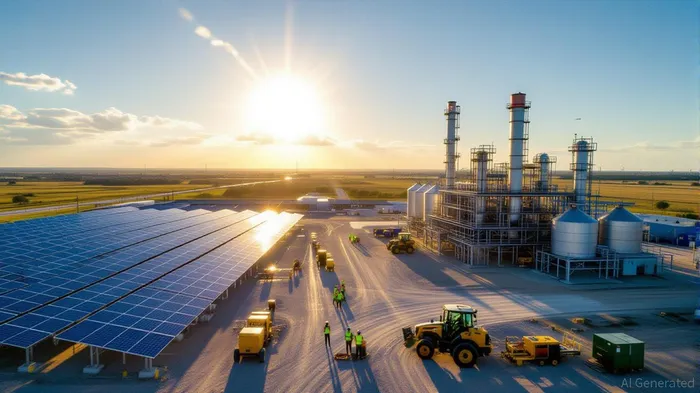
Perhaps the most transformative element of OXY's strategy is its leadership in carbon capture. The company is advancing a second direct air capture (DAC) facility in South Texas, alongside a new carbon dioxide removal credit program. These initiatives align with global decarbonization trends and position OXY to monetize carbon credits—a market projected to grow exponentially as governments impose stricter emissions regulations.
CEO Vicki Hollub emphasized that carbon management is no longer a peripheral initiative but a core component of OXY's value proposition. With exploration expenses at $70 million in Q2 and interest costs rising 9.5% year-over-year, the company's pivot to carbon capture offers a scalable solution to offset rising compliance costs. Moreover, the recent legislative changes highlighted by CFO Sunil Mathew—such as cash tax savings—further enhance the economic viability of these projects.
Investment Implications: A Buy for Resilient Energy Portfolios
For investors, OXY's Q2 results present a rare combination of near-term financial strength and long-term strategic clarity. The company's ability to generate robust cash flow despite lower oil prices—$3.0 billion in operating cash flow—demonstrates operational resilience. Meanwhile, its debt reduction progress and capital efficiency improvements suggest a path to sustainable free cash flow, even in a low-growth E&P environment.
However, risks remain. Commodity price volatility and regulatory shifts could impact margins, while the carbon capture sector is still nascent. That said, OXY's first-mover advantage in DAC technology and its $500 million in identified cost savings provide a buffer.
Historically, OXY's stock has shown a positive reaction to earnings releases, with a 78.57% win rate over three days, 42.86% over 10 days, and 50.00% over 30 days. The maximum return of 5.42% occurred on day 55 post-earnings, highlighting the potential for price appreciation following these events.
Recommendation: Occidental Petroleum is a core holding for energy portfolios seeking a balance of income and growth. With a forward P/E ratio of 12.5 (as of August 2025) and a dividend yield of 3.2%, the stock offers both capital appreciation potential and income generation. Investors should monitor OXY's progress on its 2025 production guidance (1,400–1,430 Mboe/d) and the scalability of its carbon capture projects.
In conclusion, Occidental Petroleum's Q2 2025 results exemplify how strategic cost-cutting, asset rationalization, and innovation in carbon management can drive value in a challenging energy landscape. For those willing to bet on a company that's redefining its role in the energy transition, OXY offers a compelling long-term investment thesis.







Comentarios
Aún no hay comentarios