
Obayashi's Share Buyback Strategy and Its Implications for Shareholder Value
Obayashi Corporation's recent completion of a ¥29.99 billion share buyback program—repurchasing 14.56 million shares (2.04% of outstanding stock)—has reignited investor interest in the Japanese engineering giant. This move, executed at an average price of ¥2,060 per share, underscores management's conviction in the company's undervaluation and its disciplined approach to capital allocation. For long-term investors, the buyback represents a strategic catalyst that could drive both near-term earnings growth and long-term value creation.
Capital Allocation Efficiency: A Strategic Reallocation of Resources
Obayashi's buyback is not an isolated action but a core component of its broader capital reallocation strategy under the Medium-Term Business Plan 2022. By reducing cross-shareholdings—a traditional but inefficient corporate structure—Obayashi has freed up ¥243.8 billion in capital, which is now being redirected toward high-growth initiatives. These include digital transformation (DX), human capital development, and expansion into renewable energy infrastructure. The company's decision to prioritize share repurchases over less productive uses of capital reflects a modernized approach to governance, aligning with global investor expectations for transparency and shareholder-centric policies.
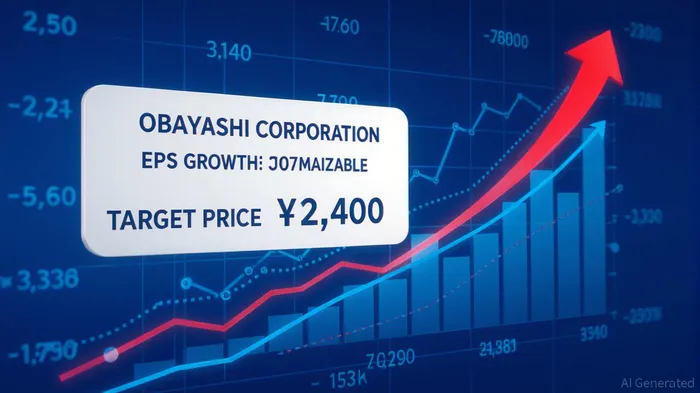
The buyback's timing is also telling. With Obayashi's stock trading at a market cap of ¥1.59 trillion—well below historical peaks—management has signaled that the company's intrinsic value is being overlooked. This is a classic case of a firm using its balance sheet to capitalize on market dislocations. By repurchasing shares at a 17.5% discount to the ¥2,400 analyst price target, Obayashi is effectively creating a margin of safety for investors, a hallmark of value-oriented capital allocation.
Earnings Per Share (EPS) Accretion and Valuation Implications
The immediate financial impact of the buyback is clear: a reduction in outstanding shares will directly boost EPS. Assuming stable net income, the 2.04% reduction in shares is projected to increase EPS by approximately 2.1%. This EPS accretion is critical for improving the company's valuation metrics. As of August 2025, Obayashi's P/E ratio stood at 11.78, down 41.07% from the previous year's 19.99. While this decline reflects broader market skepticism, the buyback's EPS lift could reverse this trend, narrowing the gapGAP-- between current earnings and the ¥2,400 price target.
Moreover, the buyback enhances the company's price-to-book ratio by reducing the denominator in the EPS calculation. With a Debt-to-Equity ratio of 0.31, Obayashi maintains a conservative capital structure, ensuring that the buyback does not strain liquidity. This financial prudence further strengthens the case for the program's success.
Governance Transparency and Investor Sentiment
The buyback also addresses governance concerns that had previously deterred institutional investors. By reducing cross-shareholdings to 15.8% of consolidated net assets by March 2027, Obayashi is mitigating risks flagged by Institutional Shareholder Services (ISS). The company has clarified that these holdings are for business collaboration, not vote manipulation, and its share circulation ratio of 84% now meets Tokyo Stock Exchange standards. These improvements have bolstered investor confidence, with analysts assigning a “Buy” technical rating and a ¥2,400 price target.
A Compelling Case for Investors
For investors, Obayashi's buyback program presents a rare combination of near-term catalysts and long-term strategic alignment. The immediate EPS boost, coupled with the redirection of capital into high-margin sectors like renewable energy, positions the company to benefit from global infrastructure trends. Additionally, the buyback's execution at a discount to analyst targets creates a floor for the stock price, reducing downside risk.
However, the true test of this strategy will come in Q3 2025, when investors can assess the impact of cross-holding reductions and EPS growth. Those who monitor these metrics closely may find themselves well-positioned to capitalize on a stock that is undervalued today but primed for appreciation.
Conclusion
Obayashi's share buyback is more than a financial maneuver—it is a statement of intent. By prioritizing shareholder returns, improving governance, and reallocating capital toward growth, the company is demonstrating a modern, value-driven approach to capital allocation. For investors seeking a blend of capital preservation and upside potential, Obayashi offers a compelling case. The key will be to track the company's progress on cross-holding reductions and EPS growth, both of which could serve as powerful catalysts for near-term outperformance.







Comentarios
Aún no hay comentarios