
Oakley Capital Investments Limited: Strategic Asset Allocation and Portfolio Resilience in Q2 2025
Oakley Capital Investments Limited (OCI) has demonstrated a disciplined approach to strategic asset allocation and portfolio resilience in Q2 2025, positioning itself as a standout performer in the alternative investment space. According to data from its H1 2025 earnings call, the firm reported a 7% net asset value (NAV) return for the first half of the year, with the NAV per share rising to 742p and a five-year compound annual growth rate (CAGR) of 17%[2]. This performance underscores OCI's ability to balance growth-oriented investments with risk mitigation, even amid macroeconomic uncertainties.
Strategic Asset Allocation: Sector and Geographic Diversification
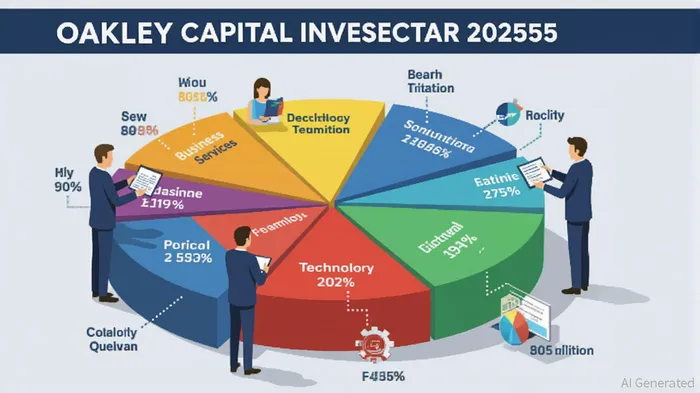
OCI's Q2 2025 asset allocation strategy reflects a clear focus on high-growth sectors. Business services emerged as the largest sector, holding £416 million in assets, followed closely by technology at £364 million[2]. This emphasis on scalable, recurring revenue models—particularly in business services and technology—aligns with broader market trends toward digital transformation and operational efficiency. The consumer and education sectors, at £266 million and £257 million respectively, further diversified the portfolio, reducing exposure to sector-specific downturns[2].
Geographically, OCI's investments span the U.K., DACH (German-speaking countries), and other European markets[2]. This diversification not only mitigates regional economic risks but also taps into growth opportunities in fragmented markets, such as the European Underground Infrastructure Maintenance (UIM) sector. A notable example is the firm's investment in Infravadis, a tech-enabled platform targeting the >€25 billion UIM market, through Oakley Capital Origin Fund II[4]. This marks the first step in a buy-and-build strategy aimed at consolidating a niche sector with long-term value potential.
Portfolio Resilience: Liquidity, Age, and Responsible Investment
Portfolio resilience in Q2 2025 was bolstered by robust liquidity and a maturing investment portfolio. OCI reported adequate liquidity to support 12+ months of deployment, enabling further realizations and strategic exits[2]. A key driver of resilience was the successful exit of VLEX, which achieved a 6.3x multiple of invested capital (MOIC), significantly contributing to the firm's NAV growth[2]. Additionally, the weighted average age of portfolio holdings increased to three years, with many investments entering the two-year-plus category—where value creation typically accelerates[2].
The firm's commitment to responsible investment practices further strengthened its risk profile. As outlined in its 2024 Responsible Investment Report, OCI integrates sustainability considerations across its investment lifecycle, from initial screening to ongoing stewardship[3]. This approach not only aligns with global ESG trends but also enhances long-term value retention in an increasingly regulated market.
Conclusion: A Model for Sustainable Growth
Oakley Capital Investments Limited's Q2 2025 performance exemplifies a strategic balance between aggressive sector targeting and prudent risk management. By prioritizing business services and technology, leveraging geographic diversification, and embedding sustainability into its operations, OCI has built a resilient portfolio capable of navigating both cyclical and structural market shifts. As the firm continues to execute its buy-and-build strategy in niche markets like UIM, investors may find its approach a compelling blueprint for sustainable, long-term capital appreciation.







Comentarios
Aún no hay comentarios