
NYC's Intervention in Rent-Stabilized Housing Bankruptcy and Its Impact on Real Estate Markets
New York City's intervention in rent-stabilized housing bankruptcy has become a focal point of its broader housing policy agenda, reshaping the risk-return calculus for real estate investors. The 2019 Housing Stability and Tenant Protection Act (HSTPA) fundamentally altered the financial dynamics of rent-stabilized housing by restricting landlords' ability to deregulate units, limit rent increases, and recover costs through market-rate adjustments according to proposed guidelines. While these measures were designed to protect tenants from displacement and affordability erosion, they have inadvertently exacerbated financial strain on property owners, triggering a wave of bankruptcies and distressed sales. This analysis examines how tenant protection policies are redefining risk metrics for investors, with particular attention to cap rates, vacancy trends, and the diverging trajectories of rent-stabilized versus market-rate properties.
The HSTPA's Unintended Consequences: Rising Costs and Diminishing Returns
The HSTPA's restrictions on rent increases and deregulation have created a mismatch between operating costs and revenue streams for rent-stabilized landlords. According to a Bloomberg report, insurance costs for these properties surged by 224% between 2020 and 2024, while real estate taxes rose by 118%. Meanwhile, allowable rent increases for stabilized units have been capped at levels far below inflation. For example, the Rent Guidelines Board (RGB) permitted only 2.75% and 5.25% annual increases for one- and two-year leases, respectively, in the 2024–2025 cycle. This has left many landlords operating at a loss, with one study estimating that 10% of rent-stabilized units now lose money for their owners.
The financial distress has manifested in a surge of bankruptcies and distressed sales. Pinnacle Group, a major landlord managing 9,300 rent-stabilized units, filed for Chapter 11 bankruptcy in 2025, citing $500 million in mortgage debt and deferred maintenance costs. The city's intervention in Pinnacle's bankruptcy auction- challenging a $451 million sale to Summit Properties USA-highlighted concerns about the feasibility of maintaining these properties under new ownership. Such cases underscore the growing risk of asset devaluation and operational instability in the rent-stabilized sector.
Vacancy Rates and Property Value Declines: A Market in Turmoil
Vacancy rates for rent-stabilized housing have swung dramatically in recent years. In 2023, the rate hit a historic low of 0.98%, driven by post-pandemic demand and economic resilience. However, by 2025, vacancies had spiked to at least 50,000 units-a 10-fold increase from 2019 levels-due to landlords abandoning unprofitable properties. This volatility reflects the sector's fragility: landlords are either unable to maintain units or are selling at fire-sale prices to exit the market.
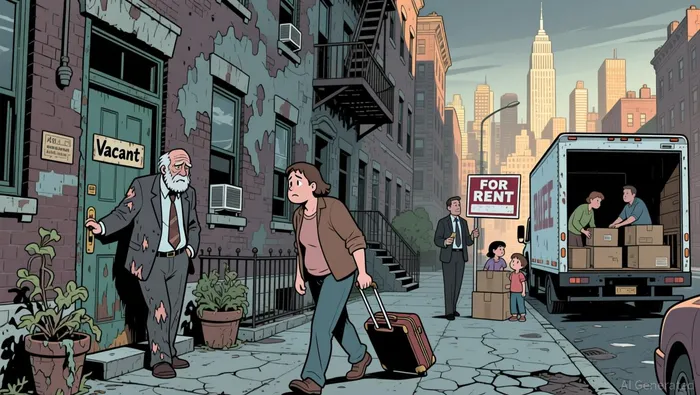
Property values for rent-stabilized buildings have plummeted, with some properties losing up to 80% of their value since 2019. A 2025 analysis by Ariel Property Assessors noted that legacy 90%+ rent-stabilized buildings-those with at least 90% of units stabilized-now trade at significantly lower valuations than their market-rate counterparts. The median collected rent for these units in 2025 was $1,395 per month, compared to $1,455 for all legacy properties. This disparity is compounded by deferred maintenance and rising operating costs, which further erode investor confidence.
Cap Rates and Risk Premiums: A Diverging Market
The financial risks associated with rent-stabilized housing are starkly reflected in cap rate trends. Post-HSTPA, cap rates for rent-stabilized properties have climbed to 7% or higher in 2024, compared to sub-5% for unregulated market-rate assets. This widening gap underscores the sector's heightened risk profile. For instance, free market multifamily sales in Manhattan alone totaled $3.44 billion in 2024, driven by institutional buyers seeking stable returns in a low-supply environment. In contrast, rent-stabilized properties face a 35-60% drop in valuations from their 2017–2018 peaks, as regulatory constraints and operating deficits deter investment.
The divergence is further amplified by the city's aggressive tenant protection agenda. Mayor Zohran Mamdani's executive order reviving the Mayor's Office to Protect Tenants has intensified scrutiny of landlords, particularly in bankruptcy cases. This regulatory environment has led to a "flight to quality" among investors, with capital increasingly flowing to market-rate properties and luxury developments.
Investor Implications: Balancing Affordability and Profitability
For investors, the HSTPA's legacy is a market where risk and return are increasingly misaligned. Rent-stabilized properties, once seen as stable income assets, now require higher risk premiums to offset operational uncertainties. A 2025 report by the Furman Center warned that 10% of rent-stabilized units (up to 100,000) are operating near insolvency, with a rent freeze potentially deepening the crisis. Conversely, market-rate properties benefit from strong demand, limited supply, and favorable cap rates, making them more attractive to capital seeking predictable returns.
Creative solutions, such as converting rent-stabilized buildings into affordable housing via tax incentives, are being explored to mitigate these risks. However, the scale of the challenge remains daunting. As one industry expert noted, "The system risks reverting to the disinvestment seen in the 1970s if financial sustainability for landlords isn't addressed."
Conclusion: A Tipping Point for New York's Housing Market
NYC's interventions in rent-stabilized housing bankruptcy reflect a broader tension between tenant protection and investor viability. While policies like the HSTPA have succeeded in curbing displacement and preserving affordability, they have also destabilized a sector already strained by rising costs and regulatory complexity. For investors, the message is clear: the risk-return profile of rent-stabilized housing has fundamentally shifted, with cap rates, vacancy trends, and property values signaling a market in transition. As the city grapples with these challenges, the path forward will require innovative policy solutions that balance the needs of tenants, landlords, and capital markets.







Comentarios
Aún no hay comentarios