
Nvidia's Uncertain OpenAI Megadeal and Its Implications for AI Infrastructure Investing
The AI infrastructure boom has long been framed as a once-in-a-generation opportunity, with companies like NvidiaNVDA-- and OpenAI at its epicenter. However, the recent delays in finalizing Nvidia's reported $100 billion investment in OpenAI-initially announced in September 2025-have cast a shadow over the sector's growth narrative. As of late 2025, the deal remains at the letter-of-intent stage, with Nvidia's CFO Colette Kress explicitly stating there is "no assurance" it will proceed on expected terms according to CNBC. This uncertainty raises critical questions: Is this a temporary setback, or does it signal deeper structural risks in the AI infrastructure sector?
The OpenAI-Nvidia Deal: A Case Study in Uncertainty
The proposed partnership between Nvidia and OpenAI is emblematic of the sector's high-stakes ambitions. Under the agreement, Nvidia would supply OpenAI with AI supercomputing infrastructure powered by its GPUs, with the first $10 billion allocated to support OpenAI's initial gigawatt-scale deployment by mid-2026. However, the deal's lack of finality underscores the logistical and financial complexities of scaling AI infrastructure. According to Nvidia's quarterly 10-Q filing, the company has acknowledged that rapid innovation in its chip development-such as annual architecture updates-complicates long-term planning, increasing the risk of overproduction or underutilization of current-generation hardware.
This hesitation is not isolated. OpenAI has also secured a separate, more concrete partnership with AMD for 6 gigawatts of Instinct GPUs, complete with signed agreements and financial incentives according to CNBC. The contrast highlights a broader trend: while AI infrastructure deals are being announced at a breakneck pace, their execution is increasingly contingent on securing funding, navigating regulatory hurdles, and aligning with rapidly evolving technological standards.
Structural Risks in AI Infrastructure: Supply Chains, Energy Grids, and Circular Financing
The delays in the Nvidia-OpenAI deal reflect systemic challenges in the AI sector, particularly in three areas: supply chain bottlenecks, energy grid constraints, and circular investment dynamics.
1. Supply Chain Lead Times and Construction Bottlenecks
Building gigawatt-scale data centers is a multi-year endeavor fraught with delays. The 2025 State of AI Infrastructure Report notes that outdated data center planning cycles and network performance issues are among the top barriers to scaling AI initiatives according to Flexential. Additionally, the supply chain for energy infrastructure is struggling to keep pace with demand. Bottlenecks in construction materials like steel, aluminum, and copper-critical for data center development-are exacerbating delays according to ElNion. For instance, the permitting process for new infrastructure projects in the U.S. is lengthy and unpredictable, further slowing deployment according to ElNion.
2. Energy Grid Constraints
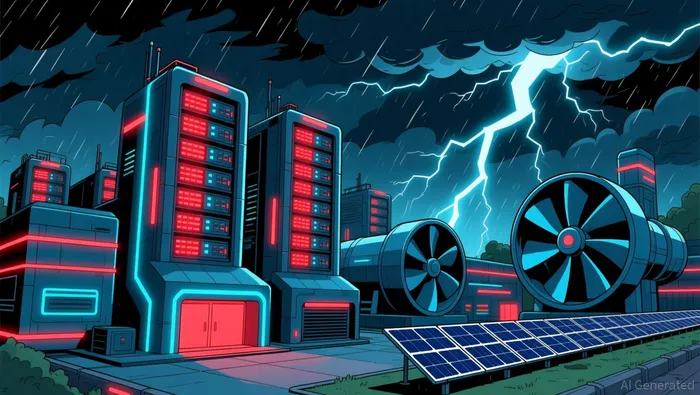 AI data centers are now among the largest consumers of electricity, with individual facilities requiring power equivalent to entire cities according to TrustNet. The scale of this demand is straining energy grids globally. In the U.S., estimates suggest that 75–100 gigawatts of new electricity generation capacity will be needed by 2030 to meet AI-driven demand according to TrustNet. This expansion requires a 10%–20% increase in natural gas production, a resource already under pressure from LNG export demands according to TrustNet. Moreover, the high and concentrated energy consumption of AI workloads has led to grid stability concerns, including harmonics and near-miss incidents according to ElNion.
3. Circular Investment Dynamics
The AI sector's growth is increasingly reliant on circular financing, where companies reinvest equity gains into new ventures that, in turn, generate demand for their products. For example, Oracle's $300 billion, five-year cloud computing contract with OpenAI is part of a broader AI infrastructure campaign involving partners like SoftBank according to Intuition Labs. While proponents argue this model is necessary to overcome supply bottlenecks, critics warn of overleveraging. Oracle's debt-to-equity ratio has surged to 500% due to its aggressive data center investments according to TrustNet, raising concerns about financial stability. Similarly, Nvidia's circular investment in OpenAI-where OpenAI's AI models could drive demand for Nvidia's next-generation chips-introduces a feedback loop that may not hold if market conditions shift according to Fortune.
Is This a Temporary Setback or a Warning Sign?
The Nvidia-OpenAI delay must be contextualized within the broader AI infrastructure landscape. On one hand, the sector is undeniably expanding. The Stargate project, involving Oracle, OpenAI, and SoftBank, aims to build up to 30 gigawatts of AI computing capacity in the U.S. by 2030 according to Intuition Labs. Meanwhile, U.S. data centers are projected to consume 12% of the country's electricity by 2028 according to Flexential, underscoring the scale of the opportunity.
On the other hand, the structural risks outlined above suggest that the AI growth narrative is not without vulnerabilities. Energy and supply chain constraints are likely to persist for years, while circular financing models may prove unsustainable if demand for AI infrastructure outpaces revenue generation. As Sean Peche, a financial analyst, notes, "While these valuations look attractive on paper, they become problematic when adjusted for true free cash flow-leaving investors with low yields akin to historical bubbles" according to TrustNet.
Conclusion: Navigating the AI Infrastructure Boom
For investors, the Nvidia-OpenAI deal serves as a cautionary tale. The AI infrastructure boom is real, but its execution is fraught with risks that cannot be ignored. Supply chain delays, energy grid constraints, and circular financing dynamics are not isolated issues-they are systemic challenges that could reshape the sector's trajectory.
However, this does not mean the AI growth story is over. Innovations in grid optimization, renewable energy integration, and AI-driven infrastructure planning (e.g., MIT's work on clean energy transitions according to MIT) offer pathways to mitigate some of these risks. The key for investors is to balance optimism with pragmatism, recognizing that the AI infrastructure sector is still in its early innings but requires careful navigation of its structural complexities.
As the Nvidia-OpenAI deal remains in limbo, one thing is clear: the AI infrastructure race is far from a straight line. It is a high-stakes, high-uncertainty journey-one that demands both vision and vigilance.







Comentarios
Aún no hay comentarios