
Nvidia's Sustained AI Growth and Supply Chain Dependency: Assessing Long-Term Investment Potential Amid Bottlenecks and Competitive Threats
Strategic Supply Chain Innovations and Bottlenecks
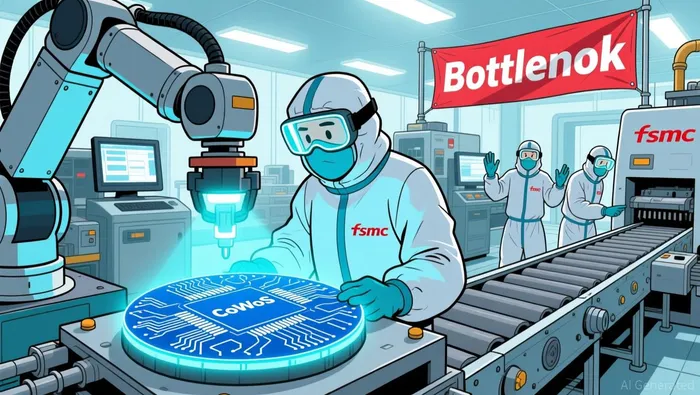
Nvidia's AI growth hinges on its ability to scale production of cutting-edge chips like the Blackwell and Rubin architectures. The company has secured critical partnerships, including a $5 billion collaboration with IntelINTC-- to co-develop CPU-GPU systems and a $40 billion acquisition of Aligned Data Centers to expand AI-ready infrastructure, as noted in Fusion's analysis of AI's impact on semiconductors. However, these efforts are constrained by bottlenecks in semiconductor manufacturing. TSMCTSM--, the sole provider of advanced packaging for Blackwell via its CoWoS technology, currently fulfills only 80% of customer demand, with lead times stretching up to 1.5 years, according to Montaka's coverage of the trade war's impact. A design flaw in the Blackwell chip further exacerbated production delays, forcing mask changes that reduced yields and pushed timelines back, as reported by Markets' coverage of AMD's AI advancements.
To mitigate these risks, NvidiaNVDA-- is diversifying its supply chain by partnering with Samsung and Intel for components like HBM memory, as noted in Montaka's coverage. Yet, TSMC's dominance in advanced packaging-accounting for over 50% of global semiconductor production-remains a vulnerability, as reported in Trading News on Intel. Geopolitical tensions, including U.S. export controls limiting access to China, add another layer of complexity. Chinese state mandates now favor domestic AI chips, eroding Nvidia's once 95% market share in the region, according to Webpro News on the China ban.
Competitive Pressures and Hyperscaler Dynamics
Nvidia's 80%+ market share in AI accelerators, as noted in Blockonomi's AI stock picks, faces mounting threats from rivals like AMD and Intel, whose advancements in AI chip design and partnerships with Tesla and others are gaining traction, as detailed in Markets' coverage of AMD's AI advancements. Hyperscalers-Amazon, Google, and Microsoft-are further reshaping the landscape. These tech giants, collectively planning $280 billion in AI-related capital expenditures for 2025, as reported in SVC's coverage of hyperscaler spending, are securing long-term contracts for GPUs and memory, creating supply shortages for non-hyperscaler clients, as noted in Fusion's analysis. For instance, Microsoft's $80 billion AI investment and Amazon's $26.3 billion Q4 2024 capex underscore their role as both customers and competitors, according to SVC's coverage.
Nvidia's response includes expanding its software ecosystem, such as CUDA and NIM microservices, to lock in developers and partners. The company's vision of becoming an "operating system" for AI-spanning reasoning, physical AI, and industrial digitalization-aims to create a moat against hardware-only competitors. However, hyperscalers' ecosystem-centric strategies, offering open platforms for AI model deployment, pose a direct challenge, as reported in Montaka's coverage.
Financial Projections and Analyst Sentiment
Analysts remain cautiously optimistic. Jefferies raised its price target for Nvidia to $240, projecting $384 billion in revenue by 2027, according to Yahoo Finance's analysis, while 43 of 48 analysts recommend "Buy" or "Strong Buy" as of Q1 2025, as reported in Blockonomi's AI stock picks. These forecasts assume successful navigation of supply chain constraints and sustained demand for Blackwell and Rubin GPUs. However, gross margins are expected to dip to the low-70% range in the short term due to production costs, as noted in Markets' coverage, and geopolitical risks-such as U.S.-China tensions-could disrupt revenue streams, as detailed in Webpro News on the China ban.
Nvidia's strategic investments in AI-powered supply chain tools, including LLM-driven replanning systems and autonomous logistics, aim to offset these pressures, as noted in Blockonomi's AI stock picks. The company's $6.3 billion acquisition of CoreWeave's AI compute capacity also signals a shift toward vertical integration.
Conclusion: Balancing Opportunity and Risk
Nvidia's long-term investment potential rests on its ability to innovate beyond hardware. While supply chain bottlenecks and competitive threats are significant, the company's ecosystem-driven approach, strategic partnerships, and leadership in AI software position it to capitalize on the $3–$4 trillion AI infrastructure market. Investors should monitor production timelines, geopolitical developments, and hyperscaler dynamics, but Nvidia's first-mover advantage and R&D prowess suggest resilience. For now, the stock's 10% upside potential from current levels, as indicated by analyst price targets, reflects confidence in its ability to adapt.







Comentarios
Aún no hay comentarios