
Nvidia's Strategic Position in a Shifting AI Trade Landscape: Implications for Investors
The Trump administration's recent approval of Nvidia's H200 AI chip sales to China has reignited debates about the company's long-term competitive positioning and valuation. This decision, which imposes a 25% U.S. government fee on sales to "approved customers" in China, marks a pivotal shift in the U.S.-China tech rivalry. For investors, the move raises critical questions: Can NvidiaNVDA-- reclaim lost ground in a market it once dominated? How will domestic Chinese competitors like Huawei and Cambricon respond? And what does this mean for the company's valuation in an increasingly fragmented global semiconductor landscape?
Reopening a Strategic Market
Nvidia's H200 chip, with a Total Processing Performance (TPP) of 15,831-far exceeding the prior export limit of 4,800-represents a significant leap in AI hardware capabilities. The Trump administration's conditional approval allows the company to access a market that historically contributed 20–25% of its data-center revenue. However, the 25% fee-a higher cut than the previously discussed 15%-reduces the net financial upside. Analysts estimate this policy could add $2 billion to $5 billion in annual revenue for Nvidia, depending on shipment volumes.
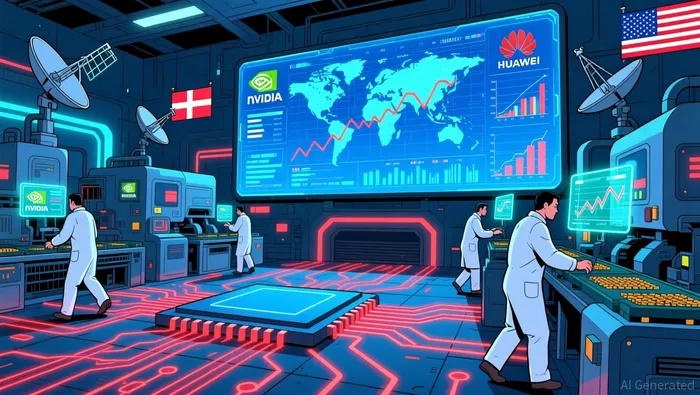 The immediate market reaction was positive: Nvidia shares surged 2% in premarket trading following the announcement. Yet, the company's China revenue share has been declining steadily, from 26% in 2021 to under 8% in 2025. This decline reflects Beijing's strategic push to reduce reliance on foreign tech, including steering state-backed entities toward domestic alternatives like Huawei's Ascend and Cambricon's Siyuan chips. The H200 approval may stabilize this trend but is unlikely to reverse it entirely.
Competitor Dynamics and Market Share
The Chinese AI chip market is witnessing a surge in domestic competition. Cambricon has tripled production plans to 500,000 AI accelerators in 2026, with a 14-fold revenue increase in Q3 2025. Huawei, already holding 23% of China's AI chip market share in 2024, aims to double its advanced processor output in the coming year. These developments underscore Beijing's commitment to self-sufficiency, even as U.S. export restrictions create a vacuum.
Nvidia's H200, however, remains a formidable product. Its superior performance could outpace domestic alternatives, particularly in high-stakes applications like large-scale AI training. Yet, Chinese regulators are reportedly considering purchase caps and approval processes to limit access to the H200, prioritizing local solutions. This dual-track approach-U.S. conditional access and Chinese domestic restrictions-creates a complex regulatory environment where Nvidia's market share may grow incrementally but remain constrained.
Investor Sentiment and Valuation Metrics
Investor optimism is palpable. As of November 2025, 43 of 48 analysts rate Nvidia a "Strong Buy," with average price targets between $235 and $249. The company's Q3 2025 revenue of $57.0 billion (up 62.5% YoY) further reinforces confidence. However, the potential $25–30 billion annual revenue from H200 sales-assuming full regulatory and market access-could translate to a $0.60–$0.70 per share earnings boost, a material tailwind for valuation.
That said, risks persist. The bipartisan SAFE Chips Act, which seeks to block such exports for 30 months, introduces regulatory uncertainty. Meanwhile, China's own restrictions on H200 buyers could limit the scale of sales. Investors must weigh these geopolitical risks against Nvidia's technological edge and the broader AI market's growth trajectory.
Conclusion: A Calculated Bet
For investors, Nvidia's H200 approval represents a calculated opportunity. The company's ability to navigate a dual-regulatory framework-balancing U.S. export controls and Chinese industrial policy-will determine its long-term success. While the 25% fee and domestic competition temper the upside, the H200's performance advantages and the AI market's insatiable demand position Nvidia as a key player in the global AI arms race.
In the end, this is not just a story about chips-it's a case study in how geopolitical strategy and technological innovation intersect to shape investment outcomes. For those willing to stomach the risks, Nvidia's strategic pivot could yield substantial rewards.





Comentarios
Aún no hay comentarios