
Nvidia's Strategic Position in the Quantum Computing Ecosystem: Infrastructure as the Hidden Catalyst for Breakthroughs
The NVQLink Revolution: Bridging the Gap Between Theory and Utility
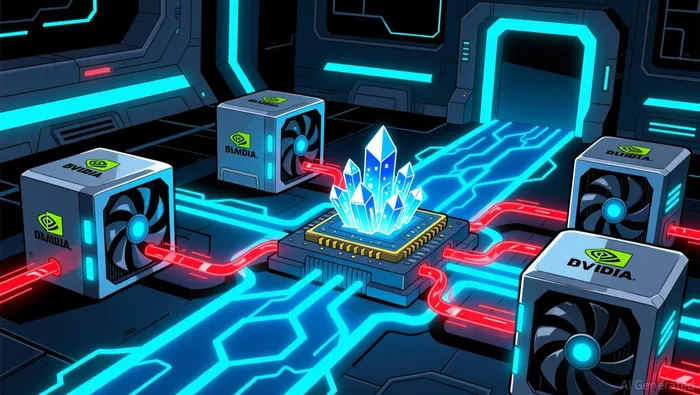
Nvidia's NVQLink platform, unveiled in 2025, is a masterstroke of integration. This high-speed interconnect technology links traditional GPU-based supercomputers with quantum processors, enabling real-time control, calibration, and error correction-three of the most persistent challenges in quantum computing scalability, according to a Nextgov report. By collaborating with 17 quantum hardware providers, including IonQ, Rigetti, and Quantinuum, as well as control system suppliers like Keysight, Nvidia has created a universal framework that abstracts the complexity of quantum hardware into a cohesive ecosystem, as noted in a CoinCentral article.
The significance of this cannot be overstated. Quantum processors remain fragile, with qubits prone to decoherence and errors. NVQLink's ability to execute quantum error correction algorithms over low-latency channels stabilizes these systems, making them viable for practical use. According to the EE News Europe report, this architecture is already being deployed in U.S. national laboratories such as Brookhaven and Oak Ridge, where it is being tested for high-energy physics and materials science simulations.
Supercomputing as the Quantum Launchpad: Solstice, Equinox, and the Blackwell Era
Nvidia's infrastructure ambitions extend beyond software. The company has announced two AI-ready supercomputers, Solstice and Equinox, to be deployed at Argonne National Laboratory by mid-2026. Powered by its Blackwell GPUs, these systems will serve as testbeds for hybrid quantum-classical workloads, accelerating research in fields ranging from drug discovery to climate modeling, as the Nextgov report notes.
This move underscores a strategic pivot: by embedding quantum-ready infrastructure in leading research institutions, Nvidia is ensuring that its technology becomes the de facto standard for next-generation computing. As stated by a Nextgov analysis, "Nvidia is not just selling hardware; it's building an ecosystem where quantum computing transitions from academic curiosity to industrial tool," the Nextgov report argues.
Case Studies in Scalability: Partnerships as Proof of Concept
Nvidia's partnerships with quantum pioneers like IQM and Quantum Circuits offer concrete evidence of its infrastructure-driven approach. IQM, a leader in superconducting quantum computers, has integrated NVQLink into its systems to scale error correction-a critical step toward fault-tolerant quantum computing, as reported in a Morningstar business wire. Similarly, Quantum Circuits' Aqumen Seeker QPU, paired with Nvidia's CUDA-Q platform, enables real-time error correction and error-aware programming, reducing the overhead of quantum operations, the EE News Europe report notes.
SEEQC's collaboration with Nvidia further illustrates the potential of hybrid systems. By developing a fully digital interface between quantum processors and GPUs, the companies achieved microsecond-latency error correction with minimal bandwidth usage-a breakthrough that removes key scaling bottlenecks, the EE News Europe report reports. These case studies highlight how Nvidia's infrastructure is not just theoretical but already enabling tangible progress.
The Investment Thesis: Infrastructure as a Moat
For investors, the implications are clear. Nvidia's focus on infrastructure creates a self-reinforcing cycle: the more quantum hardware providers adopt NVQLink, the more data Nvidia can use to optimize its algorithms, which in turn attracts more partners and customers. This network effect mirrors the company's dominance in AI, where its GPUs became the industry standard through early adoption and ecosystem building.
Moreover, the deployment of Solstice and Equinox at Argonne National Laboratory positions Nvidia at the forefront of government-funded quantum research-a sector expected to grow exponentially as nations compete for technological supremacy, as the Nextgov report observes. With Blackwell GPUs already outperforming previous generations in AI workloads, the integration of quantum capabilities could further cement Nvidia's role as the backbone of future computing.
Conclusion: A New Era of Computing, Engineered by Nvidia
Quantum computing has long been a promise waiting for a platform. Nvidia's NVQLink and Blackwell-driven supercomputers are that platform. By addressing the infrastructure gaps that have stymied progress, the company is not only accelerating quantum breakthroughs but also securing its position as the gatekeeper of the next computing revolution. For investors, this is more than a bet on hardware-it's a bet on the architecture of the future.





Comentarios
Aún no hay comentarios