
Nvidia's Strategic Position in the U.S.-China Tech Cold War: Geopolitical Risk as an Investment Opportunity
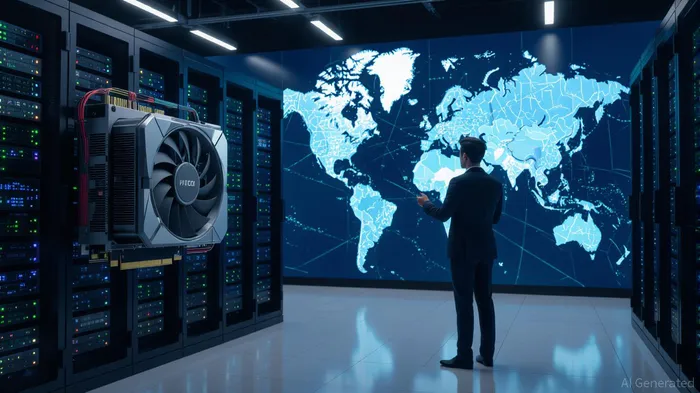
The U.S.-China tech cold war has transformed global supply chains into battlegrounds for strategic dominance. At the center of this conflict lies NvidiaNVDA--, a company uniquely positioned to exploit the tension between national security and technological progress. For investors, this duality—Nvidia as both a geopolitical actor and a market leader—creates an asymmetric upside in AI and semiconductor demand, even as risks persist.
Geopolitical Leverage: From Export Controls to Strategic Reentry
U.S. export restrictions on AI semiconductors to China, intensified under the Biden administration and further refined under Trump, have long curtailed access to advanced chips like Nvidia's H100 and H20. These policies, aimed at stifling China's AI ambitions, inadvertently elevated Nvidia's role as a gatekeeper of global AI infrastructure. By 2025, the company's Data Center division had surged to $100 billion in annual revenue, with AI chips accounting for 87% of the $110 billion global AI semiconductor market.
Yet, the same export controls that shielded U.S. leadership also created a $18 billion backlog of unmet demand in China. The recent Trump-era easing of restrictions—allowing H20 chip sales to resume—has turned this tension into a revenue catalyst. Analysts project an additional $10–$20 billion in 2026 revenue from China, with the H20's return addressing a critical gap in AI training capacity for Chinese institutions. This strategic reentry underscores Nvidia's ability to navigate policy shifts while capitalizing on pent-up demand.
Asymmetric Upside: Resilience Through Global Diversification
Nvidia's dominance is not solely tied to its U.S. or Chinese operations. Its global client base—spanning cloud providers, automotive firms, and enterprise clients—acts as a buffer against regional volatility. In 2025, China contributed $17.11 billion (13.11% of total revenue), but the U.S. accounted for 46.94%, with Singapore and Taiwan as key secondary markets. This diversification mitigates the risk of overreliance on any single region, even as geopolitical tensions persist.
Moreover, the company's full-stack AI ecosystem—encompassing hardware (Hopper, Blackwell), software (CUDA), and networking (NVLink)—creates a moat against competitors like AMDAMD-- and IntelINTC--. While AMD's AI IC revenue in 2024 reached $4.5 billion, it remains a distant second to Nvidia's $96 billion. This technological edge, paired with strategic partnerships (e.g., MicrosoftMSFT--, Oracle), ensures Nvidia's infrastructure remains the default choice for AI developers worldwide.
Supply Chain Reallocation: A Double-Edged Sword
The U.S.-China rivalry has accelerated a reallocation of tech supply chains. Nvidia's decision to produce Blackwell chips in the U.S. aligns with the Trump administration's “Investing in America” agenda, securing political support while reducing exposure to China's retaliatory measures. However, this shift also raises costs and risks overreliance on U.S. manufacturing, which lags behind TSMC's cutting-edge capabilities.
For investors, this reallocation presents two key dynamics:
1. Short-Term Gains: Resumption of China sales and U.S. policy tailwinds (e.g., tax incentives for domestic chipmaking) will likely drive revenue growth through 2026.
2. Long-Term Uncertainty: A policy reversal or escalation in tensions could disrupt supply chains. Chinese companies are already diversifying their AI chip suppliers, with Huawei and BaiduBIDU-- investing in alternatives to reduce dependency on U.S. tech.
Investment Implications: Balancing Risk and Reward
Nvidia's stock has historically rewarded investors for its role in the AI revolution, but its current valuation—trading at a P/E ratio of 45x (as of July 2025)—reflects high expectations. For those seeking asymmetric upside, the following strategies merit consideration:
- Core Position: Allocate to Nvidia as a long-term hold, betting on its entrenched dominance in AI infrastructure and the inevitability of global AI adoption.
- Hedging: Offset exposure with short-term plays on alternative AI chipmakers (e.g., AMD, Cerebras) or companies benefiting from supply chain reallocation (e.g., ASML, TSMC).
- Policy Monitoring: Closely track U.S.-China trade talks and export control updates. A policy shift could unlock $20+ billion in China revenue for Nvidia in 2026, while a tightening regime might force Chinese firms to accelerate self-reliance.
Conclusion: The Cold War as a Catalyst
Nvidia's strategic position in the U.S.-China tech cold war is not a liability but a feature of its business model. By aligning with U.S. national security priorities while maintaining access to high-growth markets like China, the company has created a unique value proposition. For investors, the challenge lies in balancing the risks of geopolitical volatility with the rewards of a firm poised to dominate the AI era. As the world's two largest economies continue to decouple, Nvidia's ability to straddle both sides of the divide may prove to be its greatest asset.





Comentarios
Aún no hay comentarios