
NVIDIA's Strategic Position Amid U.S.-China Chip Trade Dynamics and Revenue Sharing Deal
NVIDIA's dominance in the AI chip market has solidified its position as a cornerstone of the global artificial intelligence (AI) revolution. As of 2025, the company controls an estimated 80% to 92% of the AI accelerator market, driven by its high-performance GPUs like the H100/H200 series and the cutting-edge Blackwell architecture. This leadership has translated into explosive data center revenue growth, with NVIDIA reporting $51.2 billion in data center revenue during Q3 2026-a 112% year-over-year increase. However, the company's long-term profitability and market leadership are increasingly entangled in the complex web of U.S.-China trade dynamics and a controversial 15% revenue-sharing agreement with the U.S. government.
Market Leadership and Financial Performance
NVIDIA's Blackwell architecture has cemented its status as the world's most valuable company, with a market capitalization exceeding $4 trillion by 2025. The AI chip market is projected to grow at a 15% annual rate through 2028, driven by surging demand for high-bandwidth memory and advanced packaging technologies like TSMC's CoWoS. NVIDIA's Q3 2025 data center revenue of $30.8 billion underscores its critical role in powering AI infrastructure. Yet, this growth is not without geopolitical headwinds.
U.S.-China Trade Dynamics and Export Restrictions
U.S. export controls, initially imposed under the Trump administration and expanded under Biden, have severely curtailed NVIDIA's chip sales to China. The company now forecasts zero sales to China for the next two quarters, a stark contrast to its previous $18 billion in annual China chip sales. These restrictions aim to prevent China from accessing advanced AI chips and manufacturing equipment, but they have also created a vacuum in the Chinese market. Chinese firms like Tencent and DeepSeek have struggled to match the performance of U.S. chips, with DeepSeek CEO Liang Wenfeng noting that Chinese companies require two to four times the computing power to achieve comparable results.
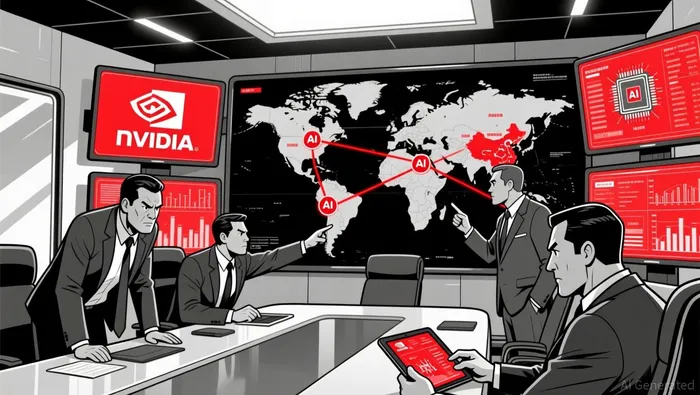
China's push for semiconductor self-reliance has accelerated, with Alibaba and Huawei developing proprietary chips. Huawei's recent announcement of publicly available chip designs could further reduce reliance on American technology. However, industry experts highlight a persistent performance gap in complex analytical functions, where NVIDIA's ecosystem remains unmatched.
The 15% Revenue-Sharing Agreement: Financial and Strategic Implications
In August 2025, NVIDIANVDA-- and AMD struck an unusual deal with the U.S. government: they would share 15% of their China chip sales revenue in exchange for export licenses to sell specific AI chips, such as the H20 and MI308 according to reports. This arrangement, confirmed by President Trump, allows NVIDIA to recoup up to $15 billion in revenue in the second half of 2025, potentially reaching $20 billion in 2026 fiscal sales. While this deal provides a financial lifeline, it has sparked legal and ethical debates. Critics argue it blurs the line between national security and financial incentives, with some questioning its constitutionality under the Export Clause according to analysis.
NVIDIA CEO Jensen Huang has framed the agreement as a pragmatic solution to maintain U.S. leadership in AI. He emphasizes that access to the Chinese market is essential for sustaining innovation, given that half of the world's AI researchers are based in China. However, U.S. lawmakers like House Select Committee on China Chairman John Moolenaar warn that resuming advanced chip sales to China risks enabling Beijing's military AI ambitions and undermining U.S. technological dominance according to a recent report.
Long-Term Projections and Strategic Outlook
Despite these challenges, NVIDIA's long-term prospects remain robust. The AI chip market is expected to reach $200 billion by the end of the decade, with NVIDIA's CUDA ecosystem and Blackwell architecture positioning it to capture a significant share. The 15% revenue-sharing deal, while contentious, provides a temporary bridge to maintain NVIDIA's presence in China while the U.S. government navigates broader trade negotiations.
However, the deal's precedent could fragment the AI industry into parallel ecosystems, with U.S. and Chinese firms developing divergent standards. This fragmentation may slow global AI innovation but could also create opportunities for NVIDIA to leverage its first-mover advantage in the U.S. ecosystem. Meanwhile, China's push for self-reliance will likely spur domestic innovation, though it remains unclear whether local firms can close the performance gap in critical applications.
Conclusion
NVIDIA's strategic position in the AI market is defined by its technological leadership, financial strength, and the geopolitical tensions surrounding its access to China. While the 15% revenue-sharing deal offers a short-term financial buffer, it also highlights the fragility of NVIDIA's long-term strategy in a world increasingly divided by U.S.-China tech rivalry. For investors, the key risks lie in the potential for further export restrictions, the rise of Chinese alternatives, and the legal challenges to the revenue-sharing model. Yet, NVIDIA's unparalleled ecosystem and the insatiable demand for AI infrastructure suggest that its market leadership will endure-provided it can navigate the turbulent geopolitical landscape.





Comentarios
Aún no hay comentarios