
Nvidia's Strategic Position in the China AI Market: Geopolitical Tailwinds and High-Growth Opportunities
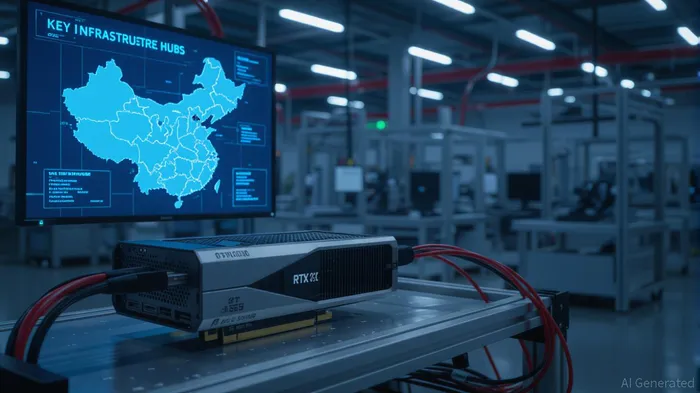
The global AI arms race has entered a new phase, with NvidiaNVDA-- emerging as a pivotal player in unlocking China's AI infrastructure potential. Recent geopolitical and regulatory shifts—driven by U.S.-China trade negotiations, strategic corporate diplomacy, and China's domestic AI ambitions—have created a unique inflection point for the chipmaker. As the U.S. government grants licenses for the sale of H20 AI chips to China and Nvidia rolls out new products tailored to Beijing's needs, the company is poised to capitalize on a market projected to grow by 48% in 2025, reaching $98 billion. This article examines the interplay of policy, technology, and market dynamics shaping Nvidia's re-entry into China and evaluates the investment implications.
Geopolitical Tailwinds: A Calculated Re-Engagement
The U.S. government's recent easing of export controls on Nvidia's H20 AI chips marks a strategic recalibration. After a 15-month hiatus, the resumption of sales follows a preliminary trade framework agreement between the U.S. and China, which included China's commitment to relax rare-earth export restrictions and the U.S. softening its stance on tech exports. This shift reflects a recognition that China's AI market—now the world's second-largest—cannot be fully isolated without significant economic and technological consequences for both sides.
Nvidia's CEO, Jensen Huang, has leveraged this window of opportunity with a dual strategy: securing regulatory approvals while reinforcing partnerships with Chinese tech giants. His high-profile visit to Beijing in 2025 underscored the company's commitment to compliance, with Huang emphasizing that Nvidia's new RTX Pro GPU—designed for smart factories and logistics—fully adheres to U.S. export restrictions. This product, tailored for China's industrial AI applications, aligns with Beijing's push to modernize its $50 trillion manufacturing sector through robotics and automation.
China's AI Infrastructure: A $50 Billion Opportunity
China's AI infrastructure plans are ambitious and uniquely positioned to absorb Nvidia's offerings. The “Eastern Data, Western Computing” initiative, launched in 2022, aims to build eight national computing hubs in energy-rich western provinces like Xinjiang and Qinghai. These hubs, powered by renewable energy, are designed to house tens of thousands of AI chips, including Nvidia's H100 and H200 models, which are still sought after despite U.S. export bans.
The scale of these projects is staggering. One Xinjiang data center compound is expected to house 115,000 banned Nvidia chips, rivaling U.S. AI infrastructure in capacity. While the U.S. government disputes the feasibility of such numbers, the sheer pace of construction and government incentives—free electricity, tax breaks, and operation support—suggest that Chinese firms are determined to access advanced computing resources, even through illicit channels if necessary.
Nvidia's re-entry into this market is further bolstered by the entrenched dominance of its CUDA ecosystem. Despite China's push for domestic alternatives like Huawei's Kunpeng and Baidu's PaddlePaddle, major Chinese AI firms—including DeepSeek, Alibaba, and Tencent—still rely on CUDA for model training and deployment. This creates a “lock-in” effect, making it difficult for local alternatives to compete.
Strategic Adaptation: RTX Pro and the Future of Industrial AI
Nvidia's RTX Pro GPU, introduced in 2025, represents a masterstroke in navigating regulatory constraints. Designed for smart factories and robot training, the chip leverages China's $50 trillion manufacturing sector to expand its footprint in industrial AI. This move aligns with Beijing's 10-year roadmap to integrate AI into its supply chain, where Nvidia's Omniverse platform for digital twins and factory simulations is already gaining traction.
The RTX Pro also addresses a critical gap in China's AI infrastructure: the lack of high-performance, cost-effective hardware for robotics and automation. With 1.5 million developers in China already building on Nvidia platforms, the company is well-positioned to capture a growing segment of the market that domestic alternatives struggle to serve.
Investment Considerations: Balancing Risks and Rewards
The resumption of H20 sales and the RTX Pro launch position Nvidia to benefit from China's AI boom. However, investors must weigh several risks:
1. Geopolitical Volatility: The U.S.-China trade framework is still nascent, and a shift in leadership or policy could reignite export restrictions.
2. Domestic Competition: China's state-backed chipmakers, such as Huawei and SMIC, are rapidly advancing, though they still lag in performance and production capacity.
3. Regulatory Compliance: Nvidia's success hinges on maintaining its “compliant” image in Washington, which requires continuous engagement with policymakers.
Despite these challenges, the fundamentals are compelling. Bank of AmericaBAC-- forecasts AI funding in China to grow to $98 billion in 2025, with infrastructure spending accounting for over 60%. Nvidia's ability to supply both cutting-edge chips (via H20 licenses) and industrial AI solutions (via RTX Pro) gives it a dual revenue stream.
Conclusion: A Win-Win for Nvidia and China's AI Ambitions
Nvidia's strategic re-engagement in China is a textbook example of navigating geopolitical complexity to unlock high-growth opportunities. By aligning its product roadmap with Beijing's infrastructure priorities and maintaining regulatory compliance in Washington, the company is securing a long-term foothold in one of the world's most dynamic markets. For investors, the combination of AI-driven demand, regulatory tailwinds, and Nvidia's technological edge makes this a compelling opportunity—though one that requires vigilance in monitoring geopolitical shifts.
As China races to build its AI infrastructure, the question is no longer whether Nvidia can succeed in the region, but how quickly it can scale its influence before domestic alternatives catch up. For now, the calculus favors the chipmaker—and by extension, its shareholders.





Comentarios
Aún no hay comentarios