
NVIDIA's Strategic Position in the AI Supercycle and China's Demand Surge
The AI revolution is accelerating, and NVIDIANVDA-- (NVDA) stands at its epicenter. With its H200 GPU poised to meet surging demand from Chinese tech giants and a $20 billion Groq acquisition reshaping its inference capabilities, the company is navigating a high-stakes landscape of geopolitical tensions, production constraints, and regulatory scrutiny. For investors, the question is whether these catalysts can drive sustainable growth or if bottlenecks will temper its trajectory.
H200 Production and the China Demand Surge: A Double-Edged Sword
NVIDIA's H200 GPU, part of its Hopper generation, has become a linchpin in the global AI race. Chinese tech firms, including Alibaba and ByteDance, have placed orders exceeding two million units for 2026, far outpacing NVIDIA's current inventory of 700,000 chips according to reports. The H200's sixfold performance advantage over the China-specific H20 variant has made it indispensable for companies seeking to build advanced AI infrastructure. However, production scaling is constrained by TSMC's limited 4nm manufacturing capacity, which NVIDIA must share with its next-generation Blackwell and Rubin GPUs.
The U.S. government's recent approval of H200 exports to China-imposed with a 25% fee-has opened a path for sales, but Beijing has yet to formally approve imports. Chinese authorities are reportedly considering policies that would require H200 purchases to be bundled with domestically produced chips, aiming to bolster local semiconductor development. This regulatory uncertainty creates a dual risk: delayed access to a critical market and potential dilution of the H200's value proposition.
Despite these hurdles, NVIDIA plans to ship 40,000–80,000 H200 units to China in mid-February 2026 from existing inventory, with production ramp discussions with TSMC expected to begin in Q2 2026. The company has assured U.S. clients that China sales won't disrupt domestic supply, but TSMC's capacity constraints and geopolitical tensions could force trade-offs between short-term revenue and long-term innovation.
The Groq Acquisition: Strengthening AI Dominance or Inviting Scrutiny?
NVIDIA's $20 billion licensing agreement with Groq-a company known for its low-latency Language Processing Units (LPUs)-is a strategic masterstroke. By structuring the deal as a "non-exclusive licensing agreement," NVIDIA avoids antitrust scrutiny while acquiring Groq's IP, talent, and inference technology. This move neutralizes a potential competitor in a market projected to capture 45% of AI workloads by 2030 and fills a gap in NVIDIA's GPU-centric portfolio.
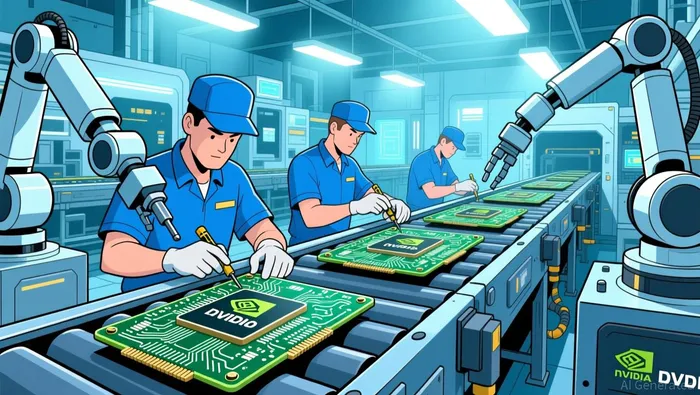
The integration of Groq's LPUs with NVIDIA's H200 and Blackwell GPUs is expected to create hybrid clusters that reduce energy use and latency. However, operational risks persist. Rapid engineering absorption and software harmonization could delay the realization of synergies, and the deal's structure-keeping Groq nominally independent-may attract regulatory skepticism, particularly in China, where NVIDIA already faces antitrust investigations over its 2020 Mellanox acquisition.
For investors, the Groq deal underscores NVIDIA's commitment to dominating the AI stack but also highlights its vulnerability to regulatory pushback in key markets.
TSMC Constraints and Geopolitical Risks: The Invisible Bottleneck
TSMC's role as NVIDIA's manufacturing partner is both a strength and a vulnerability. The H200's 4nm process is critical for its performance, but TSMC's advanced-node capacity is already stretched thin, with NVIDIA prioritizing Blackwell and Rubin production. This creates a bottleneck for scaling H200 output, even as demand from China surges.
Geopolitical tensions further complicate matters. U.S. export controls and China's push for domestic chip development are reshaping the semiconductor landscape. While NVIDIA's H200 is six times more powerful than China's best domestic accelerators, Beijing's conditional approval of imports and potential import quotas could limit sales. Meanwhile, U.S. policies-such as the 25% export fee-add margin pressure.
The Investment Thesis: Catalysts vs. Constraints
NVIDIA's position in the AI supercycle is formidable. The H200's demand surge, Groq's inference capabilities, and TSMC's manufacturing expertise create a compelling growth narrative. However, three risks must be weighed:
1. Production Constraints: TSMC's capacity limits could delay H200 scaling, capping revenue potential.
2. Regulatory Hurdles: U.S.-China trade dynamics and antitrust scrutiny may restrict market access or force costly concessions.
3. Integration Challenges: The Groq acquisition's success hinges on seamless technical and operational integration.
For now, NVIDIA's ability to navigate these challenges-while leveraging its first-mover advantage in AI-positions it as a key beneficiary of the AI revolution. Yet, investors must remain vigilant. The difference between a sustainable rally and a correction will depend on how well NVIDIA balances innovation with geopolitical and production realities.







Comentarios
Aún no hay comentarios