
Nvidia's Strategic Position in the AI Infrastructure Boom: Capitalizing on the OpenAI Partnership and AI-Driven Compute Demand
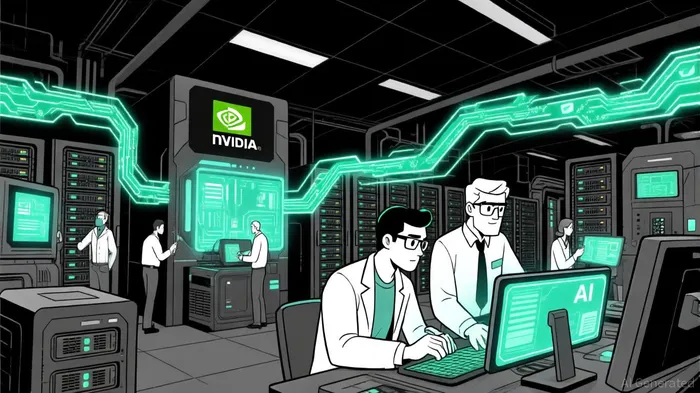
The artificial intelligence revolution is accelerating, and no company sits at its crossroads quite like NvidiaNVDA--. The recent landmark partnership between Nvidia and OpenAI—announced in September 2025—has redefined the trajectory of AI infrastructure, positioning the chipmaker as a linchpin in the next phase of compute demand. With a $100 billion investment in OpenAI and a commitment to deploy 10 gigawatts of AI data centers by 2026, Nvidia is not only securing its dominance in the AI hardware market but also aligning itself with the most ambitious AI research in the industry.
A $100 Billion Bet on the Future of AI
Nvidia's partnership with OpenAI is more than a financial transaction; it is a strategic alignment of two industry titans. By investing up to $100 billion in OpenAI, Nvidia ensures its cutting-edge hardware, including the Vera Rubin platform, will power the next generation of AI models, including those targeting artificial general intelligence (AGI) [1]. The first gigawatt of this infrastructure is slated for deployment by late 2026, with the full 10-gigawatt project requiring energy equivalent to 10 nuclear reactors or the power consumption of multiple major cities [3]. This scale underscores the urgency of AI infrastructure expansion, as OpenAI CEO Sam Altman has emphasized that “compute infrastructure will be the basis for the economy of the future” [2].
The partnership also marks a pivotal shift for OpenAI, which has historically relied on Microsoft for cloud resources. By diversifying its compute supply chain with Nvidia, OpenAI reduces dependency on a single provider while gaining access to hardware optimized for its specific AI workloads [5]. For Nvidia, this deal locks in long-term demand for its GPUs and ensures co-optimization of hardware and software roadmaps, reinforcing its position as the go-to supplier for high-performance AI infrastructure [2].
The AI Infrastructure Gold Rush
Nvidia's collaboration with OpenAI is emblematic of a broader industry trend: the explosive growth of AI-driven compute demand. According to McKinsey, global data centers are projected to require $6.7 trillion in capital expenditures by 2030, with AI workloads accounting for $5.2 trillion of that total [6]. This surge is fueled by the proliferation of generative AI and the need for specialized hardware to train and run large language models.
Gartner forecasts that worldwide AI spending will reach $1.5 trillion in 2025 alone, with AI-optimized servers and infrastructure software contributing over $267 billion [5]. Nvidia's dominance in this space is evident: its GPUs are already the backbone of AI training, and the OpenAI partnership cements its role in the next frontier. Analysts at Reuters note that the deal “solidifies Nvidia's dominance in the AI hardware space” while signaling OpenAI's growing independence from Microsoft [3].
Strategic Advantages and Market Implications
Nvidia's strategic advantages extend beyond its hardware. The company's ability to co-design infrastructure with AI leaders like OpenAI creates a flywheel effect: as OpenAI pushes the boundaries of AI, it drives demand for more advanced Nvidia chips, which in turn accelerates innovation. This dynamic is amplified by the Vera Rubin platform, a next-generation system designed for exascale computing and AGI research [1].
Moreover, the partnership aligns with Nvidia's broader ecosystem-building efforts. OpenAI is part of the Stargate project, a coalition involving Microsoft, Oracle, and SoftBank to develop AI infrastructure at scale [1]. By securing a key role in this initiative, Nvidia positions itself as a critical supplier for multiple stakeholders, further diversifying its revenue streams.
Challenges and the Road Ahead
Despite its strengths, Nvidia faces challenges. The energy demands of the 10-gigawatt project will require significant investments in power infrastructure, including renewable energy solutions to mitigate environmental concerns [3]. Additionally, competition from cloud providers like Microsoft and Amazon Web Services (AWS) remains intense. However, OpenAI's shift toward a multi-provider strategy and Nvidia's technological edge in GPU design provide a buffer against these risks.
For investors, the partnership represents a high-conviction play on the AI infrastructure boom. With AI spending projected to grow at a compound annual rate of over 30% through 2030 [6], Nvidia's ability to monetize its hardware and software ecosystem positions it as a key beneficiary. The $100 billion investment in OpenAI also signals a long-term financial stake in the success of AI, aligning incentives between the two companies.
Conclusion
Nvidia's partnership with OpenAI is a masterstroke in the AI arms race. By securing a $100 billion investment and a decade-long infrastructure deployment, the company has not only solidified its leadership in AI hardware but also positioned itself at the forefront of the next economic paradigm. As AI infrastructure spending accelerates, Nvidia's ability to scale with demand—while maintaining technological superiority—makes it a compelling investment for those betting on the future of artificial intelligence.







Comentarios
Aún no hay comentarios