
Nvidia's Strategic Payment Shift and China's AI Chip Dilemma: Risk Transfer and Market Access Implications for Global Chipmakers
The global semiconductor industry is at a crossroads, with Nvidia's recent payment strategy for its H200 AI chips in China and Beijing's escalating efforts to achieve AI chip self-sufficiency reshaping the competitive landscape. These developments highlight a critical tension between risk transfer mechanisms and long-term market access, with profound implications for global chipmakers.
Nvidia's Risk Transfer Strategy: Full Upfront Payments and U.S. Export Controls
Nvidia has adopted a stringent payment model for its H200 AI chips sold to Chinese buyers, requiring full upfront payment to mitigate financial exposure amid regulatory uncertainty. This policy, enforced after a $5.5 billion inventory write-down following the abrupt U.S. export ban on the H20 chip, transfers risk from Nvidia to its customers, who are now barred from canceling orders or requesting refunds once placed. The U.S. government further complicates this dynamic by imposing a 25% fee on H200 exports to China, effectively taxing access to the market.
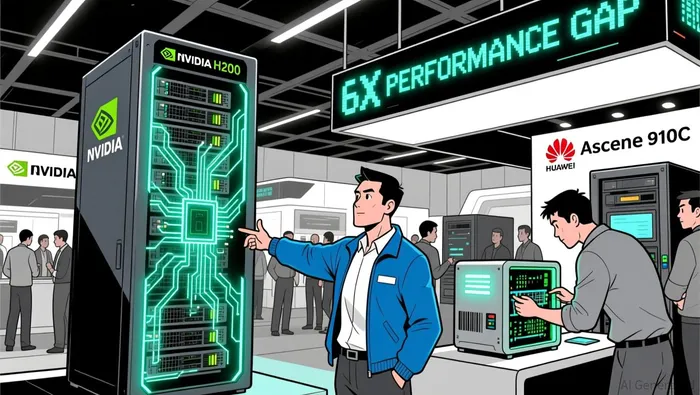
Despite these hurdles, demand for the H200 remains robust in China, with companies like ByteDance viewing it as essential for large-scale AI training. However, Beijing has temporarily paused orders for 2 million H200 chips as regulators consider mandating the purchase of domestically produced chips alongside each H200 order. This reflects China's broader push for self-reliance, even as it grapples with a performance gap: the H200 offers nearly six times the processing power of Huawei's Ascend 910C.
China's AI Chip Dilemma: Self-Sufficiency vs. Global Integration
China's strategic response to U.S. export controls has been a dual approach: banning foreign AI chips in state-funded data centers while investing heavily in domestic alternatives. The government has mandated that chipmakers use at least 50% domestically produced equipment for new manufacturing capacity, squeezing foreign suppliers like ASML and TSMC. A $70 billion incentive package aims to accelerate self-sufficiency, with state-backed firms like Huawei and SMIC expanding production capabilities despite lingering technological gaps.
Yet, China's push for self-reliance faces headwinds. While it has made strides in foundational node logic chips, it remains dependent on foreign technology for advanced AI accelerators and packaging. For instance, SMIC's 7nm process technology lags behind TSMC's 5nm, limiting the performance of Chinese AI chips. Additionally, smuggling and grey-market channels have allowed restricted chips to bypass export controls, creating a parallel ecosystem that undermines U.S. policy goals.
Implications for Global Chipmakers: Risk Mitigation and Market Access
Non-U.S. chipmakers are navigating this fragmented landscape with mixed strategies. AMD and Intel, for example, are diversifying supply chains and investing in domestic fabrication under programs like the CHIPS Act to reduce exposure to geopolitical risks. ASML, a critical supplier of lithography equipment, remains pivotal to advanced chip production but faces pressure from U.S. export controls that restrict its ability to supply China with high-NA EUV machines.
Meanwhile, Chinese startups like Cambricon and Moore Threads are filling the void left by U.S. sanctions, though profitability and manufacturing capacity remain challenges. These firms are leveraging cluster-based architectures to compete with U.S. GPU performance, albeit at higher energy costs. For global chipmakers, the key challenge lies in balancing access to China's $39.5 billion AI chip market with the risks of regulatory retaliation and technological obsolescence.
Long-Term Market Access: A Zero-Sum Game?
The long-term outlook for global chipmakers hinges on the effectiveness of U.S. export controls and China's ability to close its technological gap. While the U.S. strategy of a "high fence around a small yard" aims to preserve its lead in advanced AI infrastructure, it risks alienating allies and accelerating China's self-sufficiency drive. By 2030, China is projected to capture 45% of global advanced chip production, supported by $100 billion in state-backed investments.
For non-U.S. firms, the path forward involves adapting to a bifurcated world where access to China's market requires compliance with both U.S. and Chinese regulations. This includes establishing local R&D centers, as seen with TSMC's expanded CoWoS production capacity, and navigating the complexities of dual-use technologies. However, the growing divergence between U.S. and Chinese ecosystems suggests that market access will increasingly be a zero-sum game, with firms forced to choose sides in a geopolitical rivalry that shows no signs of abating.
Conclusion
Nvidia's payment strategy and China's AI chip dilemma underscore a broader shift in the semiconductor industry: the prioritization of risk transfer over market expansion and the acceleration of technological decoupling. While U.S. export controls aim to protect strategic assets, they also create opportunities for non-U.S. firms to fill gaps in China's supply chain. However, the long-term sustainability of these strategies remains uncertain, as China's state-backed innovation and the global AI chip market's projected growth to $846.8 billion by 2035 redefine the rules of engagement. For investors, the key takeaway is clear: the future of global chipmaking will be shaped not just by technological prowess, but by the ability to navigate an increasingly fragmented and politicized market.







Comentarios
Aún no hay comentarios