
Nvidia's Strategic Investment in Intel: A Deep Dive into Lip-Bu Tan's Deal-Making and Semiconductor Industry Implications
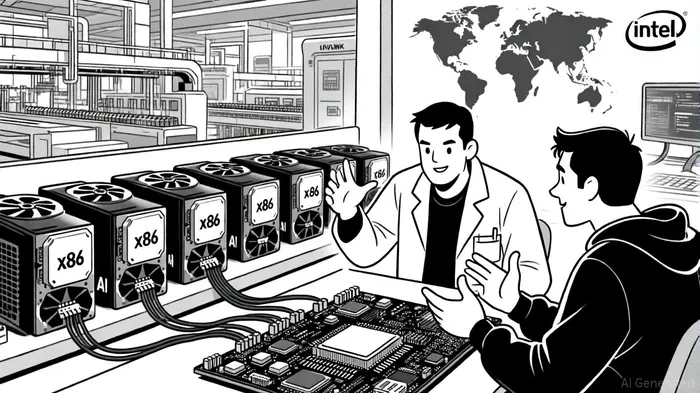
The recent $5 billion investment by NvidiaNVDA-- in IntelINTC-- marks a seismic shift in the semiconductor industry, blending financial strategy with technological innovation. At the heart of this partnership lies the acumen of Intel's CEO, Lip-Bu Tan, whose career spans decades of strategic deal-making, venture capital expertise, and transformative leadership. This collaboration not only redefines the competitive landscape but also offers critical insights into evolving investment strategies for the semiconductor sector.
Lip-Bu Tan's Strategic Blueprint: From Venture Capital to Corporate Turnaround
Lip-Bu Tan's career trajectory is a masterclass in strategic alignment. As founder of Walden International, he built a $200 million portfolio in Chinese semiconductor firms, including early investments in SMIC and AMEC, positioning himself as a pioneer in Asia's tech ecosystem[1]. His ability to identify high-growth opportunities—such as quantum computing and AI startups—demonstrates a knack for aligning capital with emerging trends[2]. At Cadence Design SystemsCDNS--, Tan's shift from software-centric R&D to integrated design platforms (incorporating AI and cloud computing) doubled the company's revenue, showcasing his capacity to modernize legacy businesses[3].
Tan's approach at Intel mirrors these principles. Since assuming the CEO role in 2025, he has prioritized restructuring, cutting 15–20% of the workforce and streamlining operations to focus on core competencies like AI acceleration and foundry services[4]. His emphasis on “engineering excellence” and “customer-centric innovation” reflects a Silicon Valley-style agility, contrasting with Intel's previously bureaucratic culture[5]. The Nvidia partnership, therefore, is not an isolated move but a continuation of Tan's broader strategy to leverage external expertise while fortifying Intel's manufacturing strengths.
The Nvidia-Intel Collaboration: Synergy Over Competition
The $5 billion stake, acquired at $23.28 per share, grants Nvidia a 4% ownership in Intel, while Intel gains access to Nvidia's NVLink technology for integrating AI capabilities into x86 CPUs and SOCs[6]. This collaboration is a calculated risk for both parties:
- For Intel, it provides a financial lifeline amid foundry challenges and allows it to pivot toward AI inference and edge computing rather than competing directly in AI training[7].
- For Nvidia, it secures a foothold in the x86-dominated PC and server markets, expanding its AI infrastructure reach without diverting resources to costly x86 R&D[8].
Tan's decision to adopt NVLink—a technology previously exclusive to Nvidia—highlights his pragmatic approach. By acknowledging Intel's limitations in AI training, he redirects resources to areas where Intel excels, such as manufacturing and x86 integration. This mirrors his past success at CadenceCADE--, where he prioritized platform integration over isolated software development[3].
Implications for Semiconductor Investment Strategies
The Nvidia-Intel deal underscores three key trends for investors:
1. Collaboration Over Rivalry: The partnership signals a shift toward cross-industry alliances, where specialization (e.g., Intel's manufacturing + Nvidia's AI) outperforms solo efforts. This aligns with Tan's history of fostering ecosystems, such as his Walden-backed semiconductor funds in China[9].
2. AI-Driven Reinvestment: Both companies are channeling capital into AI-specific applications. Intel's 18A process technology and Nvidia's RTX GPU chiplets exemplify this focus, reflecting Tan's broader AI-first strategy[10].
3. Geopolitical Hedging: With U.S. government support (e.g., $8.9 billion in CHIPS Act funding) and Intel's renewed domestic manufacturing push, the deal aligns with national security priorities, mitigating risks from global supply chain tensions[11].
Challenges and Risks
Despite its promise, the partnership faces hurdles. Intel's foundry business remains a financial drag, and its reliance on Nvidia's AI tech could limit long-term differentiation. Additionally, Tan's extensive investments in Chinese semiconductor firms—such as SMIC and YMTC—have drawn U.S. scrutiny, raising questions about potential conflicts of interest[12]. While Tan emphasizes transparency and customer trust, geopolitical tensions could complicate Intel's global operations.
Conclusion: A New Era for Semiconductor Investing
Lip-Bu Tan's strategic vision—rooted in venture capital pragmatism and operational agility—positions the Nvidia-Intel collaboration as a blueprint for future semiconductor investments. For investors, the key takeaway is the growing importance of hybrid models that combine financial partnerships with technological specialization. As the industry grapples with escalating R&D costs and geopolitical fragmentation, deals like this will likely become the norm rather than the exception.





Comentarios
Aún no hay comentarios