
Nvidia's Strategic Expansion Through Intel Investment: Accelerating AI Dominance and Supply-Chain Resilience
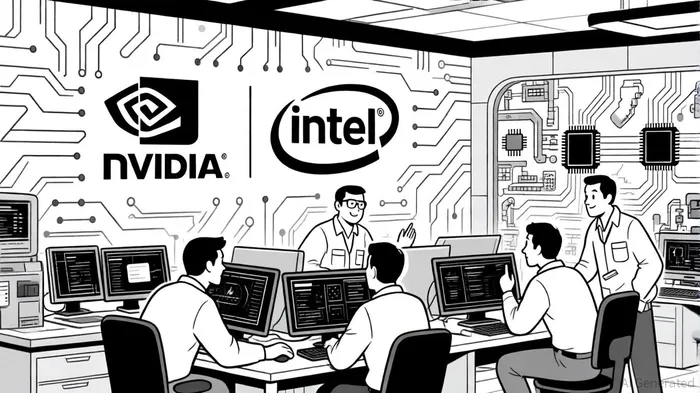
In a bold move reshaping the semiconductor landscape, NvidiaNVDA-- has secured a $5 billion stake in IntelINTC--, acquiring a 4% ownership stake at a discounted price of $23.28 per share[1]. This investment, hailed as a “historic collaboration” by Nvidia CEO Jensen Huang[2], underscores a strategic alignment between two industry titans to co-develop cutting-edge technologies for AI infrastructure and personal computing. The partnership not only accelerates Nvidia's dominance in artificial intelligence but also addresses critical vulnerabilities in global supply chains, positioning both firms to navigate an increasingly competitive and geopolitically charged market.
Accelerating AI Dominance Through Integrated Innovation
Nvidia's investment is not merely financial—it is a calculated step to integrate its AI and accelerated computing stack with Intel's x86 ecosystem. By co-developing custom x86 CPUs for data centers and system-on-chips (SOCs) with integrated Nvidia RTX GPU chiplets for PCs, the collaboration aims to create a seamless architecture for hyperscale, enterprise, and consumer applications[2]. This synergy is particularly significant for AI workloads, where Intel's manufacturing prowess and Nvidia's GPU expertise can deliver unprecedented performance.
A key differentiator lies in the integration of NVLink technology, which enhances data throughput between Intel's CPUs and Nvidia's AI GPUs[1]. This advancement addresses a critical bottleneck in AI training and inference, enabling faster processing of complex models. For instance, the partnership's Confidential AI initiative—combining Intel's Trust Domain Extensions with Nvidia's H100 GPUs—offers a unified attestation solution for secure AI deployment[3]. Such innovations position the duo to capture a larger share of the AI infrastructure market, which is projected to grow exponentially as enterprises adopt generative AI and large language models.
Strengthening Supply-Chain Resilience Through Diversification
Beyond AI, the partnership addresses supply-chain fragility, a persistent challenge for semiconductor firms. Intel's commitment to manufacturing Nvidia's custom chips using its 18A node—a next-generation process technology—reduces reliance on TSMCTSM--, Nvidia's current sole foundry partner[1]. This diversification mitigates risks associated with geopolitical tensions and production bottlenecks, ensuring a more resilient supply chain for critical components.
For Intel, the collaboration represents a lifeline. After years of struggling to regain market share in AI and PC markets, the partnership provides a steady revenue stream and access to Nvidia's advanced GPU technologies[1]. Intel's role in producing x86 SOCs with integrated RTX chiplets also aligns with its broader strategy to revitalize its x86 ecosystem, which has faced competition from ARM-based architectures[2]. By leveraging Nvidia's design capabilities and its own manufacturing infrastructure, Intel can reassert itself as a key player in the AI era.
Geopolitical Implications and Long-Term Vision
The partnership also aligns with U.S. government priorities to reinforce domestic technological leadership. As global competition in AI intensifies, particularly with China's advancements in semiconductor design and manufacturing, the Nvidia-Intel alliance strengthens the U.S. tech ecosystem[4]. The collaboration's emphasis on secure, domestically produced chips ensures compliance with export controls and reduces dependency on foreign suppliers—a critical consideration for national security.
While no specific timelines for product launches have been announced[1], the long-term vision is clear: multiple generations of co-developed chips will underpin the next era of computing. This includes not only data-center solutions but also consumer-grade hardware, such as the recently introduced workstations powered by Intel Xeon processors and Nvidia RTX GPUs[5]. Such products cater to a growing demand for high-performance computing in fields like scientific research, autonomous systems, and immersive AI applications.
Conclusion
Nvidia's $5 billion investment in Intel is a masterstroke of strategic foresight. By combining Intel's manufacturing scale and x86 ecosystem with Nvidia's AI leadership, the partnership accelerates the development of next-generation computing solutions while fortifying supply chains against global disruptions. For investors, this move signals Nvidia's commitment to dominating the AI era and Intel's potential to reclaim relevance in a rapidly evolving industry. As the collaboration unfolds, its impact on both companies—and the broader tech sector—will be profound.





Comentarios
Aún no hay comentarios