
Nvidia's Strategic Commitment to U.S. Talent and Long-Term Innovation: Visa Sponsorship as a Catalyst for AI-Driven Growth
Nvidia's Strategic Commitment to U.S. Talent and Long-Term Innovation: Visa Sponsorship as a Catalyst for AI-Driven Growth
In the high-stakes race to dominate artificial intelligence, talent is the ultimate currency. For companies like NvidiaNVDA--, securing top-tier technical expertise is not just a strategic priority-it is an existential imperative. Recent data reveals that Nvidia's aggressive visa sponsorship programs are not merely a response to labor shortages but a calculated move to cement its leadership in AI-driven markets. By analyzing the scale, cost, and impact of these initiatives, investors can discern how Nvidia is leveraging immigration pathways to fuel innovation and outpace competitors.
Visa Sponsorship as a Strategic Investment
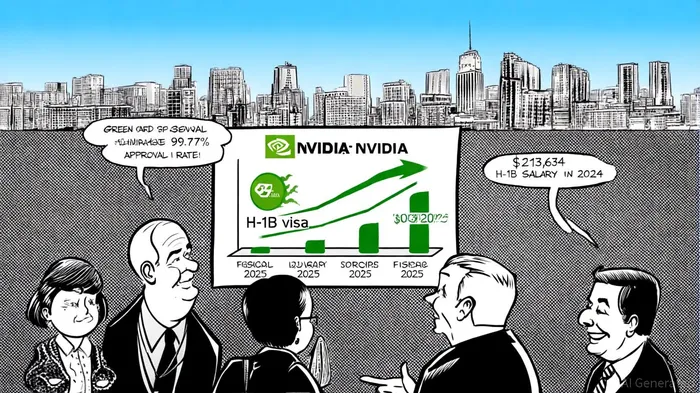
Nvidia's fiscal year 2025 data paints a clear picture of its commitment to foreign talent, according to a Nvidia blog post. The company filed 1,434 Labor Condition Applications (LCAs) for H-1B visas and 532 labor petitions for green cards, with an average salary of $213,634 for H-1B roles and $195,905 for green card positions. These figures far exceed industry benchmarks and underscore the premium Nvidia is willing to pay for specialized skills in AI, machine learning, and hardware development.
The high salaries are not arbitrary. They reflect the demand for expertise in fields such as Electrical Engineering (493 sponsored roles), Computer Science (411), and Computer Engineering (356), as the Nvidia blog post details. These disciplines are central to Nvidia's core business, where breakthroughs in AI algorithms, GPU architecture, and autonomous systems require deep technical knowledge. By offering competitive compensation, Nvidia not only attracts top global talent but also signals to the market its willingness to invest in long-term innovation.
Green Card Dominance and Risk Mitigation
Nvidia's green card sponsorship program further solidifies its advantage. In 2025, the company achieved a 99.77% approval rate for PERM labor certifications, with 433 successful petitions, according to H1BGrader. This near-perfect success rate is rare in the notoriously complex U.S. immigration system and highlights Nvidia's ability to navigate regulatory hurdles. For investors, this efficiency translates to reduced attrition risk and sustained access to critical talent, ensuring continuity in R&D pipelines.
The strategic value of green card sponsorship extends beyond stability. Permanent residency offers foreign employees greater job security and integration into the U.S. workforce, fostering loyalty and long-term contributions. This is particularly vital in AI, where the pace of innovation demands sustained collaboration and knowledge retention.
Navigating Policy Challenges: Cost vs. Commitment
The Trump administration's recent executive order imposing a $100,000 fee on new H-1B applications has raised concerns across the tech sector, as reported in a Business Insider report. However, Nvidia CEO Jensen Huang has publicly affirmed the company's commitment to covering these costs, stating, "The miracle of Nvidia... would not be possible without immigration," according to a Yahoo Finance article. This stance aligns with Huang's broader vision of immigration as a driver of U.S. technological leadership, even as he acknowledges the potential for unintended consequences, such as capital flight or disadvantages for smaller firms, as discussed in The Economic Times article.
Nvidia's willingness to absorb these fees demonstrates its prioritization of long-term gains over short-term cost savings. While the policy shift may pressure some companies to offshore hiring or limit junior hires, Nvidia's deep financial resources and strategic focus on AI ensure it remains unshaken. This resilience is a critical differentiator in an industry where talent acquisition is increasingly constrained by regulatory and geopolitical factors.
Innovation Through Global Partnerships and Acquisitions
Beyond direct sponsorship, Nvidia is expanding its talent ecosystem through strategic acquisitions and global partnerships. In 2025, the company acquired CentML (Toronto) and Gretel Technologies (AI data privacy), adding specialized teams and intellectual property to its portfolio, according to a Tracxn list. These moves not only diversify Nvidia's technical capabilities but also tap into regional talent hubs, creating a flywheel effect where acquisitions feed into its broader sponsorship and R&D strategies.
Additionally, Nvidia's participation in the U.S. government's Partnership for Global Inclusivity on AI (PGIAI)-providing training, GPU credits, and grants to universities in developing countries-further cements its role as a global talent incubator, as noted in the Nvidia blog post. By investing in education and infrastructure, Nvidia is cultivating a pipeline of future innovators, ensuring a steady supply of skilled labor for decades to come.
Implications for Investors
For investors, Nvidia's visa sponsorship programs are more than a compliance exercise-they are a strategic asset that directly correlates with its market leadership. The company's ability to attract and retain top-tier talent at scale, combined with its high approval rates and policy resilience, positions it to outperform peers in AI-driven markets.
Moreover, the financial metrics speak for themselves. With average H-1B salaries exceeding $213,000, Nvidia is clearly targeting the upper echelon of technical expertise. In an industry where innovation is measured in months rather than years, this investment in human capital is a key driver of sustained growth.
As AI reshapes industries from healthcare to autonomous vehicles, companies that can secure and retain elite talent will dominate. Nvidia's visa sponsorship strategy is not just a response to current challenges-it is a forward-looking blueprint for maintaining a competitive edge in the AI era.







Comentarios
Aún no hay comentarios