
Nvidia's Strategic Bet on Autonomous Driving through its Investment in Wayve
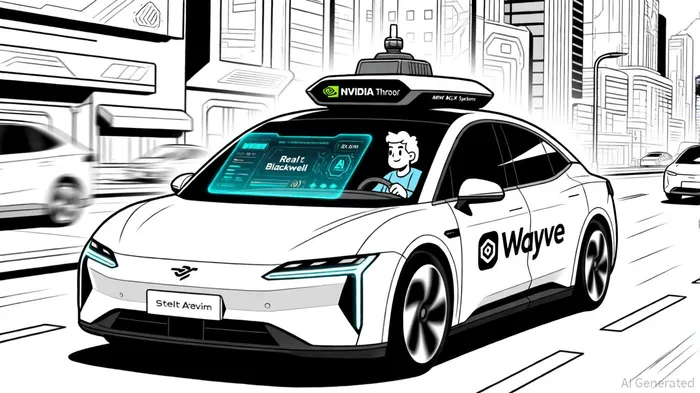
In a bold move to cement its leadership in the autonomous driving sector, NvidiaNVDA-- has announced a potential $500 million strategic investment in Wayve, a UK-based self-driving startup, as part of the latter's next funding round[1]. This development, disclosed on September 18, 2025, marks a significant escalation of the partnership between the two companies and underscores Nvidia's commitment to shaping the future of AI-driven mobility. The investment builds on Nvidia's prior participation in Wayve's Series C funding and aligns with a shared vision to deliver scalable, safe autonomous driving solutions[1].
Strategic Rationale: Bridging AI Innovation and Automotive Infrastructure
Wayve's AI-driven approach to autonomous driving, which relies on machine learning and camera sensors to adapt to real-world traffic patterns without detailed digital maps, complements Nvidia's automotive-grade computing platforms[2]. The collaboration is poised to accelerate the deployment of next-generation mobility solutions, particularly through Wayve's upcoming Gen 3 platform. This platform will leverage NVIDIA DRIVE AGX Thor, powered by the Blackwell GPU architecture and safety-certified NVIDIA DriveOS, to enable Level 3 and Level 4 autonomous driving capabilities in both urban and highway environments[2].
Nvidia's investment also aligns with its broader strategy to strengthen its presence in the UK AI ecosystem. The company has committed £2 billion to UK startups, reflecting its confidence in the region's innovation potential[1]. For Wayve, the funding could catalyze its expansion into commercial fleets, where it has already secured 15% of the global autonomous driving software market by 2025[3]. Analysts note that Wayve's hardware-agnostic, mapless technology offers automakers and fleet operators a cost-effective and adaptable solution, positioning it to capture a larger share of the $8 billion autonomous vehicle market[3].
Market Potential and ROI Projections
The financial implications of this partnership are equally compelling. Wayve's shift toward a software-as-a-service (SaaS) model, projected to account for 60% of its revenue by 2026, signals a scalable path to profitability[3]. With 70% of its current $100 million annual revenue derived from commercial fleet partnerships, the company is well-positioned to capitalize on the growing demand for autonomous logistics solutions[3].
Nvidia, meanwhile, stands to benefit from its expanding role in the autonomous driving value chain. In Q4 2025, the company's automotive and robotics segment reported record revenue of $570 million, a 103% year-on-year increase[4]. This growth is driven by partnerships with industry leaders like ToyotaTM--, Aurora, and Continental, which are deploying NVIDIA-powered fleets[4]. Analysts project that the segment could become a “billion-dollar” business for Nvidia, despite currently representing just 1.45% of its total revenue[4].
Broader Implications for the AI Ecosystem
Nvidia's investment in Wayve is emblematic of its broader strategy to orchestrate the AI value chain, from foundational models to application-specific solutions[5]. By embedding its Blackwell GPUs into Wayve's AI Driver, Nvidia ensures its hardware remains indispensable in the race for autonomous mobility. This approach mirrors its success in data centers and gaming, where ecosystem dominance has driven recurring revenue streams.
For investors, the partnership highlights the transformative potential of AI-driven innovation in the self-driving ecosystem. Wayve's focus on commercial fleets—a sector projected to grow at 25% CAGR through 2030—offers a clear path to scalable ROI[3]. Meanwhile, Nvidia's ability to monetize its AI infrastructure through both direct sales and strategic equity stakes (e.g., its $1.05 billion investment in Wayve in May 2024[5]) reinforces its long-term growth narrative.
Conclusion
Nvidia's $500 million bet on Wayve is more than a financial transaction—it is a strategic alignment of two innovators poised to redefine autonomous driving. By combining Wayve's adaptive AI with Nvidia's cutting-edge hardware, the partnership addresses critical challenges in scalability, safety, and cost-efficiency. As the autonomous vehicle market matures, this collaboration could yield substantial returns for both companies while accelerating the global transition to driverless mobility.





Comentarios
Aún no hay comentarios