
Nvidia's Stock Volatility and the Wider AI Valuation Bubble: Assessing Long-Term Investment Risks in a Correction-Prone Market
The Surge and the Selloff: A Tale of Two Narratives
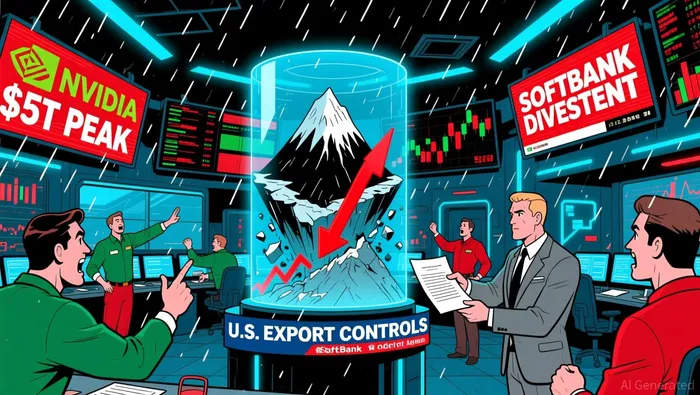
Nvidia's dominance in AI chips has been the cornerstone of its valuation surge. Data-center AI processors drove a 56% year-over-year revenue increase in Q3 2025, with net profit margins hovering near 50%. Yet, the stock's 4.5% drop to $185 in late November-despite record results-signals a shift in investor focus from earnings strength to regulatory and geopolitical risks. SoftBank's complete divestment of its $5.83 billion stake, coupled with speculative concerns about U.S. export controls and a denied $1 billion data-center project in Mexico, has amplified uncertainty.
This selloff mirrors broader market anxieties. Nvidia's price-to-earnings (P/E) ratio of 53.64, while historically high for a growth stock, is now being scrutinized through the lens of past tech bubbles. Analysts remain split: 56 "Buy" ratings versus 2 "Hold" ratings as of late November 2025, but with price targets ranging from $350 to cautionary warnings about "pricing in perfection."
The AI Sector's Valuation Bubble: Fact or Fiction?
The AI sector's broader valuation trends reveal a market in overdrive. Q3 2025 venture capital data shows AI capturing 46.4% of the $97 billion in global VC funding, with megadeals like Anthropic's $13 billion round accounting for nearly a third of AI-specific investments. This frenzy extends beyond software: AI infrastructure firms like Nscale and Cerebras Systems secured over $1 billion each, while 172 AI startup M&A deals accelerated enterprise AI adoption.
Yet, this capital influx raises red flags. Late-stage funding now dominates, with $58.4 billion allocated in Q3 2025-suggesting a shift from innovation to consolidation according to analysis. The sector's reliance on speculative bets, rather than proven monetization models, mirrors the dot-com era's excesses. For NvidiaNVDA--, the risk lies in whether demand for its Blackwell chips and data-center solutions can sustain these valuations amid tightening export controls and slowing enterprise adoption.
Strategic Considerations: Earnings, Exit Risks, and Entry Points
Nvidia's November 19 earnings report will be a litmus test for the sector's resilience. Current expectations cluster around $54.6B–$56.2B in revenue and $1.23–$1.29 in EPS, but the market is pricing in perfection. A miss-particularly on guidance for supply chains or China-related risks-could trigger a sharper correction. Conversely, a beat might reaffirm confidence in AI's long-term trajectory, though at the cost of inflating valuations further.
For investors, the key lies in balancing optimism with caution. Short-term traders may find opportunities in volatility, using the recent dip as a potential entry point if earnings exceed expectations. However, long-term investors should prioritize diversification and risk management. The AI sector's concentration in a handful of "winner-takes-all" players like Nvidia increases systemic risk; a prolonged correction could disproportionately impact high-multiple stocks.
Conclusion: Navigating the AI Gold Rush
Nvidia's stock volatility is a microcosm of the AI sector's broader challenges. While the company's financials remain robust-return on equity (ROE) exceeding 105%-the market's fixation on regulatory risks and speculative overreach underscores genuine overvaluation concerns. The coming weeks will test whether this is a temporary correction or the early stages of a larger market rebalancing.
For now, investors must tread carefully. The AI revolution is real, but its valuation metrics demand a critical eye. As the November 19 earnings report approaches, the line between innovation and speculation will become clearer-and for Nvidia, the stakes have never been higher.







Comentarios
Aún no hay comentarios