
Nvidia's Rubin Chips and the Shifting AI Infrastructure Landscape: Investment Opportunities in AI-Driven Mining and Semiconductor Sectors
The AI infrastructure landscape is undergoing a seismic shift, driven by breakthroughs in semiconductor design and the exponential growth of AI-driven applications. At the forefront of this transformation is Nvidia's Vera Rubin platform, a next-generation AI superchip architecture announced at CES 2026. With its unprecedented performance metrics and strategic partnerships with hyperscalers, Rubin is poised to redefine the boundaries of AI computing. For investors, this innovation opens a window into two high-growth sectors: AI semiconductors and AI-driven mining.
Technical Breakthroughs in the Vera Rubin Platform
Nvidia's Vera Rubin platform represents a leap forward in AI hardware. The platform integrates a Vera CPU (based on Arm's Olympus cores) and two Rubin GPUs into a single processor, delivering 5x AI inference performance and 3.5x training performance over the Blackwell architecture according to Nvidia's CES 2026 announcement. The Rubin GPU alone offers 50 petaflops of NVFP4 inference and 35 petaflops of training performance, while the Vera CPU boasts 88 custom cores and 1.5 TB of on-chip memory as reported by HPCWire. These advancements are complemented by cutting-edge networking and storage components, including NVLink 6 Switch and ConnectX-9 SuperNIC, enabling seamless data flow in large-scale AI deployments according to Nvidia's CES 2026 announcement.
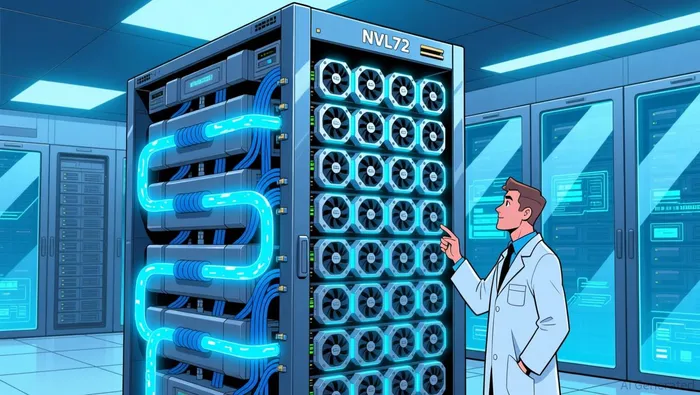
The platform's NVL72 server, housing 72 Rubin GPUs, can be aggregated into a DGX SuperPOD, a modular supercomputer tailored for hyperscalers like Microsoft, Google, and Amazon as detailed in the CES 2026 keynote. Notably, the NVL72's 100% liquid-cooled, cable-free design reduces installation time from two hours to five minutes, addressing critical data center efficiency challenges according to Nvidia's CEO announcement. Production of Rubin chips is already underway, with cloud providers like AWS and Google Cloud expected to launch Rubin-based instances in late 2026 as reported by WCCF Tech.
Market Dynamics: A $1.2 Trillion AI Semiconductor Opportunity
The AI semiconductor market is accelerating toward a $1.2 trillion valuation by 2030, driven by surging demand for AI accelerators and infrastructure. Bank of America analyst Vivek Arya highlights that AI accelerators alone could reach $900 billion in sales, fueled by a 38% annual growth rate in the AI data center market according to Yahoo Finance. This growth is underpinned by 30% year-on-year expansion in semiconductor sales in 2026, pushing the industry toward a historic $1 trillion revenue milestone as projected by Economic Times.
Nvidia's dominance in this space is evident: its AI processors are projected to generate $500 billion in revenue by 2026, with a 50% sales and earnings growth forecast for the next fiscal year according to Yahoo Finance. Competitors like Advanced Micro Devices (AMD) and Broadcom are also gaining traction, particularly in custom ASICs for hyperscalers as noted in Economic Times. However, Nvidia's annual cadence of AI supercomputer releases and its extreme co-design approach-optimizing hardware, software, and networking-position it as the industry's pace-seter according to Nvidia's CES 2026 announcement.
Investment Opportunities in Semiconductors
The Rubin platform's success hinges on a robust supply chain, creating investment opportunities across the semiconductor ecosystem. TSMC, the world's largest chipmaker, reported 39% year-on-year profit growth in Q3 2025, driven by 57% of its revenue from high-performance computing (HPC), including AI chips according to Carbon Credits. Similarly, Samsung Electronics is set to report a 160% surge in Q4 operating profit, bolstered by 314% price increases in DDR5 DRAM and HBM chips used in AI infrastructure as reported by Asia Financial.
High-bandwidth memory (HBM) is a critical enabler of AI performance, with Micron projecting the HBM market to reach $100 billion by 2028 according to Yahoo Finance. HBM4, the next-generation memory standard, is expected to command significantly higher average selling prices than HBM3E, further driving growth. Equipment manufacturers like Lam Research and KLA are also beneficiaries, as demand for HBM manufacturing tools surges according to Yahoo Finance.
AI-Driven Mining: A New Frontier
Beyond data centers, AI is transforming resource extraction and optimization in the mining sector. AI chips are now used to process vast datasets for geological modeling, autonomous drilling, and energy efficiency. For instance, Broadcom's custom ASICs are being deployed in mining operations to accelerate data processing, with the company reporting a $73 billion AI backlog and 74% year-on-year revenue growth in Q4 2025 as detailed in Broadcom's earnings call.
The AI-driven mining sector is also attracting infrastructure investments. Arizona-based companies, for example, have seen gains from AI-related utility and semiconductor demand as reported by AZCentral. As AI reshapes mining, firms with expertise in edge computing, HBM, and specialized ASICs are well-positioned to capitalize on this trend.
Conclusion: A Strategic Inflection Point
Nvidia's Rubin platform is not just a technological milestone but a catalyst for a $1.2 trillion AI semiconductor market. For investors, the key opportunities lie in:
1. Semiconductor leaders like TSMC, Samsung, and Broadcom, which are scaling AI chip production.
2. HBM and equipment manufacturers, as AI accelerators demand higher memory bandwidth.
3. AI-driven mining, where specialized chips and infrastructure are unlocking new efficiencies.
As the Rubin Ultra (scheduled for 2027) and future iterations emerge, the AI infrastructure landscape will continue to evolve. Investors who align with this trajectory-backing companies at the intersection of AI semiconductors, memory innovation, and resource optimization-stand to benefit from one of the most transformative economic shifts of the decade.





Comentarios
Aún no hay comentarios