
NVIDIA's Robotics Revolution: A Trillion-Dollar Play on the Future of Automation
The world is on the cusp of an automation revolution, and NVIDIANVDA-- (NASDAQ: NVDA) is positioned to dominate it. With autonomous vehicles and industrial robotics markets forecast to expand into the trillions, the company's AI-driven robotics strategy is no longer just a side bet—it's the engine of its next decade of growth. Let's dissect why NVIDIA's chip-software ecosystem is primed to capitalize on this opportunity, and why investors should take note.
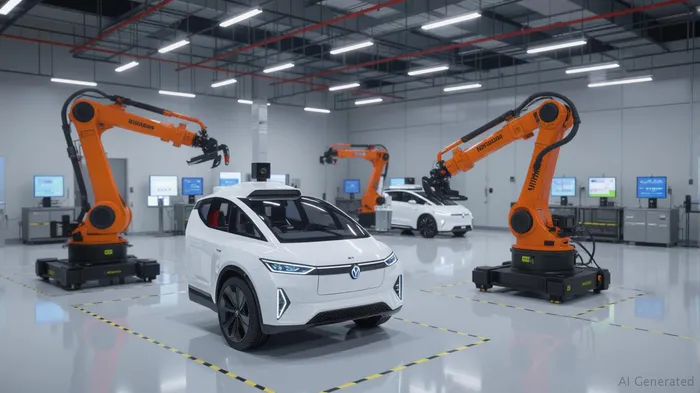
Sector Dominance: The AI-Driven Flywheel
NVIDIA's robotics pivot is underpinned by its unique chip-software ecosystem, which combines its GPUs with AI platforms like Drive (for autonomous vehicles) and Isaac (for industrial robotics). This stack is not just hardware—it's a closed-loop innovation system where data from real-world deployments improves algorithms, which in turn drive demand for more advanced hardware.
Consider the numbers:
- The autonomous vehicle market is projected to grow at a 19.9% CAGR, reaching $214.32 billion by 2030 ().
- Industrial robotics, including cobots and humanoid robots, are expected to hit $35 billion by 2030, with NVIDIA's software enabling 90% of self-driving car platforms and 50% of industrial robots.
NVIDIA's Q1 2025 automotive and robotics revenue hit $567 million, a 72% YoY jump, despite representing just 1% of total revenue. This segment's growth is exponential, not incremental. Competitors like IntelINTC-- (Mobileye) and AMDAMD-- lack NVIDIA's end-to-end AI stack, making it nearly impossible to replicate its lead in software-defined automation.
Valuation Potential: A $4.5T TAM and Monopoly-Like Margins
The $4.5 trillion autonomous vehicle market (by 2034) and the $280 billion industrial robotics sector (by 2034) are not just numbers—they're addressable markets where NVIDIA can command premium margins. Its software licenses, IP royalties, and high-margin GPUs (e.g., H100) ensure profitability even in commoditized hardware markets.
Analysts at Loop Capital recently raised their price target to $250, implying a 40% upside from current levels. While NVDA's valuation is rich (forward P/E ~60), its growth trajectory justifies it:
- The autonomous vehicle segment alone could generate $10+ billion annually by 2030, with robotics adding another $5-7 billion.
- NVIDIA's 30+ partnerships (e.g., Mercedes-Benz, Boston Dynamics) and its $4.5B R&D investment in AI factories (per Q1 2025 earnings) signal a long-term commitment to this space.
Near-Term Catalysts: Growth on Multiple Fronts
- Hardware-Software Synergy: The launch of NVIDIA DRIVE Hyperion 5+6, a unified platform for Level 4 autonomy, could secure deals with major automakers.
- Robotics as a Service (RaaS): Partnerships like the Stretch robot (with NFI) highlight NVIDIA's move into subscription-based software models.
- Regulatory Tailwinds: U.S. and EU safety standards (e.g., ANSI B56.5) are accelerating autonomous vehicle adoption, reducing deployment risks.
- Data Center Demand: While AI infrastructure dominates NVIDIA's current revenue, its robotics segment's 72% growth shows it's a dual-engine growth story.
Risks and Counterarguments
Critics argue NVIDIA's valuation is too high, and its $4.5B charge for H200 GPU export restrictions (to China) hints at geopolitical headwinds. However, these are temporary blips:
- The robotics/AI market is decoupled from near-term macro trends, as automation adoption is a secular necessity for companies.
- NVIDIA's diversified revenue streams (data center, gaming, automotive) reduce reliance on any single market.
Investment Thesis: Buy the Dip, Own the Future
NVIDIA's robotics pivot isn't just a growth lever—it's a monopoly in disguise. With a $4.5T+ addressable market, a 72% revenue surge in its key segment, and Loop Capital's bullish $250 target, the stock remains a buy despite high valuations.
Actionable Idea:
- Buy: Accumulate NVDANVDA-- on dips below $170, with a 12-18 month horizon.
- Watch: Q3 2025 earnings for robotics/AI segment growth, and regulatory approvals for autonomous trucking in the U.S.
In a world where automation is inevitable, NVIDIA is the closest thing to a “winner-take-all” player in the $4.5 trillion robotics economy. The question isn't whether to invest—it's how to miss it.





Comentarios
Aún no hay comentarios