
NVIDIA's Robotics Push: A New Frontier for AI-Driven Productivity and Market Dominance
In the relentless march of the AI revolution, NVIDIANVDA-- has emerged not just as a participant but as a defining force. By 2025, the company has redefined its role in industrial automation, robotics, and AI infrastructure, positioning itself at the intersection of hardware innovation and software ecosystems. With a strategic focus on robotics as a "multitrillion-dollar market", NVIDIA's capital allocation and partnerships are reshaping the landscape of AI-driven productivity. This analysis explores how NVIDIA's aggressive investments, ecosystem expansion, and technological leadership are cementing its dominance in the AI era.
Strategic Partnerships and Ecosystem Expansion
NVIDIA's robotics strategy is anchored in a web of partnerships that span continents and industries. In Europe, the company has partnered with leaders like NEURA Robotics, Delta Electronics, and Doosan Robotics to integrate its Isaac Sim and Omniverse platforms into real-world deployment pipelines. These collaborations are not mere transactions but foundational to NVIDIA's vision of democratizing AI robotics. For instance, the Germany-based AI factory, equipped with 10,000 NVIDIA GPUs, serves as a hub for industrial AI cloud infrastructure, enabling secure, scalable solutions for digital twins and robotics.
In the U.S., NVIDIA's $1.2 trillion investment in reindustrialization underscores its commitment to physical AI. By aligning with manufacturing leaders, the company is accelerating the adoption of AI-enhanced robotics in sectors like logistics and healthcare. 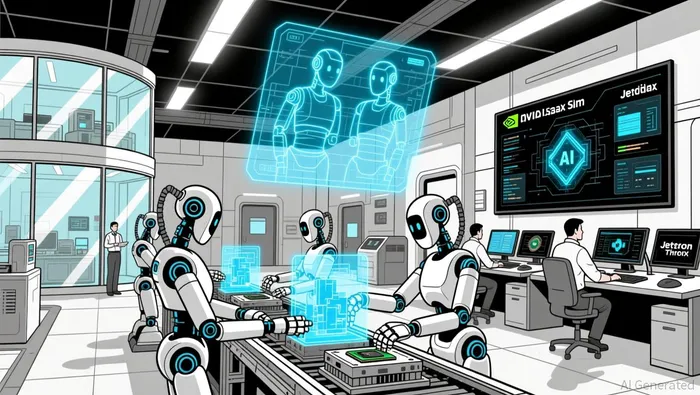 Notably, NVIDIA's investment in startups such as Figure AI-valued at $39 billion-highlights its strategy to back innovation at the frontier of humanoid robotics. These partnerships are not just about market share; they're about building an ecosystem where NVIDIA's hardware and software become indispensable.
R&D Investments and Technological Innovations
NVIDIA's R&D expenditures, averaging nearly 10% of annual revenue, have fueled breakthroughs like the Isaac GR00T N1.5, an open foundation model for humanoid robot reasoning, and the GR00T-Dreams blueprint for synthetic data generation. These tools address critical bottlenecks in robotics, such as adaptability and task performance, by leveraging NVIDIA's expertise in generative AI.
The company's Blackwell architecture, powering exascale computing, is another cornerstone of its robotics ambitions. By optimizing GPUs for AI workloads, NVIDIA ensures that its hardware remains the backbone of next-generation robotics. For example, the Jetson AGX Thor and Isaac Sim are enabling real-time decision-making in autonomous systems, from factory floors to self-driving vehicles. These innovations are not incremental-they're transformative, redefining what robots can achieve in dynamic environments.
Capital Allocation and Financial Commitments
NVIDIA's financials in 2025 reflect its aggressive capital allocation strategy. Fiscal 2025 revenue reached $130.5 billion, with the Data Center segment contributing $115.2 billion-88% of total revenue. This segment, driven by AI infrastructure demand, is pivotal to NVIDIA's robotics ambitions. The company's Q3 FY2026 results further underscore its momentum, with the robotics and automotive business unit generating $567 million in quarterly sales-a 72% annual increase.
NVIDIA's capital expenditures are equally telling. By 2026, the company is projected to benefit from a $3–4 trillion annual global data center buildout, with its GPUs remaining the preferred choice for AI training. While competitors like Alphabet and Tesla are investing in in-house solutions (e.g., TPUs, Robotaxi), NVIDIA's CUDA ecosystem creates high switching costs for customers. This moat, combined with its dominance in cloud GPU sales, reportedly "sold out" in Q3 FY2026, positions NVIDIA to capture disproportionate value from the AI boom.
Market Positioning and Competitive Landscape
The AI robotics market is projected to grow at a 40.4% CAGR from 2025 to 2030, reaching $33.39 billion by 2030. NVIDIA's strategic investments align perfectly with this trajectory. With 80% of the GPU market for AI training, the company is uniquely positioned to capitalize on the surge in demand for physical AI. Its partnerships with Toyota, Hyundai, and Agile Robots further solidify its role in autonomous systems and industrial automation.
Competitors like Alphabet and Tesla are making strides, but NVIDIA's ecosystem advantage is hard to replicate. Alphabet's TPUs, while promising, remain niche compared to NVIDIA's broad adoption. Tesla's Optimus and Robotaxi projects, though ambitious, lack the software infrastructure and partner network that NVIDIA has cultivated. Meanwhile, traditional robotics firms like FANUC and ABB are playing catch-up, unable to match NVIDIA's AI-first approach.
Long-Term Outlook and Investment Implications
NVIDIA's robotics push is not a side bet-it's a core pillar of its AI strategy. With the global data center market expanding and AI-driven robotics becoming table stakes for industries, NVIDIA's capital allocation and R&D focus are poised to deliver outsized returns. The company's partnerships, technological edge, and financial strength create a flywheel effect: more customers, more data, and more innovation.
For investors, the implications are clear. NVIDIA's ability to monetize AI infrastructure, coupled with its leadership in robotics, positions it as a must-own stock in the AI era. While risks like competitive threats and regulatory scrutiny exist, the scale of NVIDIA's ecosystem and its first-mover advantage in physical AI make it a compelling long-term investment.





Comentarios
Aún no hay comentarios