
Nvidia's Path to Sustained Growth in a Maturing AI Market
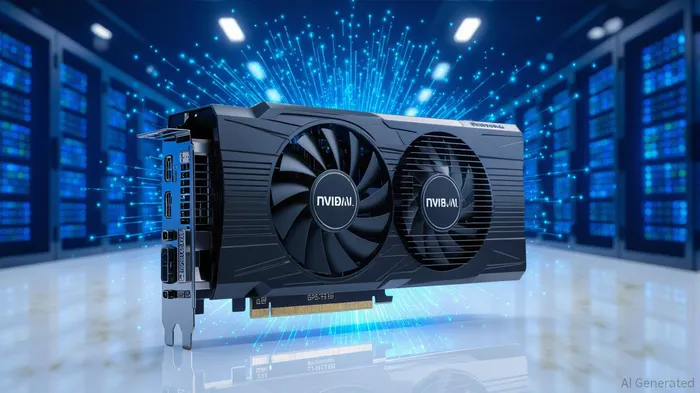
The artificial intelligence (AI) revolution is no longer a speculative horizon but a foundational pillar of global economic transformation. As the market matures, investors face a critical question: Can companies like NVIDIANVDA-- maintain their dominance in an increasingly competitive and regulated landscape? For NVIDIA, the answer lies in a combination of technological leadership, strategic agility, and a recalibrated approach to geopolitical dynamics. This article evaluates the catalysts, valuation, and China re-entry strategy that underpin a long-term buy thesis for the stock.
Catalysts for Sustained Growth
NVIDIA's growth trajectory in 2025 is anchored by its ability to align product innovation with industry needs. The Blackwell GPU, launched in late 2024, has already driven a 73% year-over-year surge in data center revenue, even before the full deployment of its successor, the GB300, slated for Q3 2025. These chips deliver a 2.2x performance leap on MLPerf benchmarks, enabling hyperscalers like MicrosoftMSFT-- to scale AI workloads at unprecedented speeds. Beyond raw compute power, NVIDIA's ecosystem—encompassing CUDA, NeMo, and AI Radio Access Networks (AI-RAN)—creates a flywheel effect, locking in developers and enterprises.
Strategic partnerships further amplify this momentum. In healthcare, NVIDIA's agentic AI and digital twin simulations are accelerating drug discovery and surgical robotics. In automotive, its three-computer approach (training, simulation, and in-vehicle computing) is redefining autonomous vehicle safety. Meanwhile, edge computing trends are expanding demand for NVIDIA's small language models and low-latency AI solutions, positioning the company to capitalize on real-time data processing across industries.
Valuation: Justifying the Premium
NVIDIA's valuation metrics—currently trading at 56 times trailing earnings—reflect its structural growth in the AI infrastructure market. With a market capitalization briefly exceeding $3.77 trillion, the company's data center revenue hit $39 billion in Q1 2026, driven by Blackwell adoption. Compute revenue alone reached $34.2 billion, with 70% attributed to Blackwell. These figures underscore NVIDIA's pricing power, evidenced by gross margins hovering near 70%, even amid headwinds like the H20 export restrictions.
Critics may argue that the valuation is stretched, but the math remains compelling. The GB300's 50% performance improvement over the GB200 and the potential resumption of H20 sales to China could unlock $15–20 billion in annual revenue. This would not only reverse impairment charges but also reinforce NVIDIA's dominance in a market where it already holds 54% of AI chip share in China (despite rising local competition).
Strategic Re-entry into China: A Calculated Gambit
The U.S. government's recent approval to resume H20 sales to China marks a pivotal shift in NVIDIA's strategy. While the H20 is less powerful than the H100, its 20% faster inference performance and $10,000–12,000 price point make it a viable solution for Chinese firms. Analysts estimate this could generate $10–15 billion in 2025 revenue, directly boosting the data center segment.
However, the re-entry is not without risks. Beijing's Cyberspace Administration has raised national security concerns, alleging potential backdoors in U.S.-designed chips. NVIDIA denies these claims but is proactively developing a “made-for-China” Blackwell variant priced at $6,500–8,000 to comply with export controls. This dual approach—leveraging existing products while tailoring solutions to local regulations—demonstrates strategic flexibility.
Challenges and the Road Ahead
NVIDIA's path to sustained growth is not without obstacles. Production delays for Blackwell and GB300 could slow adoption, while Chinese firms like Huawei and Hygon are gaining traction in the domestic market. The localization ratio of China's AI chip market is projected to rise from 17% in 2023 to 55% by 2027, signaling a shift toward homegrown solutions.
Yet, NVIDIA's first-mover advantage and ecosystem dominance provide a moat. Its CUDA platform powers nearly every major AI model, and its NVLink interconnect technology enables efficient scaling of large models. These barriers to entry, combined with a three-year GPU roadmap through 2027, position NVIDIA to maintain its leadership even as competition intensifies.
Investment Thesis: A Long-Term Buy
For investors, NVIDIA represents a rare confluence of innovation, market power, and strategic foresight. While short-term risks—geopolitical tensions, production bottlenecks, and rising competition—exist, the company's ability to adapt and innovate mitigates these concerns. The resumption of H20 sales to China, coupled with the GB300's launch, offers a clear path to revenue diversification and margin expansion.
The valuation, though elevated, is justified by the scale of NVIDIA's addressable market and its role as the de facto infrastructure provider for AI. For those with a 5–10 year horizon, the stock's current multiple appears warranted, particularly given the lack of viable alternatives in the AI hardware space.
Conclusion
NVIDIA's journey in the maturing AI market is a testament to the power of technological leadership and strategic agility. By leveraging its ecosystem, navigating geopolitical complexities, and continuously innovating, the company is not only adapting to change but shaping the future of AI. For long-term investors, the combination of robust fundamentals, a clear growth trajectory, and a defensible moat makes NVIDIA a compelling addition to a diversified portfolio.





Comentarios
Aún no hay comentarios