
Nvidia's Path to a $7 Trillion Market Cap by 2026: AI Infrastructure Demand and Strategic Production Scaling
The semiconductor industry is witnessing a seismic shift, driven by the explosive growth of artificial intelligence (AI). At the center of this transformation is Nvidia, whose dominance in AI infrastructure has positioned it as a key beneficiary of the global AI boom. With a $4.5 trillion market cap as of late 2025, the company is now on a trajectory to potentially reach a staggering $7 trillion valuation by the end of 2026. This projection is not speculative-it is underpinned by Nvidia's unparalleled leadership in AI chip innovation, strategic production scaling, and a rapidly expanding ecosystem of partnerships.
AI Infrastructure Demand: A $7 Trillion Opportunity
The foundation of Nvidia's growth lies in the surging demand for AI infrastructure. In Q4 2025, the company reported $39.3 billion in revenue, with its data center segment alone generating a record $35.6 billion, a 93% year-over-year increase. This growth was fueled by the launch of the Blackwell AI supercomputers, which achieved $11 billion in first-quarter revenue-a testament to the insatiable demand for high-performance computing (HPC) in AI training and inference.
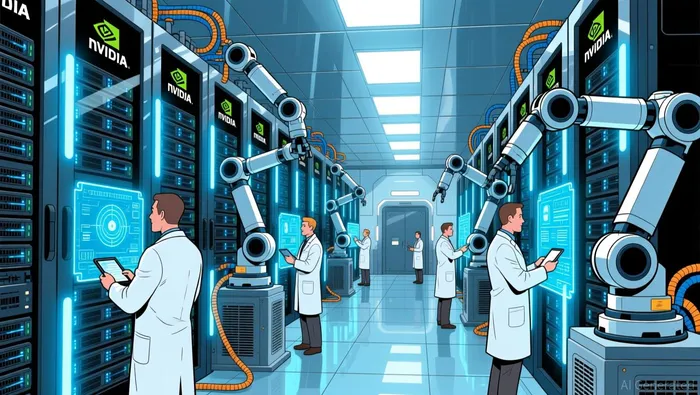 Nvidia's dominance in the data center AI chip market is equally staggering. By Q3 2025, its data center revenue had reached $51.2 billion, dwarfing the combined data center and CPU revenue of historical rivals Intel and AMD by a factor of six. The Blackwell architecture, including the B200 and GB200 chips, has set new benchmarks in performance and efficiency, delivering 10x throughput per megawatt compared to previous generations. This technological edge has cemented Nvidia's role as the de facto supplier for cloud providers like AWS, Google Cloud, Microsoft Azure, and Oracle Cloud, which are racing to build AI infrastructure at scale.
Strategic Production Scaling: Building the AI Supply Chain
To meet this unprecedented demand, NvidiaNVDA-- has embarked on an aggressive strategy to scale production and secure its position in the global supply chain. A critical component of this strategy is vertical integration-expanding control over key infrastructure components such as networking (via its 2019 acquisition of Mellanox) and memory solutions (through partnerships with Samsung for HBM4 development) according to Samsung.
Nvidia's partnerships with leading foundries like TSMC and Samsung are central to its production expansion. In 2025, TSMC began volume production of Blackwell chips at its Phoenix, Arizona facility, aligning with U.S. efforts to localize semiconductor manufacturing. Meanwhile, the AI Megafactory collaboration with Samsung will integrate over 50,000 NVIDIA GPUs into Samsung's semiconductor processes, embedding AI across design, production, and quality control according to Samsung. These partnerships are not just about scaling output-they are about ensuring supply chain resilience in a geopolitical climate where semiconductor security is a top priority.
Nvidia is also expanding its horizontal reach into industries beyond traditional computing. Collaborations with Siemens and Synopsys are transforming manufacturing and engineering. For example, the Siemens partnership aims to create AI-driven "adaptive manufacturing sites," with the Siemens Electronics Factory in Germany serving as a blueprint for AI-optimized production starting in 2026 according to Nvidia. Similarly, the Synopsys collaboration is accelerating engineering workflows through NVIDIA's CUDA-X libraries and Agentic AI stack, enabling autonomous design in sectors like semiconductors and aerospace according to Synopsys.
Financial Projections and Market Cap Trajectory
The financial implications of these strategic moves are profound. Analysts project that Nvidia's data center segment will grow at a 36% compound annual growth rate (CAGR) through 2030, reaching a mid-$900 billion run rate by the end of the decade. This growth is supported by a $7 trillion global AI infrastructure spending opportunity, with $3.5 trillion allocated to GPUs and chips alone according to Private Markets Insights.
The $7 trillion market cap projection for 2026 is not just a function of revenue growth-it reflects the broader economic transformation driven by AI. As Jensen Huang, Nvidia's CEO, has emphasized, AI is now infrastructure, requiring physical factories, energy systems, and gigawatt-scale data centers according to Virtant. This shift is already materializing: ABB and NVIDIA's collaboration on an 800 VDC power architecture, for instance, is optimizing energy efficiency in data centers, addressing one of the key constraints of AI scaling according to LinkedIn.
Moreover, Nvidia's ecosystem of 59 AI startup investments as of October 2025 underscores its intent to embed itself into the core of AI innovation according to Tech Policy. These investments, combined with its leadership in AI software (e.g., CUDA, Omniverse, and AI-Physics tools), create a flywheel effect-driving demand for its hardware while locking in long-term partnerships.
Challenges and Risks
Despite its dominance, Nvidia faces challenges. Short-term margin pressures persist due to early-stage production costs for Blackwell, with non-GAAP gross margins in the data center segment declining to 76.2% in Q4 2025. Additionally, geopolitical risks-such as U.S. export controls and potential regulatory scrutiny-could disrupt its access to key markets like China. However, these risks are largely seen as temporary, with analysts anticipating margin normalization as production scales and demand stabilizes.
Conclusion: A $7 Trillion Future
Nvidia's path to a $7 trillion market cap is not a leap of faith-it is a calculated outcome of its leadership in AI infrastructure, strategic production scaling, and ecosystem-building. The company's ability to align with global trends in AI, semiconductors, and energy infrastructure positions it as a cornerstone of the next industrial revolution. While challenges remain, the confluence of technological innovation, financial strength, and strategic foresight makes this valuation not just plausible, but inevitable.
For investors, the question is no longer if Nvidia will reach $7 trillion-it is how quickly it will get there.





Comentarios
Aún no hay comentarios