
Nvidia and Palantir: Two Rails for the AI Infrastructure S-Curve
The buildout of AI infrastructure is no longer a trend; it is a multi-year paradigm shift. The evidence points to an exponential adoption curve, where demand is outstripping supply and traditional IT systems are becoming obsolete. In 2025, AI infrastructure spending surged 166% year-over-year as organizations scrambled to secure the compute needed for large-scale deployments. This isn't a one-off spike. The market is projected to grow from $87.6 billion in 2025 to $197.64 billion by 2030, following a steady 17.71% compound annual growth rate. This is the fundamental rail for the next technological era, and two companies are positioned at its core.
Nvidia represents the undisputed leader in the compute layer, the foundational hardware that powers the entire stack. Its dominance is reflected in its financials, with revenue of $57 billion in its latest quarter, a 62% year-over-year increase. The company is the essential engine for training and running AI models, making it a non-negotiable infrastructure play.
Palantir, meanwhile, operates at a different, but equally critical, layer: the software and platform layer that makes AI usable and productive for enterprises. Its growth trajectory is explosive, with 121% year-over-year U.S. commercial revenue growth in Q3 2025. This surge is driven by its Artificial Intelligence Platform, which is shortening sales cycles and closing large deals at a rapid pace. PalantirPLTR-- is building the operating system for the AI enterprise, translating raw compute power into business value.
A key insight from the data is that consensus estimates for AI spending consistently lag reality. Analysts have consistently underestimated capex spending related to AI, with actual investment exceeding 50% growth in both 2024 and 2025. This divergence is now driving market dynamics, as investors rotate away from infrastructure plays where capex isn't clearly linked to revenue. The setup is clear: NvidiaNVDA-- provides the essential compute rail, while Palantir provides the software layer that ensures that rail is efficiently utilized. Together, they represent two distinct, high-growth layers of the same exponential infrastructure buildout.
Nvidia: The Compute Layer Leader and Its 2026 Catalysts
Nvidia's position as the foundational compute layer is cemented by its premium valuation and sustained outperformance. The stock's 24.41% rolling annual return anchors its leadership, reflecting the market's view that it is the essential engine for the AI paradigm. This isn't a speculative bubble; it's a valuation that prices in the company's role as the non-negotiable hardware rail for the entire infrastructure buildout.
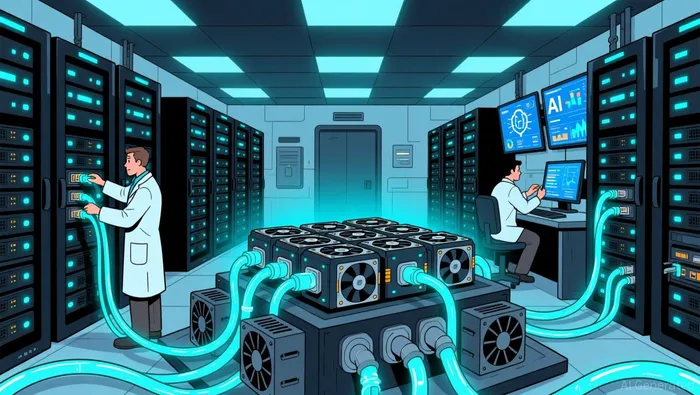
The key catalyst for 2026 is a potential shift in the interconnect layer that binds its GPUs into clusters. Nvidia is a central player in the Ultra Ethernet Consortium (UEC), a group aiming to standardize high-speed networking for next-generation AI systems. If the UEC specifications gain traction, they could challenge the entrenched dominance of InfiniBand, a technology where Nvidia has a significant stake. This is a critical watchpoint because the efficiency of GPU clusters is paramount to AI performance. A successful UEC standard could either open new revenue streams for Nvidia through its networking IP or, conversely, disrupt its existing ecosystem if it forces a costly transition for customers.
More broadly, Nvidia's future depends on the continuation of the capital intensity that has powered its growth. The company has benefited from a clear link between massive capex and revenue, a dynamic that investors are now demanding. The evidence shows that consensus estimates for AI capex have consistently underestimated actual spending, with investment exceeding 50% growth in both 2024 and 2025. This divergence is now driving market rotation, as investors favor infrastructure plays where spending is clearly tied to future earnings. For Nvidia, the key watchpoint is whether this trend of infrastructure spending outpacing consensus estimates continues into 2026. Sustained capital intensity validates the exponential adoption curve and supports the premium valuation, while a slowdown would be a major red flag for the entire compute layer.
Palantir: The Commercial AI Platform Growth Engine
Palantir is executing a powerful pivot from a government-centric model to a commercial AI powerhouse. The evidence is clear: in its third quarter of 2025, the company posted 121% growth in U.S. commercial revenue. This isn't just a number; it's a signal of a new, scalable growth engine. The company closed 204 deals of at least $1 million last quarter alone, a staggering volume that demonstrates the platform's ability to move quickly at scale. This acceleration is driven by its Artificial Intelligence Platform, which uses intensive workshops to shorten sales cycles from months to weeks, fueling a rapid deal pipeline.
The stock's performance tells the same story of exponential growth. Since its 2020 direct listing, Palantir's shares have rallied 1,680%, a figure that dwarfs the 107% gain of the S&P 500 over the same period. This isn't a speculative bubble but a valuation that prices in a fundamental shift in the company's business model. The commercial AI platform is becoming the primary driver of its value, moving beyond its legacy government contracts.
Yet, the major risk for Palantir is one that plagues many high-growth software plays: commoditization or cyclical peaks. The company's current premium valuation demands that its growth continues to outpace the market. If the commercial AI market matures or faces a downturn, the intense competition for enterprise deals could compress margins. The evidence highlights a key pattern: infrastructure investments struggle when they hit physical limits, cyclical peaks, or commoditization traps. Palantir's challenge is to maintain its pricing power and differentiation as its platform becomes more widely adopted, ensuring that overall sector growth translates into sustained profitability for the company itself.
Comparison and Investment Thesis: Complementary Rails for the Future
The investment case for Nvidia and Palantir rests on a simple, powerful truth: they represent two distinct but symbiotic layers of the same exponential infrastructure buildout. Nvidia provides the essential physical compute layer-the steel and concrete, as Jensen Huang frames it-while Palantir builds the software layer that makes that compute productive and deployable at scale. This is not a competition; it is a partnership. The AI revolution requires both the powerful engine and the operating system to run it.
The thesis hinges entirely on the sustained capital intensity of this buildout. The evidence shows that consensus estimates for AI capex have consistently underestimated actual spending, with investment exceeding 50% growth in both 2024 and 2025. This divergence is now driving market dynamics, as investors rotate toward companies where capex spending is clearly linked to future revenue. For Nvidia, this validates its role as the indispensable hardware rail. For Palantir, it fuels the demand for its platform, which shortens sales cycles and accelerates the deployment of AI solutions. The setup is one of complementary rails, each benefiting from the other's growth.
Yet, the path is not without friction. The major risk for any infrastructure play is commoditization or cyclical peaks. As the market matures, the intense competition for enterprise deals could compress margins, a vulnerability highlighted by the structural headwinds that can plague infrastructure investments. Nvidia must navigate potential disruption in the interconnect layer, while Palantir must defend its pricing power as its platform becomes more widely adopted. Both face the challenge of maintaining differentiation in a crowded field.
The bottom line is that this is a bet on the continuation of the AI S-curve. The valuation premiums paid for both companies reflect the market's expectation of exponential growth. The key watchpoint is whether the capital intensity that has powered this buildout continues to outpace consensus estimates. If it does, the symbiotic relationship between the compute layer and the software layer will drive compounding returns. If it slows, the entire paradigm faces a reality check. For now, the rails are being laid.







Comentarios
Aún no hay comentarios