
Nvidia vs. Palantir: The 2026 Expectation Arbitrage
The investment case here is a classic game of priced-in growth versus priced-in perfection. NvidiaNVDA-- and PalantirPLTR-- are both AI leaders, but the market is demanding vastly different things from each of them. For Nvidia, the expectation is for continued dominance. For Palantir, the expectation is for flawless execution to justify a premium that already prices in near-miracle results.
The valuation gap tells the story. Nvidia trades at a forward P/E of 24 times its fiscal 2027 earnings. That's a steep multiple, but it reflects a market that sees its growth trajectory as largely secure. Palantir's multiple is a different universe: 421 times trailing earnings, or roughly 175 times its forward fiscal 2026 earnings. This isn't just a premium; it's a bet that Palantir's growth will accelerate to levels that can support that price forever. The market is not pricing in a slowdown for Nvidia; it's pricing in a potential stumble for Palantir.
This divergence is mirrored in analyst sentiment. Nvidia's consensus is overwhelmingly bullish, with an average price target implying a 43% rally from recent levels. That's the market saying, "Buy the rumor of continued dominance." Palantir's consensus is a stark contrast. With a Hold rating and an average price target of $174.69, the market is telling investors to stand pat. The stock is seen as fairly valued at best, with little room for error. This skepticism is a direct response to the valuation; it's a warning that any stumble in growth or margins could trigger a sharp re-rating.
The bottom line is one of risk and expectation. Nvidia's path is clear: it must execute, but the market already expects it to. The stock's rally is the market buying the rumor of continued leadership. Palantir's path is narrower: it must not only execute but exceed near-perfect expectations to justify its price. The high multiple means there is no margin for error. For an investor, that makes Palantir a higher-risk bet on an expectation gap that is already wide.
Catalysts vs. Reality: The 2026 Playbook
The coming year is a test of whether these companies can meet the towering expectations already priced into their stocks. For Nvidia, the catalyst is clear and massive: the resumption of sales in China. Analysts see this as a major upside driver, with Mizuho noting it could reignite growth. The numbers are staggering. If Nvidia can ship the over 2 million H200 chips Chinese firms have ordered, it could generate just over $40 billion in revenue this year. That alone could add roughly 25% to its 2026 revenue forecast. The market consensus, however, has not yet baked this in. This creates a classic "expectation gap" where a positive catalyst could easily lead to a beat-and-raise.
Yet the bar for Nvidia is already set extremely high. Even with the China catalyst, the stock must now exceed an explosive growth trajectory. Evercore ISI's $352 price target implies explosive 79% revenue growth by mid-2026. That's a monumental leap from its current pace. The stock's recent 27% gain over the past year, while healthy, has underperformed the broader semiconductor sector. This suggests the market is already pricing in a strong year, leaving little room for a "sell the news" reaction if the China reopening is slower or more limited than hoped.
Nvidia's path is to accelerate past its own high bar. Palantir's test is more immediate and binary. Its next major event is the full-year earnings report in early February. This report must do two things: justify its valuation and provide guidance that supports it. With a forward multiple of 175 times fiscal 2026 earnings, the company cannot afford a single quarter of underwhelming growth or margin pressure. The market is waiting for a flawless print that confirms the narrative of relentless, high-margin expansion. Any deviation from that script-a guidance reset, a margin dip, or a slowdown in government contract wins-could trigger a sharp re-rating, as the high multiple leaves no margin for error.
The bottom line is a stark contrast in risk profiles. Nvidia's catalyst is a potential windfall that could push it past an already lofty target. Palantir's catalyst is simply meeting its own perfection. For an investor, the 2026 playbook is about managing this asymmetry: betting on Nvidia to exceed its own high expectations, while watching Palantir for any crack in the facade that its premium prices.
Valuation and Risk: The Sandbagging Test
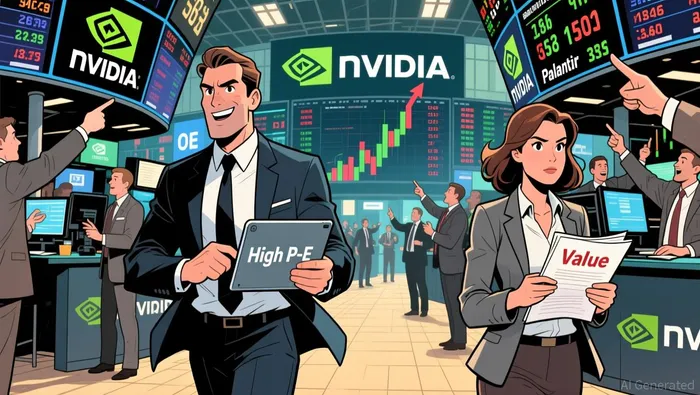
The risk/reward for these two AI giants is defined by their respective expectation gaps. For Nvidia, the market is pricing in a smooth, high-growth trajectory. For Palantir, the market is pricing in perfection. This sets up a stark test of whether their recent performance aligns with those priced-in realities.
Insider activity at Palantir provides a clear cautionary note. Over the past 90 days, insiders have sold 1,023,444 shares totaling about $167.4M. This heavy selling, including large November transactions by key executives, creates a tangible signal of risk. It suggests those closest to the company's operations see value that may not be fully reflected in the stock's recent momentum. This is a classic "sandbagging" dynamic: while retail and some analysts are bullish, the insiders are taking money off the table. It adds a layer of skepticism to the rally, making any subsequent guidance reset more likely to trigger a sharp reaction.
In contrast, Nvidia's recent price action shows remarkable calm. The stock has exhibited low volatility, with a daily volatility of just 1.45%. This stability indicates a market that is not pricing in significant near-term shocks. It's a sign of confidence in the current trajectory, but also a potential vulnerability. A stock that moves little can also fall quickly if a major catalyst-like a slower-than-expected China reopening-fails to materialize. The low volatility suggests the "buy the rumor" phase is complete, leaving the stock exposed if the "sell the news" phase begins.
The expectation gap for Palantir is simply wider. Its valuation demands flawless execution, and its upcoming full-year earnings report in early February is the ultimate test. The market consensus is already cautious, with a Hold rating and an average price target implying little upside. Any miss on growth, margins, or guidance could trigger a severe valuation reset. The high multiple leaves no room for error, making the stock a prime candidate for a sharp re-rating if reality falls short of the perfection already priced in.
The bottom line is one of asymmetric risk. Nvidia's path is to exceed its already high bar, a task made easier by its lower volatility and more secure growth narrative. Palantir's path is to avoid any stumble, a far more precarious proposition given the insider selling and the binary nature of its valuation. For an investor, the sandbagging test is clear: Nvidia is being trusted to keep delivering, while Palantir is being watched for any crack in its flawless facade.
The Takeaway: Where the Arbitrage Lies
The expectation arbitrage is clear. Nvidia offers growth that is priced in but execution risk is low. Palantir offers a premium valuation that demands perfection. For an investor, the play is to identify which company is more likely to close its expectation gap-or which one will see reality fall short.
For Nvidia, the watchpoint is China. The stock's recent 27% gain has underperformed the broader semiconductor sector, suggesting the market is already pricing in a strong year. The real test is whether the company can meet the high whisper number for AI accelerator demand growth. Watch the sales data for the over 2 million H200 chips Chinese firms have ordered. Any sign of a slower reopening or fulfillment could trigger a "sell the news" reaction, as the stock's low volatility leaves it exposed. The broader catalyst is sustained hyperscaler capex, with AI accelerator demand seen as a notable tailwind for the year.
For Palantir, the watchpoint is the upcoming full-year earnings report in early February. This report must not only deliver strong growth but also provide guidance that supports its 175-times forward earnings multiple. Any adjustment to that guidance, or commentary on margins, could spark a sharp re-rating. Track insider trading activity for signs of confidence; the heavy insider selling of $167.4M in the past 90 days is a tangible signal of risk that could amplify any negative news flow.
Both stocks are sensitive to broader tech sector sentiment and AI capex trends. A slowdown in hyperscaler spending could reset market expectations for the entire AI theme, pressuring Nvidia's growth narrative and crushing Palantir's premium valuation. The arbitrage lies in betting on Nvidia to exceed its own high bar, while watching Palantir for any crack in the facade that its premium prices.





Comentarios
Aún no hay comentarios