
El riesgo de NVIDIA: El shock geopolítico revela las debilidades de los semiconductores
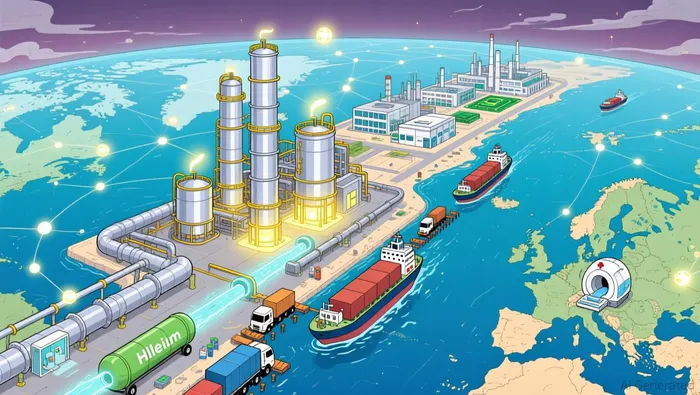
El helio es un subproducto energético estratégico, no una mercancía tradicional. Se encuentra atrapado en un ciclo geopolítico y macroeconómico. Su valor se determina por su papel insustituible en las industrias avanzadas, así como por la extrema fragilidad de su cadena de suministro. Catar es el país que provee aproximadamente…Un tercio de la producción mundial de helio.Se produce en la planta de procesamiento de gas natural licuado más grande del mundo, ubicada en Ras Laffan. Esto convierte a esta instalación en un punto clave para las cadenas de suministro tecnológico y médico a nivel mundial.
El reciente conflicto ha causado daños graves y duraderos. Después de una breve pausa en la producción,Los misiles balísticos iraníes volvieron a impactar en Ras Laffan los días 18 y 19 de marzo.Esto ha causado “daños extensos” en la planta de producción de GTL y en otras plantas de generación de GNL. Esta destrucción física prolonga significativamente el tiempo necesario para reanudar la producción, más allá de una simple cesación del fuego. Como señaló un experto, es muy poco probable que sea posible recuperar algo de producción en seis semanas.
Esta perturbación ocurre en un contexto de oferta ya muy limitada. El mercado mundial de helio ha agotado el exceso de oferta anteriormente, dejando casi ningún margen de maniobra. Este producto se suministra en forma de “just-in-time”, y la cadena de suministro mundial funciona de manera bastante eficiente.45 days of buffer before inventory evaporates. Unlike oil, helium's tiny molecules make it nearly impossible to stockpile, and its extremely low freezing point means it cannot be liquefied. This creates a high-risk, high-volatility setup where geopolitical shocks can rapidly translate into price spikes and industrial bottlenecks.
Semiconductor Production and the AI Investment Cycle
The semiconductor industry is in a high-growth phase, driven by the explosive demand for AI. This is exemplified by NVIDIA's record results, which show revenue of $68.1 billion for the quarter ended January 25, 2026, up 73% year-over-year. The company's CEO has declared the arrival of an "agentic AI inflection point," with customers racing to invest in the "factories powering the AI industrial revolution." This massive investment cycle has scaled production to near capacity, making the entire system more sensitive to any input cost shock.
Helium is a critical, non-substitutable input in this process. It is used as a carrier gas, for wafer cooling, and in leak detection within fabrication plants. A disruption to its supply directly increases operating costs for chipmakers. As the conflict has shown, helium shipments through the Strait of Hormuz came to a standstill, forcing fabs to ration supplies and sending prices for ultra-pure helium soaring. For a company like NVIDIA, which operates at such a scale, even a temporary spike in a key input cost can pressure margins and profitability.
The impact is not immediate but follows a lagged production cycle. A reduction in helium supply today translates to fewer wafer starts. Given the time required for the full fabrication process, this ultimately leads to a constrained volume of finished chips 8 to 12 weeks later. This creates a vulnerability where a geopolitical shock can disrupt the flow of chips into the very AI systems that are driving the industry's growth, potentially creating bottlenecks just as demand peaks.
NVIDIA's Position and Margin Resilience
NVIDIA's dominant position in the AI chip market provides a significant buffer against input cost shocks like the helium disruption. The company's recent financials underscore this strength, with record revenue of $68.1 billion for the quarter ended January 25, 2026, up 73% year-over-year. More importantly, it posted gross margins of 75.0% for the quarter. This high-margin model creates a crucial financial cushion, allowing the company to absorb some cost increases without immediately sacrificing profitability.
This cushion is amplified by NVIDIA's market leadership. As the primary supplier of AI compute, it holds a privileged position in the supply chain. This leverage enables the company to prioritize its own production needs and potentially pass through some of the rising helium costs to its customers, who are themselves racing to build AI infrastructure. The ability to manage its own supply chain and secure critical inputs gives NVIDIA a strategic advantage over smaller or less dominant players.
Yet the risk is not zero. Prolonged helium scarcity could force semiconductor fabs to ration supplies, a scenario that has already begun with chip fabs across South Korea beginning to ration helium. If this rationing extends to NVIDIA's own production or that of its key partners, it could constrain the volume of high-margin AI chips coming online. The lagged nature of the semiconductor cycle means that a supply shock today could manifest as a production bottleneck 8 to 12 weeks later, directly impacting the flow of finished products into the market.
The bottom line is that NVIDIA is well-positioned to weather the current storm, thanks to its financial firepower and market power. However, the helium disruption is a stark reminder that even the most dominant players are not immune to supply chain shocks. The company's resilience will be tested if the geopolitical conflict leads to a sustained, severe shortage that forces production cuts. For now, its record margins provide a strong buffer, but the path to sustained profitability depends on the stability of the global supply chain.
Macro Scenarios and Forward-Looking Implications
The helium disruption presents a clear dichotomy of outcomes, each with distinct implications for the semiconductor cycle and broader commodity markets. The path forward hinges on the duration of the conflict and the speed of physical recovery at the Ras Laffan facility.
The most optimistic scenario is a swift peace and rapid restart. If the conflict de-escalates quickly, repairs could begin within weeks, with some output potentially returning in a matter of months. In this case, the market's tight buffers would be replenished, and prices would normalize. The global helium supply chain, already running on a 45 days of buffer, would absorb the shock. For NVIDIA and other chipmakers, this would mean a temporary cost spike and minor production hiccups, quickly resolved. The AI investment cycle would continue its upward trajectory with minimal long-term damage.
The more likely and concerning scenario is a prolonged conflict. This would extend the timeline for restarting production far beyond the initial "weeks to months" estimate, as extensive physical damage to the Pearl GTL facility and other LNG plants complicates repairs. In this environment, high helium prices would act as a persistent cost headwind for semiconductor manufacturing. More critically, the conflict could also dampen demand for AI data center buildouts due to rising energy costs, creating a double pressure on the industry. This would not only squeeze chipmaker margins but could also slow the pace of new AI hardware adoption, potentially softening the peak demand that is currently driving the cycle.
The key watchpoints for investors are the restart timeline at Ras Laffan, the adequacy of existing storage buffers like the 47mn cubic meter facility in Germany, and the pace of alternative supply development. The market's ability to withstand a shock depends on these factors. If the conflict drags on, the risk of a secondary price surge-potentially pushing prices more than four-times pre-war levels-becomes real, further destabilizing the semiconductor supply chain.
Viewed through the macro lens, this event underscores how geopolitical shocks can abruptly reset commodity cycles. The helium market, already in a tight supply phase, is now a direct lever on the AI hardware cycle. For now, NVIDIA's financial strength provides a cushion, but the broader industry's vulnerability to such shocks is laid bare. The forward view depends on a return to stability in the Middle East, a recovery that remains uncertain.





Comentarios
Aún no hay comentarios