
Nvidia's H200 Chip Export to China and the Marginal Revenue vs. Strategic Risk Tradeoff
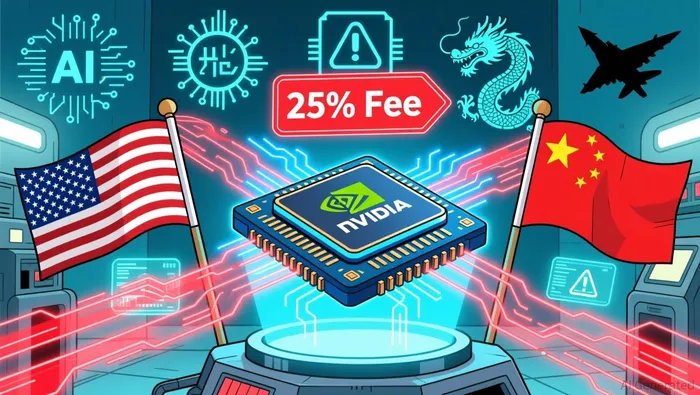
The U.S. government's recent approval of Nvidia's H200 AI chip exports to China under President Donald Trump's administration marks a pivotal shift in semiconductor policy. This decision, which imposes a 25% fee on each sale, replaces the Biden-era "total denial" strategy with a model of managed competition. While this regulatory win could unlock significant revenue for NvidiaNVDA--, it also raises critical questions about the long-term geopolitical risks of enabling China's AI ambitions. For investors, the key challenge lies in assessing whether this policy shift translates into tangible financial gains or exacerbates strategic vulnerabilities in the U.S.-China tech rivalry.
Revenue Potential: A Partial Rebound for Nvidia
The H200 chip, a high-performance AI accelerator, has drawn robust demand from Chinese hyperscalers like Alibaba and ByteDance due to robust China demand. Analysts estimate that if sales scale meaningfully, the H200 could generate $2 billion to $5 billion in annual revenue for Nvidia as Trump approves H200 AI chip sales to China. However, the 25% U.S. fee-collected during security inspections in the U.S. before re-export-reduces the net revenue potential. For context, Nvidia's China-driven data-center revenue had declined from 20–25% of its total in fiscal 2025 to just 5% in fiscal Q3 FY'26 according to reports. Even with the fee, the H200's approval could stabilize this segment, particularly if production capacity expands to meet surging demand according to analysis.
 Yet, revenue gains remain contingent on Chinese regulatory decisions. While Beijing has not outright banned the H200, officials are reportedly considering restrictions that would limit its use to scenarios where domestic alternatives cannot meet technical needs as reported by tech sources. Additionally, public-sector entities may be barred from purchasing the chips according to industry analysis, which could cap adoption in state-backed projects. For now, the largest commercial players appear to dominate the demand pipeline according to reports, but this narrow focus may limit the chip's broader economic impact.
Strategic Risks: Accelerating China's AI Ambitions
The geopolitical risks of this policy shift are multifaceted. First, China's domestic semiconductor industry-led by firms like Huawei and Cambricon-is already a direct competitor to the H200 as reported by industry sources. By granting access to advanced U.S. technology, the Trump administration risks undermining its own goal of fostering a self-reliant Chinese chip ecosystem. As White House AI czar David Sacks noted, China is actively "rejecting" the H200 in favor of domestic alternatives, a move that could paradoxically accelerate its semiconductor independence according to Bloomberg reports.
Second, the H200's superior performance over China's current offerings-such as the downgraded H20 chip-poses a dual-use risk. According to a Bloomberg report, Chinese officials are exploring policies that would require H200 purchases to be bundled with a certain ratio of domestically produced chips as reported by industry sources. This "technology hybridization" strategy could mitigate the H200's disruptive potential while still leveraging its capabilities for AI development. However, critics argue that even limited access to the H200 could accelerate China's military and technological advancements, undermining U.S. strategic interests according to experts.
Geopolitical Implications: A Fragile Equilibrium
The Trump administration's approach reflects a broader pivot toward economic pragmatism over strict containment. By taxing rather than banning the H200, the U.S. aims to balance revenue generation with national security concerns according to analysis. However, this model is inherently fragile. For instance, the 25% fee is higher than the previous 15% rate according to reports, signaling a more aggressive stance in extracting value from China's AI growth. Yet, this policy could backfire if China retaliates by accelerating its own chip development or imposing tariffs on U.S. goods.
Moreover, the H200's integration into China's AI ecosystem risks creating a dependency on the CUDA platform, which could lock Chinese developers into Nvidia's ecosystem according to analysis. While this might seem beneficial for Nvidia in the short term, it could also incentivize Beijing to invest more heavily in breaking this dependency, further destabilizing the U.S.-China tech balance.
Conclusion: A Calculated Bet with Uncertain Payoffs
For investors, the H200 export approval represents a calculated bet. On one hand, it offers a partial rebound for Nvidia's China revenue and aligns with the Trump administration's broader economic agenda. On the other, it exposes the company-and by extension, U.S. national security-to the risks of enabling China's AI ascent. The 25% fee may mitigate some of these risks by reducing the net value of the technology transfer, but it does not eliminate the strategic vulnerabilities inherent in the policy.
In the short term, the H200's approval could boost investor confidence in Nvidia, particularly if production scales to meet demand according to industry analysis. However, the long-term outlook hinges on China's regulatory response and the pace of domestic chip development. For now, the H200 remains a high-stakes gamble: a potential revenue generator for Nvidia, but also a geopolitical wildcard in the U.S.-China tech cold war.





Comentarios
Aún no hay comentarios