
Nvidia's H200 Access to China: A Strategic Win or a Temporary S-Curve Detour?
The approval of Nvidia's H200 chips for sale to China is a pivotal moment in the U.S.-China AI infrastructure race. Framed as a concession, it is better understood as a tactical play on the technological S-curve. The U.S. is monetizing its access by demanding a 25 percent revenue stake from these sales, creating a pay-to-play scheme that turns a strategic vulnerability into a direct financial flow. This deal accelerates China's near-term compute access, but it does nothing to close the fundamental performance gap that defines the next paradigm.
The numbers reveal a widening chasm. The best U.S. AI chips are currently about five times more powerful than Huawei's top offerings, and that gap is projected to explode to seventeen times by 2027. This isn't a race; it's a widening gulf. The approval is further limited to select commercial use, excluding military and critical infrastructure-a move that mirrors past security restrictions on foreign tech. This carve-out ensures the U.S. maintains a strategic advantage in its most sensitive domains while allowing the commercial layer to be monetized.
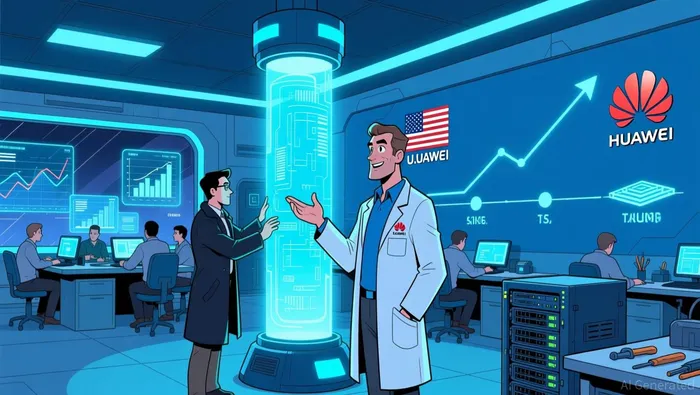
The bottom line is that NvidiaNVDA-- is being paid to build the infrastructure layer for China's AI expansion. By providing the most powerful chips approved for export, the company reinforces its position as the indispensable rails for the next paradigm. The concession accelerates adoption in a key market, but the underlying exponential growth in compute demand China faces will only highlight the performance ceiling its domestic alternatives hit. For now, the deal is a win for Nvidia's revenue, but a reminder that the true S-curve for AI dominance remains firmly in the hands of those who control the most advanced compute.
Adoption Mechanics and Infrastructure Impact
The approval is a green light for a massive, near-term compute build-out in China. The H200's architecture is purpose-built for the workloads driving this expansion. Its 141GB of HBM3e memory and 4.8 TB/s bandwidth directly address the bottlenecks that plague training next-generation large language models. This isn't incremental improvement; it's the performance leap that makes training models with hundreds of billions of parameters feasible at scale. For Chinese tech giants like Alibaba and ByteDance, which have signaled interest in ordering more than 200,000 units each, the H200 is the preferred platform to close the gap with U.S. rivals. The deal accelerates adoption by providing the most powerful chips available for commercial use, effectively monetizing the infrastructure layer for China's AI ambitions.
Financially, the addressable market is staggering. Chief Executive Jensen Huang has stated that the AI chip segment alone could generate $50 billion in revenue for Nvidia in the coming years. This approval unlocks a significant portion of that potential. The U.S. government's 25 percent revenue stake ensures this is a direct financial flow, not just a strategic concession. For Nvidia, it translates to a multi-year revenue stream from a market it had been largely excluded from, providing a powerful tailwind for its data center growth.
Yet the infrastructure impact reveals a critical constraint. China's push for self-sufficiency is a double-edged sword. While the H200 chips can be imported, the country's new mandate requires chipmakers to use at least 50% domestically made equipment for new capacity. This rule, aimed at weaning the industry off foreign technology, will constrain its ability to scale AI chip production even with imported H200s. The domestic equipment ecosystem is still maturing, and this policy forces fabs to prioritize local suppliers, potentially slowing the overall build-out of AI compute capacity. It's a friction point that tempers the exponential adoption curve.
The bottom line is a race between two forces. On one side, the H200's superior performance and the massive Chinese market drive rapid adoption, boosting Nvidia's revenue. On the other, China's own industrial policy creates a bottleneck in scaling the physical infrastructure needed to deploy those chips. For now, the approval is a win for Nvidia's financials and a strategic move to capture the commercial S-curve. But the long-term trajectory depends on whether China can overcome its domestic equipment constraints fast enough to fully exploit the compute power it's now allowed to import.
Catalysts, Risks, and the Long-Term S-Curve
The near-term thesis hinges on a single, concrete catalyst: the actual implementation of this approval this quarter. This will be the first real test of the new U.S. revenue-sharing model and China's domestic equipment mandate. If orders from giants like Alibaba and ByteDance materialize at scale, it will validate the pay-to-play scheme and provide a clear financial tailwind for Nvidia. The key watchpoint will be the pace of deployment and the reported use of domestic equipment, which could reveal friction in the build-out.
The primary risk that could derail this near-term setup is China's own self-sufficiency drive. The country is accelerating its domestic chipmaking to eventually bypass the need for imported H200s. This isn't a distant threat; it's a central pillar of its 2026–2030 roadmap, with a focus on achieving independence in core equipment and materials. A potential $70 billion incentive round for the industry would supercharge this effort. If successful, it would create a domestic ecosystem capable of producing chips that could one day match the H200's performance, undermining Nvidia's commercial foothold in China. The risk is not just competition from Huawei, but the long-term erosion of the market itself.
Yet Nvidia's long-term advantage lies in its software ecosystem and the exponential adoption curve of its AI platform. China's infrastructure build-out, even with imported H200s, must still integrate with Nvidia's CUDA and other tools to be effective. This creates a sticky dependency that is harder to break than a hardware supply chain. The performance gap is widening, not closing. While China scales its domestic capacity, it will still need the most powerful chips for its most advanced models. Nvidia's role is not just selling hardware; it is providing the fundamental rails for the next paradigm. The near-term deal is a win, but the long-term S-curve for AI dominance remains defined by who controls the most advanced compute and the software that runs on it.





Comentarios
Aún no hay comentarios