
Is Nvidia Forming a Top Pattern Amid Record Earnings and AI Sector Volatility?
Nvidia's Q3 FY 2026 earnings report delivered a masterclass in fundamental strength, with Data Center revenue surging to $51.2 billion-a 66% year-over-year increase and 25% quarter-over-quarter growth. This performance, driven by Blackwell GPU demand and AI agent workloads, underscores the company's dominance in the AI infrastructure race. Yet, the stock's 3.15% post-earnings decline and growing concerns about an "AI bubble" have sparked a critical question: Is Nvidia's stock forming a top pattern as it navigates explosive growth and sector-wide volatility?
Fundamental Strength: A House Built on Blackwell
Nvidia's Data Center segment now accounts for 89.8% of total revenue, with Blackwell-based GB300 systems selling out and cloud GPU demand described as "off the charts" by CEO Jensen Huang. Networking revenue alone jumped 162% year-over-year to $8.2 billion, powered by NVLink compute fabrics. These figures validate the company's strategic pivot to AI, where it holds a near-monopoly on high-performance computing.
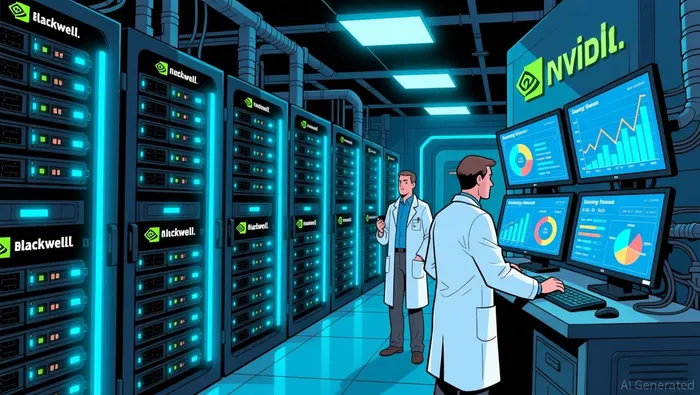 The Q4 guidance of $65 billion in revenue-well above the $60.3 billion Zacks Consensus Estimate-further reinforces confidence in the business model. Non-GAAP gross margins are projected to hit 75%, and institutional analysts remain overwhelmingly bullish, with 73 out of 80 rating the stock a "Buy" and a median price target of $233.97. By these metrics, Nvidia's fundamentals appear unshakable.
Technical Analysis: A Tense Dance with the 200-Day SMA
Despite robust earnings, technical indicators suggest growing unease. Nvidia's stock has approached its 200-day simple moving average, a critical psychological level for trend-following investors. A break below this threshold could trigger a bearish reversal, while a rebound might reaffirm the uptrend.
Recent chart patterns have also raised red flags. A potential head-and-shoulders formation-a classic bearish reversal-has begun to emerge, with the stock's post-earnings reversal signaling short-term profit-taking. Options-implied volatility suggests a ±6% price swing ahead, amplifying the risk of a sharp correction if sentiment shifts.
AI Sector Volatility: The Bubble Debate Intensifies
The broader AI sector's turbulence cannot be ignored. The S&P 500's forward P/E ratio exceeded 40 in late 2025, a level last seen during the dot-com bubble. Prominent investors like Howard Marks and Bill Gates have warned of speculative overreach, while Oracle's December 2025 earnings-revealing $10 billion in AI-related capital expenditures-sparked a sector-wide sell-off.
Nvidia, as the AI sector's bellwether, is uniquely vulnerable. While its financials remain pristine, the market is pricing in a future where AI-driven growth translates to sustainable profits. If demand for Blackwell GPUs slows or if AI infrastructure costs outpace monetization, the stock could face a reckoning.
The Verdict: Sustainable Growth or a Correction Looming?
Nvidia's fundamentals are undeniably strong, but technical and macroeconomic factors suggest caution. The stock's proximity to key support levels and the emergence of potential top patterns signal a critical inflection point. Meanwhile, the AI sector's valuation exuberance-coupled with shifting investor sentiment toward traditional sectors like industrials and utilities-heightens the risk of a pullback.
For investors, the key is to balance optimism with prudence. Nvidia's Q4 guidance and Blackwell adoption trajectory remain compelling, but the market's reaction to its earnings-despite record results-reveals underlying fragility. As the 200-day SMA looms and the AI bubble debate intensifies, the coming weeks will test whether this is a temporary correction or the early stages of a larger reversal.





Comentarios
Aún no hay comentarios