
Nvidia's Earnings Surge and the Asia-Pacific Tech Crossroads: Navigating AI Demand Amid Geopolitical Tensions
Japan's GDP Slowdown: A Drag on AI Investment?
Japan's economic trajectory in 2025 has introduced uncertainty into the APAC tech market. According to a Bloomberg report, the country's GDP slowdown has tempered domestic investment in high-growth sectors like AI, potentially reducing demand for semiconductors. While Japan remains a critical hub for advanced manufacturing and R&D, its cautious fiscal policies and aging population are creating headwinds for capital-intensive industries. This dynamic contrasts with the broader APAC region, where countries like India and Indonesia are aggressively expanding AI infrastructure.
Foxconn, a key supplier to NvidiaNVDA--, provides a microcosm of this tension. The Taiwanese firm reported a 17% increase in Q3 net profit, attributed to sustained demand for AI servers. However, its performance also highlights the fragility of the APAC supply chain: if Japan's economic stagnation spreads to its industrial partners, it could indirectly weaken demand for Nvidia's chips in the region.
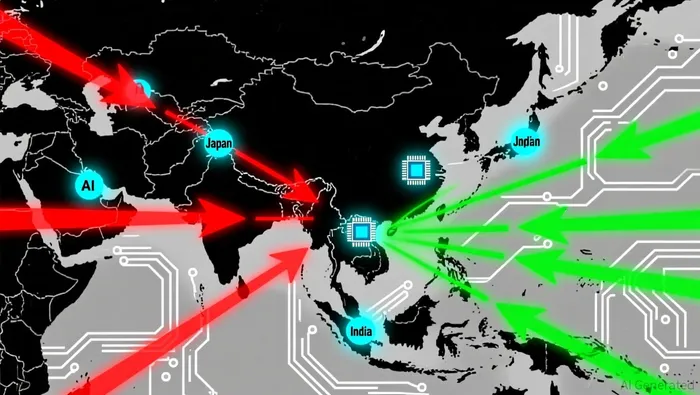
China's Geopolitical Gambit: A Double-Edged Sword
China's role in the APAC semiconductor market remains a wildcard. Despite U.S. export restrictions on advanced H20 chips, Chinese firms like Huawei are developing alternative AI technologies to reduce reliance on Western suppliers. Huawei's upcoming AI infrastructure, which promises to optimize GPU utilization rates from 30-40% to 70%, could disrupt Nvidia's dominance in the region. This shift aligns with broader efforts to localize AI capabilities, a trend accelerated by U.S. export controls and geopolitical friction.
Nvidia's strategic pivot to export throttled-down H20 chips to China in August 2025 initially seemed promising, but the move backfired when the Chinese Cyberspace Administration banned their purchase by September 17. This decision exposed the fragility of Nvidia's corporate strategy, which relied on maintaining a performance gap between its chips and Chinese alternatives. The fallout underscores a broader truth: in an era of decoupling, even commercial partnerships are increasingly entangled with national security agendas.
APAC's Semiconductor Resilience: India and Indonesia Lead the Charge
Amid these challenges, countries like India and Indonesia are redefining the APAC semiconductor landscape. India's government has prioritized AI infrastructure development, with cloud providers and industrial manufacturers adopting Nvidia's accelerated computing solutions. Similarly, Indonesia's growing industrial base is driving demand for AI-driven predictive maintenance systems, a trend highlighted by Hitachi's expansion in the region according to Nvidia's Q3 results.
However, geopolitical tensions are reshaping supply chains. Singapore-based Frencken, a semiconductor company with operations in Indonesia, reported a 7.5% rise in Q3 net profit but warned of "volatile geopolitical tensions" affecting business confidence. The firm's cautious outlook reflects a broader industry shift: APAC semiconductor strategies are increasingly focused on resilience over efficiency, with countries investing in localized production and strategic stockpiles.
Strategic Implications for Investors
Nvidia's Q3 earnings demonstrate its unparalleled position in the AI semiconductor market, but the company's long-term prospects in APAC hinge on navigating three key risks:
1. Japan's Economic Stagnation: A prolonged slowdown could dampen demand for AI infrastructure in the region.
2. China's Self-Reliance Push: Huawei's AI advancements and domestic chip development threaten Nvidia's market share.
3. Supply Chain Fragmentation: APAC countries are prioritizing geopolitical security over cost efficiency, complicating global trade dynamics.
For investors, the APAC semiconductor market remains a high-growth opportunity, but it requires a nuanced approach. While Nvidia's earnings suggest robust short-term demand, the interplay of economic and geopolitical forces will shape the sector's trajectory over the next decade.
Conclusion
Nvidia's Q3 2025 earnings highlight the company's central role in the AI revolution, but the Asia-Pacific market is a battleground of competing forces. Japan's economic slowdown, China's self-reliance drive, and APAC's strategic pivot toward resilient supply chains are creating a complex environment for semiconductor demand. Investors must weigh these factors carefully: while AI adoption is accelerating, the path to sustained growth in the region is anything but linear.





Comentarios
Aún no hay comentarios