
Nvidia’s Earnings Dilemma: A Contrarian Opportunity Amid AI Hype and Geopolitical Risk?
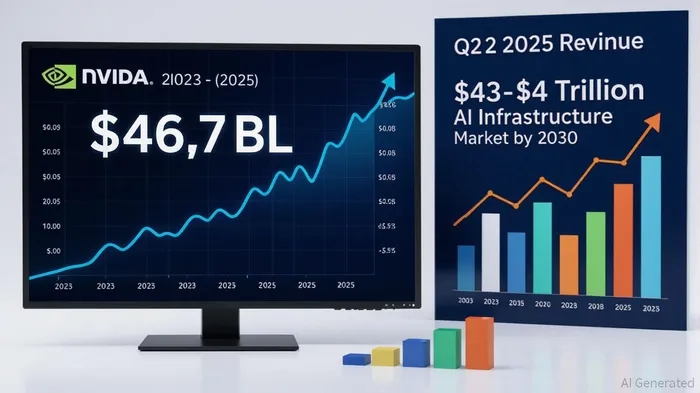
NVIDIA’s Q2 2025 earnings report revealed a striking paradox: record revenue of $46.7 billion, driven by a 56% year-over-year surge in data center sales, yet a 2% post-earnings stock decline [1]. This disconnect between financial performance and market reaction underscores a critical question for investors: Is the current pessimism over China-related risks and valuation concerns masking a contrarian opportunity in the AI infrastructure boom?
Earnings Outperformance vs. Market Pessimism
NVIDIA’s data center segment, which accounted for 88% of total revenue, grew 56% year-over-year to $41.1 billion, fueled by demand for its Blackwell architecture and AI superchips like the GB200 [1]. Despite exceeding Wall Street’s revenue and earnings expectations, the stock fell 4% in after-hours trading, reflecting investor anxiety over China’s market access. While the company reported no H20 sales to China in Q2, it benefited from $180 million in released H20 inventory [3]. The Trump administration’s recent policy shift—allowing H20 sales to China with a 15% revenue-sharing agreement—has created a hybrid model of trade and national security policy, potentially generating $2.3 billion for the U.S. Treasury in 2025 [5]. However, Chinese regulators have discouraged local firms from purchasing H20 chips due to security concerns, complicating NVIDIA’s path to market share recovery [5].
Geopolitical Risks and AI Demand Projections
The U.S.-China chip war remains a wildcard. While export controls have limited China’s access to advanced GPUs, they have also spurred domestic innovation. China’s AI infrastructure market is projected to grow from $8.17 billion in 2025 to $31.16 billion by 2030, a 30.69% CAGR, driven by AI adoption across industries [5]. NVIDIA’s leadership in CUDA-based AI training (75% of Chinese data centers still rely on its platform) positions it to benefit from this growth, even as it navigates regulatory hurdles [4]. The company’s upcoming B30A chip, designed to comply with U.S. export rules while competing in China, could unlock a $50 billion market opportunity [3].
Valuation and Analyst Sentiment
NVIDIA’s trailing P/E ratio of 58.64 and P/S ratio of 30.23 reflect a premium valuation, but these metrics are justified by its dominance in AI infrastructure and data center revenue growth [2]. Analysts remain overwhelmingly bullish, with 45 out of 46 surveyed assigning “Buy” or “Strong Buy” ratings and an average 12-month price target of $199.56 [1]. Notably, top analysts like C.J. Muse (Cantor Fitzgerald) and Tristan Gerra (Robert W. Baird) have raised targets to $240 and $225, respectively, citing Blackwell’s potential [4]. By 2030, optimistic assumptions project a $1,014 price target, assuming sustained AI adoption [2].
Contrarian Case for Long-Term Growth
The market’s short-term focus on China-related risks overlooks NVIDIA’s structural advantages. The AI infrastructure market is still in its early phase, with global spending expected to reach $3–4 trillion by 2030 [5]. NVIDIA’s $60 billion share repurchase authorization and 73.5% gross margins further reinforce its financial resilience [1]. While risks like U.S.-China tensions and competitive pressures from AMDAMD-- and IntelINTC-- persist, the company’s innovation pipeline (e.g., Blackwell, B30A) and strategic adaptability suggest it is well-positioned to navigate these challenges.
Conclusion
NVIDIA’s earnings dilemma—strong financials clashing with market pessimism—presents a compelling contrarian opportunity. The stock’s current valuation, while elevated, is supported by its leadership in AI infrastructure and long-term demand projections. Investors willing to look beyond near-term geopolitical noise may find value in NVIDIA’s ability to balance regulatory constraints with innovation, potentially capitalizing on a $3–4 trillion AI market. As Jensen Huang noted, “Everything’s sold out,” and the AI revolution is far from slowing [3].
**Source:[1] NVIDIANVDA-- Announces Financial Results for Second Quarter [https://nvidianews.nvidia.com/news/nvidia-announces-financial-results-for-second-quarter-fiscal-2026][2] NVIDIA CorporationNVDA-- (NVDA) Valuation Measures & Financial [https://finance.yahoo.com/quote/NVDA/key-statistics/][3] Nvidia Earnings: Investors Await Tech Giant's Q2 Report [https://www.investors.com/news/technology/nvidia-stock-nvidia-earnings-live-coverage/][4] Nvidia and AMD to Pay 15% of China Chip Sales to US [https://www.bbc.com/news/articles/cvgvvnx8y19o][5] AI Chips - China | Statista Market Forecast [https://www.statista.com/outlook/tmo/semiconductors/ai-chips/china]





Comentarios
Aún no hay comentarios