
Nvidia's DGX Spark: A Strategic Catalyst for Enterprise AI Adoption and Recurring Revenue Growth
The AI infrastructure market is undergoing a seismic shift, driven by enterprises' urgent need to localize high-performance computing for generative AI, data science, and edge applications. At the forefront of this transformation is NVIDIA's DGX Spark, a compact AI workstation that redefines accessibility to data-center-class AI capabilities. By democratizing access to petaflop-level performance in a desktop form factor, the DGX Spark not only accelerates enterprise AI adoption but also positions NVIDIANVDA-- to capitalize on recurring revenue streams through its ecosystem of software and cloud services.
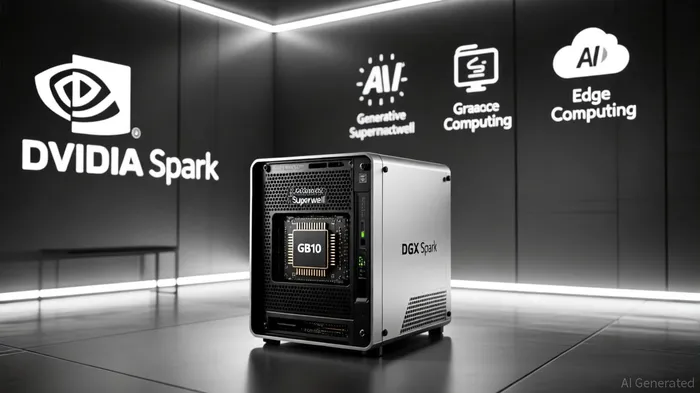
The DGX Spark: A Game-Changer for Local AI Workflows
The DGX Spark, powered by the GB10 Grace Blackwell Superchip, delivers up to 1 petaFLOP of AI performance and 128GB of unified LPDDR5x memory, enabling developers to prototype, fine-tune, and deploy models with up to 200 billion parameters directly from their desktops, according to an in-depth review. This eliminates the latency and complexity of transferring data between system memory and VRAM, a critical bottleneck for traditional GPUs, as noted in an Arm blog post. For enterprises, this means faster iteration cycles and reduced reliance on cloud infrastructure for initial model development-a shift that aligns with growing data privacy concerns and the need for on-premises governance, as described in a NVIDIA news release.
NVIDIA's strategic partnerships with Acer, ASUS, Dell, and other global manufacturers further amplify the DGX Spark's reach, ensuring availability in July 2025, according to an SLT Creative announcement. By embedding its Blackwell architecture into a consumer-friendly form factor, NVIDIA is effectively lowering the barrier to entry for AI adoption, particularly for mid-sized enterprises and academic institutions that previously lacked the budget or infrastructure for large-scale AI clusters, as highlighted on the NVIDIA product page.
Software Ecosystem: The Engine for Recurring Revenue
While the DGX Spark's hardware is impressive, its true value lies in NVIDIA's AI Enterprise software stack, a cloud-native platform optimized for end-to-end AI workflows, according to a CodingMall article. This includes tools for generative AI, data processing, and model customization, all integrated with frameworks like PyTorch, TensorFlow, and RAPIDS, as noted in an AMAX overview. For enterprises, the AI Enterprise suite offers a "build once, deploy anywhere" model, enabling seamless transitions between on-premises and cloud environments.
This software-centric approach is where NVIDIA's recurring revenue potential shines. According to a MarketsandMarkets report, the AI software market is projected to grow at a 37% CAGR through 2030. By bundling the DGX Spark with access to NVIDIA's AI Enterprise, NGC catalog, and inference microservices (NIM), NVIDIA creates a sticky ecosystem that locks in customers for long-term software subscriptions, as documented in the NVIDIA AI Enterprise docs. For instance, enterprises using the DGX Spark for edge-AI research may later scale to NVIDIA's DGX Cloud or on-premises data centers, generating additional revenue through cloud credits or enterprise licensing, as described on the DGX Cloud pricing page.
Hardware as a Gateway to Cloud and Subscription Services
The DGX Spark's pricing model-$2,999 for the standard edition and $3,999 for the Founders Edition-positions it as a one-time purchase, but NVIDIA's broader strategy extends beyond hardware. The device is designed to integrate with DGX Cloud, a service that allows users to offload compute-intensive tasks to NVIDIA's global infrastructure, as noted in a CyFuture price comparison. For organizations with variable workloads, this hybrid model offers flexibility: they can use the DGX Spark for prototyping and then scale to the cloud for deployment, paying only for the compute they consume, according to a Monexa analysis.
Moreover, the DGX Spark's ability to cluster with another unit via NVIDIA ConnectX-7 SmartNICs (handling models up to 405 billion parameters) opens new avenues for enterprise collaboration, an in-depth review also notes. This scalability, combined with NVIDIA's AI Enterprise software, creates a flywheel effect: the more enterprises invest in the DGX Spark, the more they become dependent on NVIDIA's ecosystem for advanced AI workflows.
Addressing Limitations: Memory Bandwidth and Market Competition
Critics argue that the DGX Spark's 273 GB/s memory bandwidth may lag behind competitors like Apple's M4 Max or AMD Ryzen AI MAX+ 395 for large-scale model inference, according to a Hardware Corner article. However, this limitation is mitigated by the device's focus on prototyping and edge-AI research, where unified memory access and compact form factors outweigh raw performance metrics, as the in-depth review observes. For models in the 7B-32B parameter range-common in enterprise applications like customer service chatbots or supply chain optimization-the DGX Spark demonstrates strong throughput when batching is utilized, the review further notes.
NVIDIA's competitive advantage lies in its ability to balance hardware innovation with ecosystem lock-in. While rivals may offer superior single-device performance, none match NVIDIA's breadth of software tools, partnerships, and cloud integration-a combination that ensures long-term customer retention.
Investment Implications: A Win-Win for NVIDIA and the AI Market
NVIDIA's FY2025 financials underscore the company's dominance in the AI infrastructure space, with revenue hitting $130.50 billion and a net income of $72.88 billion, according to Monexa's analysis. The DGX Spark, priced at a fraction of the cost of traditional AI supercomputers, is poised to expand this growth by targeting a broader audience. For investors, the device represents a dual opportunity:
1. Hardware Sales: The $3,000 price point is accessible for enterprises and researchers, driving unit volume.
2. Recurring Revenue: Software subscriptions, cloud services, and ecosystem expansion ensure sustained cash flows.
Conclusion
The DGX Spark is more than a hardware product-it is a strategic lever for NVIDIA to accelerate enterprise AI adoption while securing recurring revenue through its software and cloud ecosystem. By addressing the pain points of local AI development and offering a scalable path to cloud integration, NVIDIA is not just selling a workstation; it is selling a future where AI is as ubiquitous as electricity. For investors, this represents a compelling long-term bet on the AI infrastructure boom.





Comentarios
Aún no hay comentarios