
Nvidia and the China AI Chip Opportunity: A Strategic Buy Decision in 2026?
The U.S. government's recent policy shift to allow the export of advanced AI chips to China has reignited debates about the strategic value of investing in companies like NvidiaNVDA--. With the Trump administration rolling back Biden-era export controls, the resumption of H200 chip shipments to China-coupled with a 15-25% tax on these sales-signals a recalibration of U.S. technology policy that could reshape global AI dynamics. For investors, the question is whether this geopolitical pivot creates a near-term growth opportunity for Nvidia or exposes it to long-term risks as China accelerates its domestic semiconductor ambitions.
The Policy Shift: A New Era for U.S.-China Tech Trade
According to a report, the U.S. government has implemented a "pay-to-play" scheme to sell high-end AI chips to China, allowing approved Chinese firms to purchase Nvidia's H200 chip line, which is nearly six times as powerful as the H20 chip. This marks a departure from prior export control strategies and reflects a broader Trump administration effort to loosen restrictions on advanced AI hardware exports to China. Initial shipments, planned for mid-February 2026, are expected to range between 5,000 and 10,000 chip modules, equivalent to approximately 40,000 to 80,000 H200 chips. These deliveries will be drawn from existing inventory, with additional production planned for Q2 2026.
This policy shift is not without controversy. Critics argue that it risks enabling China to build large-scale AI data centers and enhance the competitiveness of its cloud providers. However, proponents view it as a pragmatic move to balance national security concerns with economic interests, particularly given the U.S. government's 15-25% tax on these chip sales.
China's Domestic AI Chip Landscape: Progress, But a Persistent Gap
Despite U.S. export controls, China's domestic AI chip production remains significantly behind that of U.S. firms like Nvidia. Huawei, one of the most advanced domestic producers, has not closed the performance gap and is projected to lag 17 times behind U.S. counterparts by 2027. While Huawei's Ascend 910B and 910C chips have shown improvements in compute power and energy efficiency, they still trail Nvidia's H20 in critical metrics. Alibaba's T-Head has developed the PPU chip, marketed as a direct competitor to the H20, and deployed it in its data centers. Baidu's third-generation P800 processors have also enabled a 30,000-chip cluster.
However, the United States continues to hold a substantial advantage in total compute capacity, producing at least twenty times as many chips (adjusted for performance) as Chinese producers in 2025. The gap in memory bandwidth and software ecosystems remains a significant challenge for China's AI chip industry.
Supply-Demand Dynamics: Bottlenecks and Growth Potential
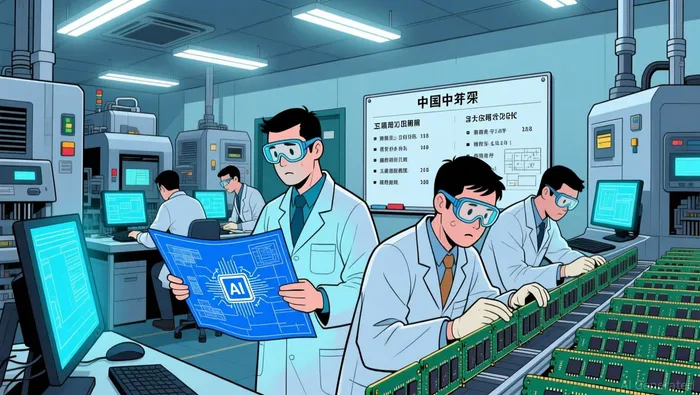 China's demand for AI hardware is expected to grow substantially, driven by the increasing complexity of AI models and the need for high-performance computing. However, this demand is constrained by supply bottlenecks, particularly in high-bandwidth memory (HBM), a critical component for AI accelerators. One major HBM supplier has already committed to full 2026 production and expects supply constraints to persist beyond that year. The HBM market is projected to grow from $35 billion in 2025 to $100 billion by 2028, highlighting its growing importance in AI infrastructure.
For Nvidia, the resumption of H200 shipments to China could partially offset the impact of these bottlenecks. Key Chinese tech firms, including Alibaba and ByteDance, stand to benefit from improved access to advanced AI hardware. However, Chinese authorities are cautious about the implications for domestic semiconductor development, as foreign-made high-performance chips could slow the growth of local industries.
Geopolitical Risks and Long-Term Outlook
The U.S. decision to allow the export of H200 chips to China represents a significant pivot in technology policy, reflecting broader geopolitical recalibrations under the Trump administration. This move enables China to access critical computing power, which had previously been restricted under the Biden administration's "small yard, high fence" strategy. The H200 chip is more than six times more powerful than the best currently available U.S. AI chip in China, significantly enhancing China's ability to develop advanced AI models and data centers.
However, this shift raises concerns about China's ability to scale its AI infrastructure and potentially challenge U.S. firms in global markets. In response, China has shown cautious interest, with regulators discussing potential restrictions on chip purchases and prioritizing domestic alternatives. Despite this, private demand from Chinese companies like DeepSeek, Tencent, and Huawei remains strong, underscoring the continued reliance on U.S. hardware for "frontier-level" AI progress.
Investment Implications: Balancing Growth and Risk
For investors, the near-term outlook for Nvidia appears favorable. The resumption of H200 shipments to China could drive revenue growth in 2026, particularly as Chinese firms seek to leverage advanced computing power for AI development. However, the long-term risks are clear: China's push for self-sufficiency in semiconductor production could reduce reliance on U.S. firms like Nvidia over time.
The key question is whether the immediate revenue boost from China outweighs the potential erosion of market share as Chinese companies close the performance gap. Given the current trajectory-where U.S. firms still hold a 20x advantage in compute capacity-the near-term benefits for Nvidia are compelling. Yet investors must remain vigilant about geopolitical shifts and China's progress in domestic production.
In conclusion, the U.S. policy pivot creates a strategic buy opportunity for Nvidia in 2026, provided investors are prepared to monitor evolving geopolitical dynamics and supply-side constraints. The company's ability to navigate these challenges while maintaining its technological edge will determine its long-term success in the China market.





Comentarios
Aún no hay comentarios