
Nvidia's CES 2026 Bet: Building the Physical AI Infrastructure Layer
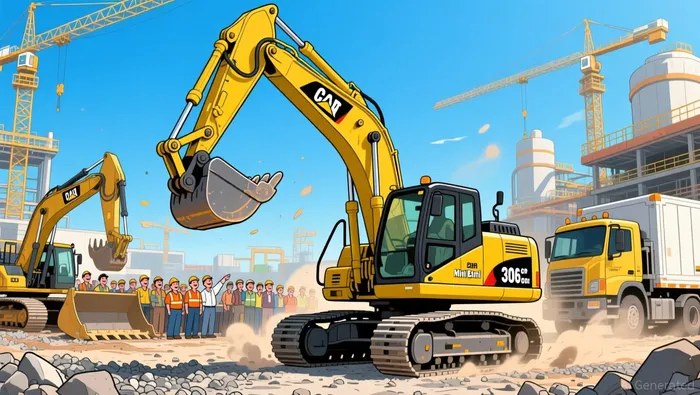
The real test of any paradigm shift is a live demo. At CES 2026, NvidiaNVDA-- and CaterpillarCAT-- delivered one that was impossible to ignore. It wasn't a sleek gadget on a table, but a six-ton Cat 306 CR Mini Excavator, its yellow steel frame dwarfing the stage. The moment the camera cut to the cab and an operator asked, "Hey Cat, how do I get started?" the future arrived in a natural voice. The machine's arm lifted in response. This was the first major commercial validation of physical AI, a live feed from the front lines of the industrial revolution.
Strategically, this demo is a masterstroke. It frames Nvidia's bet not on consumer gadgets, but on the fundamental infrastructure layer for an AI-driven physical world. Caterpillar, the top-performing Dow stock in 2025, is the ideal partner. As CEO Joe Creed stated, the company builds and powers the invisible layer of the world's modern tech stack. By collaborating with Nvidia, Caterpillar is explicitly positioning itself at the center of the AI revolution that moves beyond data centers to reshape factories, job sites, and supply chains. This isn't incremental improvement; it's the deployment of a digital nervous system for customers' jobsites.
The underlying technology stack makes this real-time interaction possible. The Cat AI Assistant runs on Nvidia's Jetson Thor platform, an edge AI system built for real-time inference in demanding industrial environments. This isn't cloud-dependent AI. The system leverages Nvidia's AI components like Riva for speech, Qwen3 4B for language understanding, and vLLM for efficient on-machine processing. As Caterpillar's VP noted, the goal is to get insights and take action while [operators] are doing the work, not after. This creates a closed loop of data and intelligence, where machines become active participants in the workflow.
For investors, this CES demo is a signal. It shows Nvidia is successfully translating its compute dominance into the physical S-curve, building the rails for an autonomous, AI-assisted industrial world. The partnership with a market leader like Caterpillar de-risks the rollout and provides a clear path to exponential adoption across a global fleet of machines. The live demo was just the start; the real growth curve begins when these AI assistants are deployed at scale.
The Infrastructure Layer: Nvidia's Role in the Physical AI S-Curve
Nvidia's role in the Caterpillar partnership is not that of a supplier, but of an infrastructure builder. The company is providing the fundamental compute and software stack that makes physical AI viable at scale. This mirrors its broader strategy of owning the foundational layer, whether for data centers or for machines in the dirt.
The core of this infrastructure is the NVIDIA Jetson Thor platform, which runs the Cat AI Assistant directly on the machine. This is critical for exponential growth. It enables real-time, on-machine inference, allowing the system to understand natural language commands and respond instantly without latency from a distant cloud. For operators working in harsh conditions, this immediacy is non-negotiable. The platform processes the AI agents' decisions locally, creating a closed loop where insights lead to action while the work is being done. This edge computing layer is the physical AI equivalent of a data center's GPU cluster, but deployed where the work happens.
Beyond the real-time compute, Nvidia's Omniverse library of simulation resources forms another key infrastructure layer. Caterpillar is using it to build digital twins of construction sites, which are essential for training and refining physical AI systems. These virtual replicas allow engineers to test scheduling scenarios, calculate material needs, and simulate operator interactions long before any physical changes are made. The data from real machines-sending roughly 2,000 messages per second-feeds these simulations, creating a powerful feedback loop. This mirrors Nvidia's own massive investments in AI infrastructure, where Omniverse is being used to design the next generation of data centers themselves.
This partnership is a direct extension of Nvidia's strategy of building the rails for the next paradigm. Just as the company is committing up to $100 billion to power OpenAI's next-generation data centers, it is now building the compute layer for the physical world. The goal is the same: to own the foundational infrastructure that enables exponential adoption. By providing the Jetson Thor platform and Omniverse tools, Nvidia is not selling a product; it is licensing the entire stack for a new S-curve. The Caterpillar demo is a live proof point that this infrastructure can work, and the partnership provides a clear path to deploy it across a global fleet of machines.
Financial Impact and Adoption Metrics
The true measure of this partnership's success lies not in stock charts, but in adoption rates and the tangible financial strength it leverages. For Caterpillar, the foundation is already robust. The company's $40 billion backlog in power generation applications is a major competitive strength and a clear indicator of sustained demand. This isn't just a pipeline for traditional mining and construction; it's a direct bet on the physical infrastructure required for the AI buildout. Every data center and power facility needs heavy machinery, and Caterpillar's backlog ensures it is positioned to supply that need for years to come.
The partnership's growth curve will be measured by the adoption rate of AI features across Caterpillar's massive global equipment fleet. The pilot on the Cat 306 CR Mini Excavator is just the start. The real exponential growth begins when these AI assistants are deployed at scale. The data from the machines themselves-roughly 2,000 messages per second sent back to the company-will be the fuel for this expansion. This closed-loop system, where real-time insights from the field directly improve the AI's capabilities, is the engine for rapid adoption. The goal is to get insights and take action while the work is being done, creating a powerful feedback loop that accelerates learning and deployment.
For Nvidia, the financial health to fund this infrastructure bet is undeniable. The company's stock is in a key technical "buy zone" between $174 and $182, a high-conviction area that has historically preceded significant upward momentum. This setup, coupled with a market cap that has surpassed $5 trillion, provides the capital to continue investing in the foundational layers for the next paradigm. The partnership with Caterpillar is a direct application of that capital, translating compute dominance into the physical S-curve. The financial metrics for both companies now point to a shared trajectory: Caterpillar's backlog funds the physical buildout, while Nvidia's capital and technology stack enable the AI layer that makes it smarter and more efficient. The bottom line is that the infrastructure for physical AI is being built, and the financial indicators suggest it is being built to scale.
Catalysts, Risks, and What to Watch
The CES demo was a proof point. The real investment thesis now hinges on execution and adoption. The forward path is defined by a set of clear catalysts that will validate the physical AI S-curve, balanced against tangible risks that could slow its exponential climb.
The primary catalyst is the commercial rollout of 'Cat AI' features. The pilot on the Cat 306 CR Mini Excavator is just the beginning. The partnership's success will be measured by how quickly these AI assistants are deployed across Caterpillar's global fleet. The goal, as stated by Caterpillar's VP, is to get insights and take action while [operators] are doing the work. This closed-loop system, where real-time data from machines fuels AI improvements, is the engine for rapid adoption. Broader adoption of AI in industrial workflows, as seen in the Siemens partnership, will follow as the value of this integrated stack becomes undeniable.
A second major catalyst is the integration of Nvidia's AI infrastructure into Caterpillar's manufacturing processes. The company is already using Nvidia's Omniverse library of simulation resources to build digital twins of construction sites. This is not just for training AI; it's for optimizing the physical world. By simulating scheduling and material needs, Caterpillar can design smarter machines and more efficient workflows. This integration turns the AI stack from a field service tool into a core part of the product lifecycle, accelerating innovation and deployment.
Yet the path is not without friction. The first risk is execution at scale. Deploying complex AI systems on six-ton machines in harsh, remote environments is a monumental engineering and logistical challenge. The high capital intensity of this infrastructure is another headwind. Nvidia's commitment to invest up to $100 billion in OpenAI for data centers sets a precedent for the scale of capital required to build the physical AI layer. This demands flawless execution and sustained funding.
The most significant risk, however, is adoption velocity. Industrial customers may move slower than expected, prioritizing reliability and ROI over cutting-edge features. The partnership must demonstrate clear, quantifiable gains in productivity or safety to overcome this inertia. The potential for slower-than-expected adoption of physical AI by industrial customers remains a key uncertainty.
For investors, the watchpoints are clear. First, monitor Caterpillar's $40 billion backlog in power generation applications and order trends. This is the financial fuel for the physical buildout and a leading indicator of demand for the AI-enabled equipment. Second, track Nvidia's data center revenue and the progress of its $100 billion investment in OpenAI's power infrastructure. This shows the company's ability to fund its foundational bets. Finally, watch for the pace of AI adoption metrics reported by industrial partners. The real-time data from machines-roughly 2,000 messages per second-will be the ultimate validation of the closed-loop system's effectiveness.







Comentarios
Aún no hay comentarios