
Nvidia CEO Praises TSMC, Confirms Six New Chips for Next-Gen AI Push
PorAinvest
domingo, 24 de agosto de 2025, 2:34 pm ET1 min de lectura
NVDA--
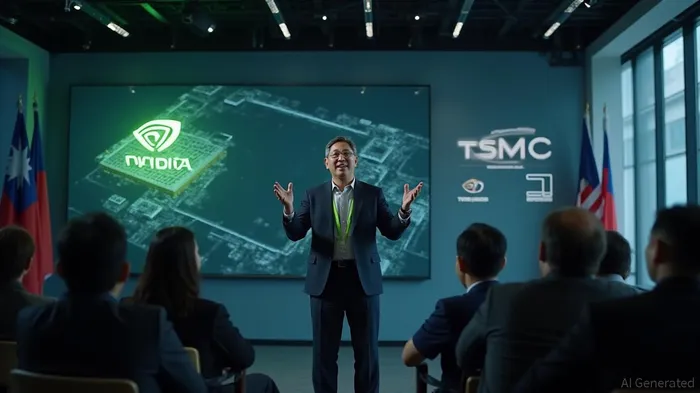
Huang confirmed that TSMC is building six new products for Nvidia, including a central processing unit (CPU) and a graphics processing unit (GPU) designed for advanced computing and AI. These new products are part of Nvidia's broader AI Factory vision, which aims to optimize end-to-end workflows for AI applications [2].
In addition to these developments, Nvidia plans to expand its presence in Taiwan with a new office. This move is part of the company's broader strategy to strengthen its supply chain and manufacturing capabilities in the region. However, Nvidia is also addressing concerns raised by Beijing over its H20 GPUs developed for China. The company has agreed to resume H20 chip sales in exchange for a 15% revenue share, indicating a willingness to navigate geopolitical tensions [1].
The collaboration between Nvidia and TSMC is a cornerstone of Nvidia's Rubin architecture, which leverages TSMC's N3P process and CoWoS-L packaging. This partnership ensures Nvidia can maintain its performance edge, with TSMC's 3nm and future 2nm technologies enabling higher transistor density and energy efficiency [2].
The Rubin architecture, set to debut in 2026, introduces several technical breakthroughs, including chiplet partitioning, HBM4 integration, and silicon photonics. These innovations position Nvidia to cement its dominance in the AI computing landscape, despite near-term headwinds and competition from AMD and Intel [2].
Financial analysts project that Nvidia's Q2 2026 revenue could reach $45.8 billion, a 52.4% year-over-year increase. This growth is driven by the Rubin architecture, which is expected to fuel Nvidia's transformation into an AI-centric juggernaut. However, investors must also consider potential risks, such as export restrictions to China and competition from AMD and Intel in cost-optimized inference markets [2].
In summary, Nvidia's collaboration with TSMC and the Rubin architecture represent a strategic pivot to dominate the next decade of AI. For investors with a long-term horizon, this opportunity presents a compelling case for sustained revenue growth, despite near-term challenges.
References:
[1] https://www.tradingview.com/news/gurufocus:6bffb1ea2094b:0-nvidia-confirms-tsmc-will-build-six-new-chips-for-its-next-gen-ai-push/
[2] https://www.ainvest.com/news/nvidia-rubin-architecture-tsmc-partnership-catalyst-long-term-ai-dominance-2508/
TSM--
Nvidia CEO Jensen Huang praised Taiwan Semiconductor Manufacturing (TSM) as one of the strongest companies in the industry, calling it a "smart" investment choice. Huang confirmed TSMC is building six new products for Nvidia, including a central processing unit and graphics processing unit designed for advanced computing and AI. Nvidia plans to expand its presence in Taiwan with a new office, while addressing concerns raised by Beijing over its H20 GPUs developed for China.
Nvidia CEO Jensen Huang recently lauded Taiwan Semiconductor Manufacturing (TSM) as one of the strongest companies in the industry, describing it as a "smart" investment choice. Huang's comments came during a trip to Taipei, where he thanked TSMC for its role in producing Nvidia's Rubin, the company's next-generation AI chip platform [1].Huang confirmed that TSMC is building six new products for Nvidia, including a central processing unit (CPU) and a graphics processing unit (GPU) designed for advanced computing and AI. These new products are part of Nvidia's broader AI Factory vision, which aims to optimize end-to-end workflows for AI applications [2].
In addition to these developments, Nvidia plans to expand its presence in Taiwan with a new office. This move is part of the company's broader strategy to strengthen its supply chain and manufacturing capabilities in the region. However, Nvidia is also addressing concerns raised by Beijing over its H20 GPUs developed for China. The company has agreed to resume H20 chip sales in exchange for a 15% revenue share, indicating a willingness to navigate geopolitical tensions [1].
The collaboration between Nvidia and TSMC is a cornerstone of Nvidia's Rubin architecture, which leverages TSMC's N3P process and CoWoS-L packaging. This partnership ensures Nvidia can maintain its performance edge, with TSMC's 3nm and future 2nm technologies enabling higher transistor density and energy efficiency [2].
The Rubin architecture, set to debut in 2026, introduces several technical breakthroughs, including chiplet partitioning, HBM4 integration, and silicon photonics. These innovations position Nvidia to cement its dominance in the AI computing landscape, despite near-term headwinds and competition from AMD and Intel [2].
Financial analysts project that Nvidia's Q2 2026 revenue could reach $45.8 billion, a 52.4% year-over-year increase. This growth is driven by the Rubin architecture, which is expected to fuel Nvidia's transformation into an AI-centric juggernaut. However, investors must also consider potential risks, such as export restrictions to China and competition from AMD and Intel in cost-optimized inference markets [2].
In summary, Nvidia's collaboration with TSMC and the Rubin architecture represent a strategic pivot to dominate the next decade of AI. For investors with a long-term horizon, this opportunity presents a compelling case for sustained revenue growth, despite near-term challenges.
References:
[1] https://www.tradingview.com/news/gurufocus:6bffb1ea2094b:0-nvidia-confirms-tsmc-will-build-six-new-chips-for-its-next-gen-ai-push/
[2] https://www.ainvest.com/news/nvidia-rubin-architecture-tsmc-partnership-catalyst-long-term-ai-dominance-2508/
Divulgación editorial y transparencia de la IA: Ainvest News utiliza tecnología avanzada de Modelos de Lenguaje Largo (LLM) para sintetizar y analizar datos de mercado en tiempo real. Para garantizar los más altos estándares de integridad, cada artículo se somete a un riguroso proceso de verificación con participación humana.
Mientras la IA asiste en el procesamiento de datos y la redacción inicial, un miembro editorial profesional de Ainvest revisa, verifica y aprueba de forma independiente todo el contenido para garantizar su precisión y cumplimiento con los estándares editoriales de Ainvest Fintech Inc. Esta supervisión humana está diseñada para mitigar las alucinaciones de la IA y garantizar el contexto financiero.
Advertencia sobre inversiones: Este contenido se proporciona únicamente con fines informativos y no constituye asesoramiento profesional de inversión, legal o financiero. Los mercados conllevan riesgos inherentes. Se recomienda a los usuarios que realicen una investigación independiente o consulten a un asesor financiero certificado antes de tomar cualquier decisión. Ainvest Fintech Inc. se exime de toda responsabilidad por las acciones tomadas con base en esta información. ¿Encontró un error? Reportar un problema


SOBRE NOSOTROS
Nuestra historiaAutores de noticiasBase de conocimientosPolítica de privacidadTérmino de usoDescargo de responsabilidad de corretaje de tercerosTérminos de uso de AIMEDivulgaciones de riesgos de AInvest AICarrerasCONTÁCTENOS
Email: support@ainvest.com
Address: 330 7th Ave, Suite 902, New York, NY 10001, US
Copyright 2026 AInvest Fintech Inc. All rights reserved.


Comentarios
Aún no hay comentarios