
"Nvidia CEO Huang Delivers GTC Keynote: Analysts' Initial Reaction"
Generado por agente de IATheodore Quinn
martes, 18 de marzo de 2025, 7:36 pm ET1 min de lectura
NVDA--
Nvidia CEO Jensen Huang took the stage at the GPU Technology Conference (GTC) 2025, delivering a keynote address that was both energetic and packed with announcements. The event, held at the SAPSAP-- Center in San Jose, California, was a showcase of Nvidia's latest advancements in AI and semiconductor technology. However, the market's reaction to Huang's presentation was mixed, with some analysts expressing disappointment and others remaining bullish on the company's future prospects.
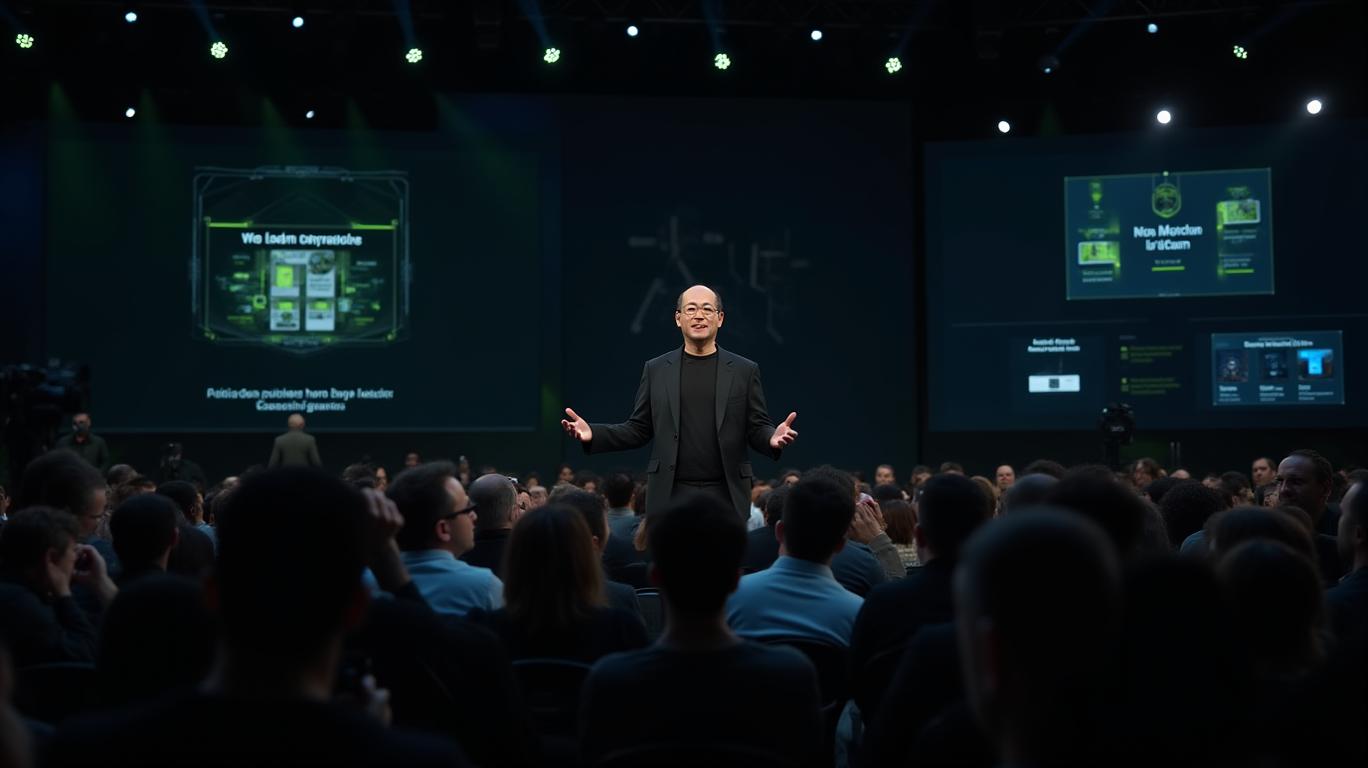
One of the key takeaways from Huang's keynote was the emphasis on the need for massive computing power to support the current trajectory of artificial intelligence. Huang stated that AI is moving toward AI agents and reasoning, which requires significant computational resources. This focus on increased computing power aligns with Nvidia's long-term strategic goals of advancing AI capabilities and maintaining its leadership in the semiconductor industry.
Nvidia unveiled several new products during the keynote, including the next-generation line of chips, such as the Black Ultra chips, and a new lineup of "AI personal supercomputers" powered by the Grace Blackwell chip platform. These announcements were aimed at reassuring investors of Nvidia's dominance in the rapidly evolving AI landscape. However, the market's reaction was less than enthusiastic, with Nvidia's stock falling after the GTC event. This suggests that investors were hoping for more groundbreaking announcements and were disappointed by the lack of fresh developments.
Despite the market's initial reaction, some analysts remain bullish on Nvidia's future prospects. Bernstein Research Senior Analyst Stacy Rasgon has an "outperform" rating and a $185 price target on NvidiaNVDA--, indicating that the company is well-positioned to maintain its leadership in the AI and semiconductor industries. Rasgon noted that "it's Nvidia's game to lose," suggesting that the company's strong position in the AI hardware market is unlikely to be challenged soon.
Nvidia's strategic partnerships with tech giants like Cisco and T-Mobile were also highlighted during the GTC event. These partnerships are crucial for integrating Nvidia's AI capabilities into various industries, from telecommunications to enterprise solutions. The company's collaboration with Yum! Brands to develop and scale AI technologies for its restaurants is another example of Nvidia's ability to expand its AI applications across diverse sectors.
In conclusion, while the immediate market reaction to Nvidia's GTC 2025 keynote was negative, there are still analysts who remain bullish on the company's future prospects. The strategic partnerships and the company's position in the AI sector suggest that Nvidia may still have significant growth potential. As the AI landscape continues to evolve, Nvidia's focus on increased computing power and its strategic partnerships are likely to enhance its competitive advantage and drive growth in the years to come.
Nvidia CEO Jensen Huang took the stage at the GPU Technology Conference (GTC) 2025, delivering a keynote address that was both energetic and packed with announcements. The event, held at the SAPSAP-- Center in San Jose, California, was a showcase of Nvidia's latest advancements in AI and semiconductor technology. However, the market's reaction to Huang's presentation was mixed, with some analysts expressing disappointment and others remaining bullish on the company's future prospects.
One of the key takeaways from Huang's keynote was the emphasis on the need for massive computing power to support the current trajectory of artificial intelligence. Huang stated that AI is moving toward AI agents and reasoning, which requires significant computational resources. This focus on increased computing power aligns with Nvidia's long-term strategic goals of advancing AI capabilities and maintaining its leadership in the semiconductor industry.
Nvidia unveiled several new products during the keynote, including the next-generation line of chips, such as the Black Ultra chips, and a new lineup of "AI personal supercomputers" powered by the Grace Blackwell chip platform. These announcements were aimed at reassuring investors of Nvidia's dominance in the rapidly evolving AI landscape. However, the market's reaction was less than enthusiastic, with Nvidia's stock falling after the GTC event. This suggests that investors were hoping for more groundbreaking announcements and were disappointed by the lack of fresh developments.
Despite the market's initial reaction, some analysts remain bullish on Nvidia's future prospects. Bernstein Research Senior Analyst Stacy Rasgon has an "outperform" rating and a $185 price target on NvidiaNVDA--, indicating that the company is well-positioned to maintain its leadership in the AI and semiconductor industries. Rasgon noted that "it's Nvidia's game to lose," suggesting that the company's strong position in the AI hardware market is unlikely to be challenged soon.
Nvidia's strategic partnerships with tech giants like Cisco and T-Mobile were also highlighted during the GTC event. These partnerships are crucial for integrating Nvidia's AI capabilities into various industries, from telecommunications to enterprise solutions. The company's collaboration with Yum! Brands to develop and scale AI technologies for its restaurants is another example of Nvidia's ability to expand its AI applications across diverse sectors.
In conclusion, while the immediate market reaction to Nvidia's GTC 2025 keynote was negative, there are still analysts who remain bullish on the company's future prospects. The strategic partnerships and the company's position in the AI sector suggest that Nvidia may still have significant growth potential. As the AI landscape continues to evolve, Nvidia's focus on increased computing power and its strategic partnerships are likely to enhance its competitive advantage and drive growth in the years to come.

Divulgación editorial y transparencia de la IA: Ainvest News utiliza tecnología avanzada de Modelos de Lenguaje Largo (LLM) para sintetizar y analizar datos de mercado en tiempo real. Para garantizar los más altos estándares de integridad, cada artículo se somete a un riguroso proceso de verificación con participación humana.
Mientras la IA asiste en el procesamiento de datos y la redacción inicial, un miembro editorial profesional de Ainvest revisa, verifica y aprueba de forma independiente todo el contenido para garantizar su precisión y cumplimiento con los estándares editoriales de Ainvest Fintech Inc. Esta supervisión humana está diseñada para mitigar las alucinaciones de la IA y garantizar el contexto financiero.
Advertencia sobre inversiones: Este contenido se proporciona únicamente con fines informativos y no constituye asesoramiento profesional de inversión, legal o financiero. Los mercados conllevan riesgos inherentes. Se recomienda a los usuarios que realicen una investigación independiente o consulten a un asesor financiero certificado antes de tomar cualquier decisión. Ainvest Fintech Inc. se exime de toda responsabilidad por las acciones tomadas con base en esta información. ¿Encontró un error? Reportar un problema


SOBRE NOSOTROS
Nuestra historiaAutores de noticiasBase de conocimientosPolítica de privacidadTérmino de usoDescargo de responsabilidad de corretaje de tercerosTérminos de uso de AIMEDivulgaciones de riesgos de AInvest AICarrerasCONTÁCTENOS
Email: support@ainvest.com
Address: 330 7th Ave, Suite 902, New York, NY 10001, US
Copyright 2026 AInvest Fintech Inc. All rights reserved.


Comentarios
Aún no hay comentarios