
Is Nvidia Still a Buy at a $4.5 Trillion Market Cap?
The question of whether NvidiaNVDA-- remains a compelling investment at its $4.5 trillion market cap hinges on two critical pillars: the sustainability of its growth in a maturing AI infrastructure cycle and the rationality of its valuation relative to industry benchmarks. As the AI revolution transitions from hype to hypergrowth, investors must dissect whether the company's dominance in data center and AI hardware can justify its premium multiples-or if the market is overestimating its long-term potential.
Growth Sustainability: A Tale of Two Forces
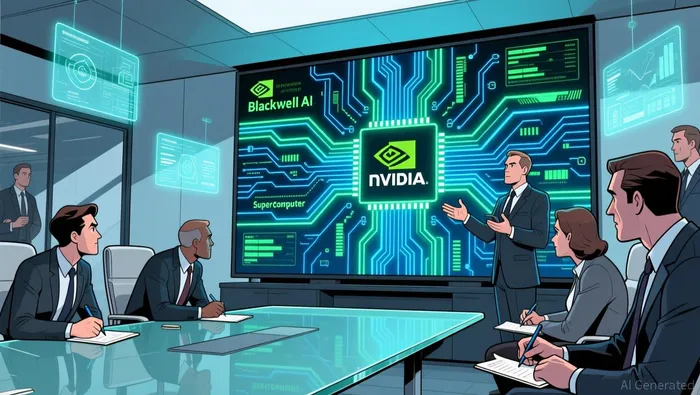
Nvidia's Q4 2025 results underscore its continued leadership in AI infrastructure. Data center revenue surged to $35.6 billion, a 93% year-over-year increase, driven by Blackwell AI supercomputer sales. This performance reflects the insatiable demand for AI compute power, particularly in training large language models and deploying edge AI in industrial applications according to market analysis. The global AI infrastructure market, valued at $26.18 billion in 2024, is projected to grow at a 23.8% compound annual rate through 2034, a trajectory that positions Nvidia to benefit from secular tailwinds.
 However, growth sustainability is not guaranteed. The maturation of the AI cycle introduces risks. For instance, Nvidia's gross margin declined to 73% in Q4 2025, down three points from the prior year, due to rising complexity and costs in data center products according to McKinsey analysis. This margin compression, coupled with the entry of formidable competitors like Alphabet and Amazon, could temper future growth. Alphabet's Tensor Processing Units (TPUs) and Amazon's Trainium3 chips are gaining traction, with AWS reporting a 150% quarter-over-quarter increase in AI chip adoption. These developments signal a shift toward self-sufficiency among cloud providers, which may reduce their reliance on third-party solutions like Nvidia's.
Valuation Rationality: Premiums and Perils
Nvidia's valuation metrics-trailing P/E of 45.8, forward P/E of 39.5, and P/S of 23.93 according to market commentary-are steep by historical standards. Yet, they are not anomalous in the context of the AI infrastructure sector. For example, Palantir Technologies, another AI-focused firm, trades at a trailing P/S of 109.64 and a P/E of 408.07 according to the same analysis, reflecting the market's willingness to pay for high-growth potential. Similarly, the "Magnificent 8" tech stocks, which include Nvidia, have driven S&P 500 earnings growth, with an average EPS increase of 17.6% in Q3 2025.
The key question is whether these multiples are justified. Nvidia's financials provide some support: its 53% net profit margin according to market commentary and 66% year-over-year data center revenue growth according to industry reports demonstrate exceptional operational leverage. However, the company's dominance is not absolute. Alphabet and Amazon are investing heavily in AI infrastructure, with Alphabet's cloud revenue growing 34% year-over-year and Amazon's AWS maintaining a 29% share of the global cloud market. These competitors are not only challenging Nvidia's market position but also reshaping the cost structure of AI compute, which could erode margins across the industry.
The Maturing Cycle: Opportunities and Risks
The AI infrastructure market is entering a phase of consolidation and efficiency. Governments are accelerating investments-such as the EU's €1.5 billion Horizon Europe program and the U.S. CHIPS Act according to market reports-to reduce reliance on foreign semiconductors. While this bodes well for Nvidia's long-term relevance, it also accelerates the development of alternative solutions. For example, Amazon's Trainium3, expected to deliver 40% better price-performance than its predecessor, could disrupt Nvidia's pricing power.
Moreover, the market's focus on energy efficiency and edge AI adoption according to industry analysis may shift demand toward specialized hardware, where Nvidia's general-purpose GPUs face steeper competition. This dynamic could fragment the AI infrastructure landscape, diluting the company's growth rates.
Conclusion: A Calculated Bet
Nvidia's $4.5 trillion valuation is a reflection of its unparalleled role in the AI revolution. Its financial performance, technological leadership, and the explosive growth of the AI infrastructure market justify a premium. However, the maturing cycle introduces uncertainties: margin pressures, competitive threats, and the need for continuous innovation. For investors, the decision to buy or hold hinges on whether they believe Nvidia can maintain its dominance while navigating these challenges.
In a market where the "Magnificent 8" continue to outperform, Nvidia remains a cornerstone. Yet, its valuation demands a high bar for execution. If the company can sustain its innovation edge and adapt to a more competitive landscape, the $4.5 trillion price tag may prove justified. If not, the risks of overvaluation could materialize.





Comentarios
Aún no hay comentarios