
Nvidia's AI21 Labs Acquisition: A Strategic Bet on AI Dominance and Valuation Resilience
Nvidia's reported $2 billion to $3 billion acquisition of AI21 Labs, an Israeli AI startup specializing in large language models (LLMs), marks a pivotal moment in the semiconductor industry's race to dominate AI infrastructure. This move, if finalized, would not only accelerate Nvidia's integration of critical AI talent and technology but also signal a broader shift in the competitive dynamics of the AI-driven semiconductor market. As the global AI chip market surges toward a projected $293 billion by 2030, Nvidia's strategic expansion into LLM development and talent acquisition underscores its ambition to cement itself as the de facto operating system for AI.
Strategic Rationale: Talent, Technology, and Ecosystem Control
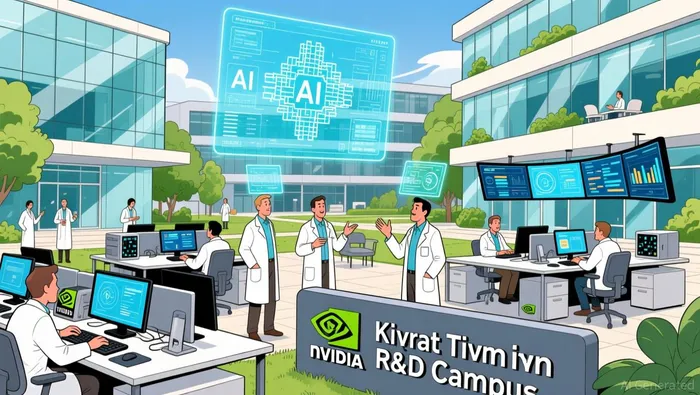
The acquisition of AI21 Labs aligns with Nvidia's long-term strategy to consolidate its leadership in AI by securing rare expertise and infrastructure in Israel, a hub for advanced AI research. AI21's 200-person workforce, including employees with advanced academic credentials, complements Nvidia's existing R&D efforts and its plans for a sprawling 10,000-employee R&D campus in Kiryat Tivon by 2031. This follows a pattern of strategic acquisitions in Israel, such as Mellanox and Deci, which have bolstered Nvidia's hardware-software integration capabilities.
Industry experts highlight that the deal's primary value lies in AI21's proprietary LLM technology, which could enhance Nvidia's offerings in enterprise AI solutions. As enterprises increasingly demand customized models for vertical applications, Nvidia's control over both the hardware (GPUs) and software (LLM frameworks) positions it to capture higher-margin segments of the AI value chain. This mirrors the company's recent pivot from being a fabless chip designer to a co-designer of entire system architectures, a shift that has historically driven revenue growth.
Competitive Positioning: NvidiaNVDA-- vs. TSMC, AMD, and Broadcom
Nvidia's aggressive expansion contrasts with the strategies of its peers. While TSMC, the world's largest semiconductor foundry, relies on its manufacturing prowess to serve a broad client base, including Nvidia itself, the latter's vertical integration strategy allows it to lock in demand for its chips through proprietary software ecosystems. TSMC's forward P/E ratio of 24.82 reflects its role as a critical enabler of AI growth but does not capture the same level of ecosystem control as Nvidia's end-to-end approach.
AMD, meanwhile, has made strides in the AI chip market with its Instinct series, but its reliance on third-party software ecosystems and limited in-house LLM development capabilities puts it at a disadvantage. Broadcom's strength in networking infrastructure and support for Google's TPUs positions it as a complementary player, but it lacks the unified hardware-software stack that Nvidia is now building.
The acquisition of AI21 Labs also amplifies Nvidia's lead over startups like Cerebras and traditional chipmakers. By integrating AI21's LLM expertise, Nvidia can address the growing demand for inference workloads-a segment where its recent $20 billion licensing deal with Groq further strengthens its position. This dual focus on training and inference ensures Nvidia remains indispensable to enterprises navigating the full AI lifecycle.
Valuation Implications: Growth, Risks, and Market Sentiment
Nvidia's valuation metrics remain robust despite its soaring market capitalization of $4.57 trillion. The company's three-year revenue growth of 70.5%, operating margin of 58.84%, and strong liquidity (current ratio of 4.47) underscore its financial health. Analysts like Restinglion argue that Nvidia's fair value is closer to $235 per share, citing its leadership in AI infrastructure and undervalued growth potential. However, discounted cash flow models suggest a fair value near $164.25, highlighting risks of overvaluation amid high expectations. This analysis draws on broader market dynamics including the projected 16.37% CAGR from 2025 to 2030 in the broader AI semiconductor market. However, challenges persist. Geopolitical tensions, supply chain vulnerabilities, and the rising R&D costs (now 52% of EBIT for the industry) could strain margins. Competitors like AMD and TSMC may also benefit from hyperscaler investments in custom chips, which could fragment demand.
Industry Dynamics: A Supercycle in the Making
The AI semiconductor market's 2025 performance-marked by a $208 billion Q3 revenue and 25.1% year-over-year growth-demonstrates the sector's resilience. Nvidia's Q3 2025 data center revenue of $30.8 billion (up 112% YoY) exemplifies its dominance, but the market is expected to face moderation in 2026 as growth shifts to PCs and smartphones. This underscores the importance of Nvidia's AI21 Labs acquisition in sustaining its momentum.
Conclusion: A Strategic Bet on the Future
Nvidia's acquisition of AI21 Labs is a calculated move to secure its position as the AI era's dominant force. By integrating cutting-edge LLM expertise, expanding its talent pool in Israel, and reinforcing its hardware-software ecosystem, Nvidia is positioning itself to outpace competitors in both innovation and market capture. While valuation risks exist, the company's financial strength and the AI semiconductor market's long-term growth trajectory justify its premium. For investors, this acquisition signals Nvidia's commitment to shaping the future of AI-and its willingness to pay a premium to get there.







Comentarios
Aún no hay comentarios