
Nvidia's AI-Driven Breakout: Unpacking the FOMO in Big Tech's Semiconductor Bet

The recent surge in Nvidia's stock price has become a defining story of 2025, fueled by a perfect storm of technical innovation, fundamental strength, and a broader market FOMO (fear of missing out) around AI. As the semiconductor industry pivots toward artificial intelligence, NvidiaNVDA-- has emerged not just as a beneficiary but as the de facto standard for AI infrastructure. This article dissects the catalysts driving Nvidia's momentum, from its financial performance and product roadmap to sector rotation trends and investor sentiment, while evaluating whether the stock's valuation reflects its long-term positioning in the AI era.
Fundamental Catalysts: Data Center Dominance and AI-Driven Revenue
Nvidia's Q2 2025 earnings report was a masterclass in execution. The company reported revenue of $46.7 billion, surpassing both its previous quarter's record of $44.1 billion and Wall Street's $46.05 billion forecast [2]. Nearly 88% of this revenue—$41.1 billion—came from the data center segment, underscoring its role as the engine of AI adoption. Adjusted earnings per share of $1.05 and net income of $25.78 billion further highlighted its pricing power and operational efficiency [2].
While these results reflect strong demand for AI infrastructure, historical data suggests caution for investors relying on short-term momentum. A backtest of Nvidia's earnings-beat events from 2022 to 2025 reveals that, on average, the stock declined by 0.3% on the day of the beat and underperformed the benchmark by 2.6% over 30 days, with no statistically significant outperformance observed in any post-event window[4]. This highlights the challenge of timing entry points in a stock where market expectations often anticipate strong results, leaving limited room for surprise-driven gains.
Analysts project this momentum to continue, with Nvidia's revenue expected to grow at a 23% annualized rate over the next three years, outpacing the semiconductor industry's 18% forecast [3]. This outperformance is driven by insatiable demand for AI training chips, particularly in large language models (LLMs), where Nvidia's GPUs remain the gold standard. The company's dominance in this niche is reinforced by its ecosystem of software tools (e.g., CUDA) and partnerships with cloud providers, creating a flywheel effect that locks in customers.
Technical Catalysts: Strategic Partnerships and AI-Optimized Innovation
Nvidia's technical edge is not just about hardware—it's about building an end-to-end AI infrastructure. A landmark example is its recent $100 billion partnership with OpenAI to deploy 10 gigawatts of AI data centers using NVIDIA systems. This collaboration, announced in Q3 2025, includes deploying millions of GPUs on the Vera Rubin platform, with the first gigawatt expected by late 2026 [1]. Such partnerships not only secure long-term revenue streams but also validate Nvidia's role as the backbone of next-generation AI.
At CES 2025, Nvidia further solidified its leadership by unveiling the GeForce 50 series for gaming and a partnership with Toyota for autonomous vehicles [3]. These moves signal a diversification strategy beyond data centers, tapping into AI's potential in consumer and industrial applications. Meanwhile, advancements in AI-driven Electronic Design Automation (EDA) tools—such as Synopsys's DSO.ai and Cadence's Cerebrus—are enabling faster, more efficient chip design cycles, indirectly benefiting Nvidia by accelerating the development of AI-optimized silicon [3].
Sector Rotation and Investor Sentiment: The AI Semiconductor Gold Rush
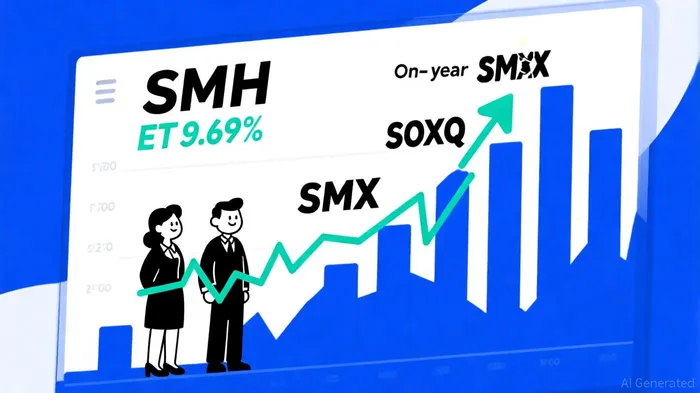
The semiconductor sector is undergoing a dramatic reallocation of capital. AI accelerators now account for 20% of the semiconductor market, with Nvidia at the forefront [1]. ETF flows reflect this shift: the VanEck Semiconductor ETF (SMH), heavily weighted toward Nvidia and TSMC, delivered a 39.69% one-year total return as of Q3 2025 [3]. Similarly, the iShares Semiconductor ETF (SOXX) has averaged 22.7% annual returns over the past decade, driven by AI and cloud computing demand [3].
This rotation is not just speculative—it's rooted in structural trends. Cloud providers plan to increase AI-related capital expenditures by 35% to 40% in 2025, while AI-optimized manufacturing processes (e.g., sub-3nm nodes at TSMC) are enabling higher performance and efficiency [1]. Even traditional players like AMD and Intel are pivoting toward AI-specific chips, but Nvidia's first-mover advantage and ecosystem lock-in make it the clear leader.
Challenges and Risks: Geopolitical Headwinds and Talent Constraints
Despite its dominance, Nvidia faces headwinds. Chinese government pressure on domestic firms to avoid certain AI processors has led to production halts for some of its chips, though analysts expect a resolution as Beijing seeks to balance AI ambitions with global supply chain realities [2]. Additionally, the semiconductor industry is grappling with a talent shortage and rising R&D costs, which could slow innovation cycles [1]. However, Nvidia's strong cash flow ($25.78 billion in Q2 2025 net income) provides a buffer to navigate these challenges.
Long-Term Positioning: The AI Semiconductor “Super Cycle”
Nvidia's trajectory aligns with a broader “super cycle” in AI semiconductors. Generative AI chip sales are projected to exceed $150 billion in 2025, driven by data centers, edge computing, and emerging applications like IoT [1]. The company's partnerships with OpenAI and Toyota, combined with its leadership in AI-optimized silicon, position it to capture a disproportionate share of this growth.
Moreover, AI is reshaping semiconductor design and manufacturing itself. AI-powered predictive maintenance and defect detection systems are improving yields at sub-3nm nodes, while advanced packaging technologies are enabling higher performance without relying on Moore's Law [3]. Nvidia's investments in these areas—both through its own R&D and strategic acquisitions—underscore its commitment to staying ahead of the curve.
Conclusion: Is the FOMO Justified?
Nvidia's breakout is not a flash in the pan but a reflection of its unparalleled role in the AI revolution. Its financial performance, technical innovations, and strategic partnerships create a self-reinforcing cycle of demand and growth. While risks like geopolitical tensions and talent shortages persist, the company's scale and ecosystem dominance provide a moat. For investors, the question is not whether AI will reshape the semiconductor industry—but whether they can afford to miss out on the company leading the charge.





Comentarios
Aún no hay comentarios