
Nvidia's AI Dominance Under Threat? Assessing the Risks and Opportunities in a Shifting Chip Market
Nvidia's Dominance: Built on Software and Hardware Synergy
Nvidia's success stems from its CUDA software ecosystem, which has become the de facto standard for AI development, and its cutting-edge hardware like the H100 GPU. Hyperscalers such as Microsoft and Alphabet have fueled demand, with Jensen Huang projecting $3–$4 trillion in annual AI infrastructure spending by 2030. However, this dominance is not without vulnerabilities. The company's stock price dipped 3.15% post-earnings in November 2025, reflecting investor anxiety over stretched valuations.
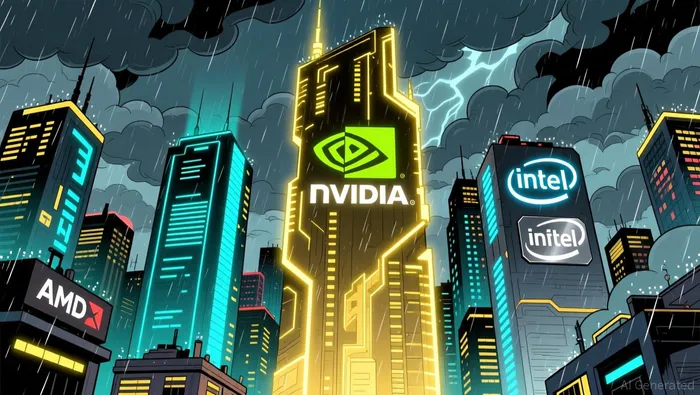
AMD and Intel: Closing the Gap with Cost and Execution
Advanced Micro Devices (AMD) and IntelINTC-- are narrowing the gap through aggressive strategies. AMD aims to capture 50% of CPU server revenue and 40% of client revenue within three to five years, while its MI300X GPU, with 192GB of HBM3 memory, directly challenges Nvidia's H100. Intel, meanwhile, is leveraging its 18A process technology and the Crescent Island AI chip, which offers 160GB of memory, to target cost-conscious enterprises. Analysts note that AMD's execution velocity and Intel's ability to overcome process delays will determine their success.
Emerging Competitors: Startups and Niche Players
Beyond AMDAMD-- and Intel, startups and niche players are entering the fray. While no single startup has yet disrupted the market, companies like PetVivo AI Inc. are leveraging AI in non-traditional sectors, such as veterinary care, to demonstrate the technology's versatility. However, these firms face significant hurdles, including limited capital and the need to compete with Nvidia's CUDA ecosystem. The sector's volatility-exemplified by a 5% drop in the PHLX Semiconductor Index following Nvidia's earnings-highlights the risks for smaller players.
Investor Sentiment: A Shift from Hype to Pragmatism
The AI semiconductor sector is experiencing a recalibration of investor sentiment. Despite Nvidia's stellar performance, fund managers are rotating capital into defensive sectors like healthcare, signaling skepticism about the sustainability of AI-driven growth. The Nasdaq Composite Index fell 2.2% in the wake of Nvidia's earnings, with pure-play AI software firms like C3.ai plummeting over 26% according to market analysis. This shift underscores a broader market reassessment of speculative valuations, particularly for companies lacking proven cash flows.
Strategic Responses and Long-Term Outlook
Nvidia's partnerships, such as its deal with Anthropic, aim to lock in long-term revenue streams, but the company must contend with rising competition. AMD's 60% projected AI GPU revenue growth and Intel's Crescent Island chip could erode Nvidia's margins if adopted widely. For investors, the key differentiator will be execution: AMD's ability to scale production and Intel's success in overcoming supply chain bottlenecks will shape the sector's dynamics.
In the long term, the AI semiconductor market is poised to grow to $697 billion by 2025, driven by insatiable demand for AI infrastructure. However, risks such as geopolitical supply chain disruptions and overbuilding remain. Nvidia's leadership is far from guaranteed, but its first-mover advantage in software and hardware integration provides a formidable moat.
Conclusion: Balancing Opportunity and Risk
Nvidia's dominance is under threat, but the market's current correction may present opportunities for disciplined investors. AMD and Intel's cost-effective alternatives and the sector's valuation reset could create entry points for long-term holders. However, the risks of an AI bubble and execution missteps by competitors cannot be ignored. As the industry evolves, the winners will be those who can innovate in energy efficiency, manufacturing, and software ecosystems-areas where Nvidia still holds a commanding lead.







Comentarios
Aún no hay comentarios