
Nvidia and Abu Dhabi's AI Robotics Lab: A Catalyst for Long-Term AI Infrastructure Growth
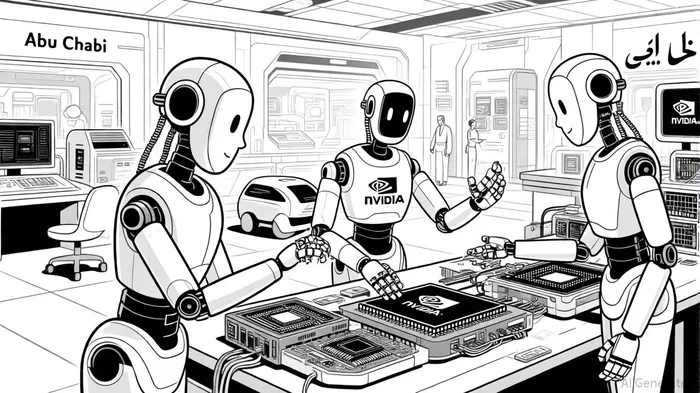
The strategic partnership between NvidiaNVDA-- and Abu Dhabi's Technology Innovation Institute (TII) represents a pivotal moment in the global AI and robotics landscape. By launching the Middle East's first joint AI and robotics research lab—the TII-NVAITC Joint Lab for AI and Robotics—the UAE is accelerating its ambition to become a technological powerhouse. This collaboration not only underscores the region's commitment to AI-driven industrial transformation but also positions Nvidia at the center of a rapidly expanding semiconductor demand driven by robotics, autonomous systems, and large-scale AI infrastructure.
Strategic Implications for AI Scalability and Robotics Adoption
The TII-NVAITC lab integrates Nvidia's accelerated computing platforms with TII's expertise in robotics and high-performance computing, focusing on embodied AI models, state-of-the-art robotics, and real-time hardware solutions[1]. Key projects include the development of humanoid robots, quadrupedal systems, and advanced robotic arms, all powered by Nvidia's Thor chip—a system-on-chip designed for real-time AI processing in robotics[2]. This partnership aligns with Abu Dhabi's broader vision to achieve technological sovereignty, as outlined in the UAE Vision 2031 and the National Artificial Intelligence Strategy[3].
The lab's emphasis on industrial applications—such as logistics, energy, and climate modeling—highlights the UAE's intent to deploy AI and robotics across critical sectors. For instance, Nvidia's Earth-2 platform, which uses AI to simulate climate phenomena, is already being leveraged to address environmental challenges in the UAE[4]. Such initiatives not only enhance operational efficiency but also create a sustained demand for high-performance semiconductors tailored to AI and robotics workloads.
Semiconductor Demand and Nvidia's Dominant Ecosystem
The global AI chip market is projected to reach $90 billion in 2025, driven by the need for advanced GPUs, TPUs, and accelerators to power AI workloads[5]. Nvidia, with over 80% of the AI GPU market share as of 2025, is uniquely positioned to capitalize on this growth[5]. The UAE's proposed deal to import 500,000 of Nvidia's most advanced AI chips annually—starting in 2025—further solidifies this trend[6]. Of these, 100,000 chips will directly support the Stargate UAE project, a 10-square-mile AI data center in Abu Dhabi expected to house 100,000 Nvidia GB300 GPUs by 2026[7]. This initiative alone will contribute to one of the world's top-five AI compute capacities, underscoring the UAE's strategic investment in semiconductor infrastructure.
Nvidia's dominance extends beyond traditional silicon. The company's “AI Factories” approach—combining hardware, software, and cloud services—ensures a sticky ecosystem for enterprises adopting AI and robotics. For example, the integration of Nvidia's Grace Blackwell architecture in the Stargate UAE project enables ultra-efficient data processing for AI simulations and autonomous systems[8]. This holistic strategy not only strengthens Nvidia's market position but also creates long-term revenue streams as industries scale their AI deployments.
Quantifying the Investment Thesis
The UAE's AI market is projected to grow from AED12.74 billion ($3.47 billion) in 2023 to AED170.14 billion ($46.5 billion) by 2030, at a compound annual growth rate (CAGR) of 44%[9]. This explosive growth is fueled by sovereign investments, including the Abu Dhabi-based MGX fund's AED367 billion ($100 billion) allocation to AI-related assets[10]. Such commitments ensure a steady pipeline of demand for semiconductors, particularly for applications in smart cities, energy optimization, and industrial automation.
Globally, the industrial AI and robotics market is expected to expand from $12.67 billion in 2025 to $52.72 billion by 2031, growing at a CAGR of 26.82%[11]. Nvidia's role in this expansion is critical: its chips power 80% of the world's top AI models, and its robotics platforms are being adopted by leading manufacturers[12]. The company's recent partnerships with UAE-based entities like G42 and Mubadala Investment Fund further amplify its exposure to this growth.
Risks and Regulatory Considerations
While the partnership presents significant growth opportunities, challenges remain. U.S. export controls on advanced GPUs have forced Nvidia to develop alternative chip variants (e.g., A800, H800) to maintain access to key markets[13]. Additionally, the semiconductor industry faces cyclical downturns and energy-intensive production constraints[14]. However, the UAE's strategic focus on AI infrastructure—backed by sovereign wealth and international alliances—mitigates many of these risks.
Conclusion
Nvidia's collaboration with Abu Dhabi's TII is more than a regional partnership; it is a catalyst for global AI infrastructure growth. By aligning with the UAE's ambitious AI and robotics strategies, Nvidia is securing a dominant role in a market poised for exponential expansion. As industrial sectors adopt AI-driven automation and the demand for advanced semiconductors surges, investors should view this partnership as a long-term growth driver for both the company and the broader AI ecosystem.





Comentarios
Aún no hay comentarios