
Nvidia's $5bn Strategic Bet on Intel: Reshaping the Semiconductor Ecosystem
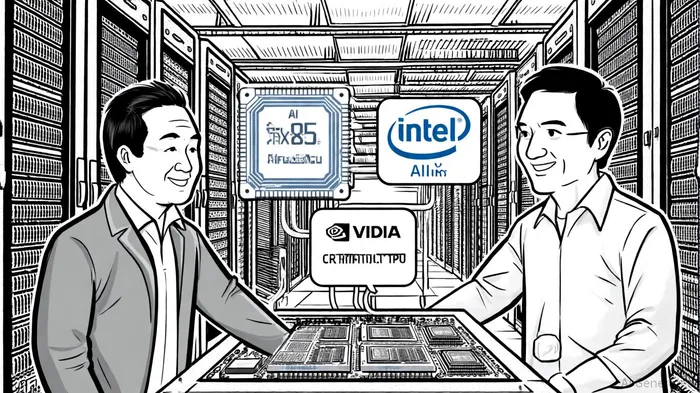
The semiconductor industry is undergoing a seismic shift as artificial intelligence (AI) redefines global demand for high-performance computing (HPC) and advanced chip architectures. At the heart of this transformation is Nvidia's $5 billion investment in IntelINTC--, a move that signals a strategic realignment of supply chain priorities and underscores the urgency of meeting AI-driven demand. By combining Intel's x86 manufacturing expertise with Nvidia's AI leadership, the partnership aims to address critical bottlenecks in the semiconductor ecosystem while reinforcing U.S. technological dominance.
AI-Driven Demand: A Catalyst for Industry Consolidation
The AI semiconductor market is surging, with global demand for AI and HPC applications projected to grow by over 15% in 2025[3]. This growth is fueled by the proliferation of generative AI, data center expansions, and the integration of AI into consumer electronics. According to a report by FusionWW, the semiconductor industry is witnessing a "renaissance" driven by the need for advanced node ICs, particularly for AI servers and high-end mobile components[3].
Key players like AMDAMD--, MicronMU--, and Samsung are already investing heavily in AI-optimized chips, but the demand outpaces supply. TSMCTSM--, the dominant foundry, is expected to capture 66% of the foundry market by 2025, driven by its leadership in advanced nodes like 3nm and 2nm[3]. However, the industry's reliance on a few key players for cutting-edge production—concentrated in Taiwan and the Americas—has exposed vulnerabilities in the global supply chain[1].
Supply Chain Consolidation: A Strategic Necessity
The Nvidia-Intel collaboration is emblematic of a broader trend: supply chain consolidation to meet AI's insatiable appetite for compute power. Intel, which has struggled with financial losses and workforce cuts in recent years[4], is now leveraging its x86 ecosystem to co-develop custom CPUs and system-on-chips (SOCs) with NvidiaNVDA--. These chips will integrate Nvidia's RTX GPU chiplets and NVLink interconnect technology, enabling seamless data transfer between CPUs and GPUs for AI workloads[1].
This partnership addresses a critical gap in the semiconductor supply chain. As noted by Design News, AI server volumes are growing at a 40–50% compound annual growth rate (CAGR), far outpacing the 4% annual growth of global wafer demand[1]. The result is a supply-demand mismatch that threatens to stifle innovation. By co-designing chips, Nvidia and Intel are not only accelerating time-to-market for AI infrastructure but also reducing dependency on third-party foundries for critical components[2].
Financial and Strategic Implications
Nvidia's $5 billion investment—purchased at $23.28 per share of Intel stock[2]—positions it as one of Intel's largest shareholders. For Intel, this infusion of capital provides a lifeline amid fierce competition from China's semiconductor industry and the rising costs of R&D in advanced nodes[3]. The deal also aligns with U.S. government efforts to bolster domestic semiconductor capabilities, as highlighted by Bloomberg's analysis of the partnership's geopolitical significance[5].
From an investment perspective, the collaboration reflects a shift toward vertical integration. As Deloitte notes, the semiconductor industry's 2025 outlook hinges on "advanced packaging technologies" like chiplets and stacked chips to meet AI demands[2]. Nvidia's integration of RTX GPU chiplets into Intel's x86 SOCs exemplifies this trend, enabling more efficient use of silicon real estate while reducing latency in AI applications[1].
Data Visualization: AI Semiconductor Market Growth and Supply Chain Trends
Conclusion: A New Era of Semiconductor Collaboration
Nvidia's strategic bet on Intel is more than a financial transaction—it is a recalibration of the semiconductor ecosystem to meet the demands of an AI-first world. By merging Intel's manufacturing prowess with Nvidia's AI stack, the partnership addresses supply chain fragility while accelerating the development of next-generation computing solutions. For investors, this collaboration underscores the importance of supply chain resilience and the need to prioritize companies that can navigate the dual pressures of AI-driven demand and geopolitical fragmentation.





Comentarios
Aún no hay comentarios