
Nvidia's $5B Impact: How AI Megatrends Are Reshaping Asia's Semiconductor Sector
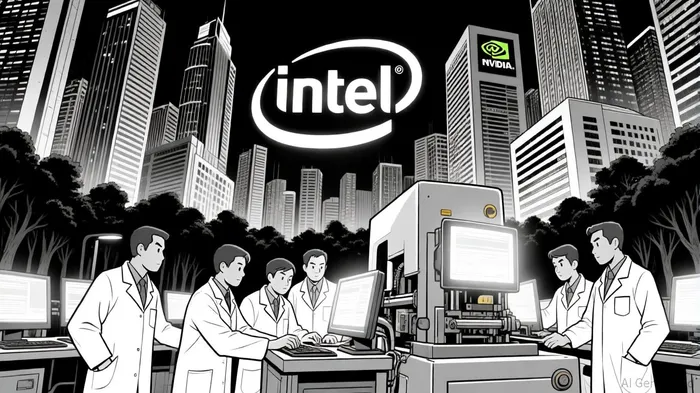
The semiconductor industry is undergoing a seismic shift as Nvidia's $5 billion investment in IntelINTC-- redefines the competitive and collaborative dynamics of the AI era. This partnership, announced in late September 2025, is not merely a financial transaction but a strategic realignment that underscores the growing interdependence between traditional computing architectures and AI-driven innovation. For investors, the implications are profound, particularly in Asia, where the semiconductor supply chain is evolving into a critical battleground for global tech dominance.
Strategic Rationale: A Fusion of Strengths
Nvidia's decision to inject $5 billion into Intel—securing a 4% stake—reflects a calculated move to diversify its manufacturing footprint and integrate Intel's x86 ecosystem into its AI infrastructure. According to a report by Reuters, the collaboration will see Intel design custom x86 CPUs for Nvidia's data centers and develop x86 system-on-chips (SOCs) that incorporate Nvidia's RTX GPU chiplets for personal computing[1]. This fusion of technologies aims to address the escalating demand for hybrid workloads, where AI inference and traditional computing coexist[3].
For Intel, the partnership provides a lifeline amid years of declining market share and operational losses. Analysts at Forbes note that the deal signals a broader industry trend: the shift from zero-sum competition to strategic alliances that pool resources to tackle complex technological challenges[3]. NvidiaNVDA--, meanwhile, gains access to Intel's extensive x86 ecosystem, potentially reducing its reliance on TSMCTSM-- and insulating itself from supply chain volatility[5].
Regional Ripple Effects: Asia's Semiconductor Ecosystem
The partnership's impact extends far beyond the U.S., with Southeast Asia emerging as a pivotal player in the new semiconductor landscape. Asian suppliers tied to Intel's supply chain, such as Japan's Lasertec Corp. and South Korea's Intekplus Co., have already seen stock price surges following the announcement[1]. This underscores the region's critical role in manufacturing and packaging advanced chips, a trend accelerated by geopolitical tensions and the U.S.-China tech rivalry.
Vietnam, in particular, is positioning itself as a semiconductor manufacturing hub. Government incentives, including covering up to 50% of initial investment costs for semiconductor projects, have attracted firms like Intel and Qualcomm[2]. By 2025, Vietnam aims to achieve full-spectrum semiconductor production, a goal that aligns with Nvidia and Intel's need for localized, high-capacity manufacturing[4]. Malaysia and Singapore, with their established infrastructure and skilled labor pools, are also expected to benefit from increased capital inflows and technology transfers[3].
Long-Term Capital Allocation: A New Paradigm
The Nvidia-Intel collaboration exemplifies a broader shift in capital allocation strategies within the semiconductor sector. Traditionally, companies invested heavily in vertical integration, but the rising complexity and cost of chip design and manufacturing have made partnerships more attractive. For instance, the integration of NVLink technology—Nvidia's high-speed interconnect—into Intel's CPUs demonstrates how cross-company innovation can accelerate time-to-market for next-generation solutions[1].
From an investment perspective, this partnership signals a pivot toward ecosystem-based value creation. As stated by TechCrunch, the deal could reduce Nvidia's exposure to single-point manufacturing risks while enabling Intel to leverage Nvidia's AI expertise to revitalize its product roadmap[2]. For Asian suppliers, the increased demand for specialized equipment and materials—from photolithography tools to advanced packaging technologies—creates a tailwind for long-term revenue growth[5].
Conclusion: A Megatrend-Driven Investment Opportunity
The Nvidia-Intel alliance is more than a corporate milestone; it is a harbinger of how AI megatrends will reshape global semiconductor dynamics. For investors, the key takeaway lies in the interplay between strategic sector momentum and regional specialization. Southeast Asia's role as a manufacturing nexus, coupled with the growing importance of AI infrastructure, positions the region as a high-conviction area for capital allocation.
However, risks remain. Regulatory scrutiny of cross-border investments, geopolitical tensions, and the pace of technological obsolescence could temper the partnership's potential. Yet, for those who recognize the inflection point in the semiconductor industry, the Nvidia-Intel deal offers a compelling case study in how strategic collaboration can unlock value in an era defined by AI.





Comentarios
Aún no hay comentarios