
Nvidia's $5 Billion Stake in Intel: A Strategic Lifeline with Material Financial Upside
The semiconductor industry in 2025 is defined by two forces: the explosive growth of AI-driven demand and the consolidation of market power among a handful of dominant players. Against this backdrop, Nvidia's $5 billion equity investment in Intel-completed in December 2025-stands out as a masterstroke of strategic capital allocation and sector alignment. By acquiring a 4.4% stake in IntelINTC-- through a private placement of 214.7 million shares at $23.28 apiece, NvidiaNVDA-- has not only secured a financial upside but also forged a partnership that could redefine the architecture of next-generation computing systems.
Strategic Rationale: Bridging Ecosystems in the AI Era
Nvidia's move is rooted in its broader strategy to dominate the AI semiconductor landscape. As stated by CEO Jensen Huang, the collaboration with Intel aims to "lay the foundation for the next era of computing" by integrating Nvidia's AI and accelerated computing stack with Intel's x86 architecture and manufacturing capabilities according to reports. This partnership includes co-development of custom data center and PC products, such as NVIDIA-designed x86 CPUs for AI infrastructure and system-on-chips (SoCs) that combine Intel CPU cores with Nvidia RTX GPU chiplets as detailed in a recent announcement.
The decision to partner with Intel reflects a calculated effort to address a critical gap in Nvidia's ecosystem. While Nvidia's GPUs have become the gold standard for AI training and inference, the x86 architecture-still dominant in enterprise and personal computing-remains a bottleneck for full-stack AI integration. By leveraging Intel's manufacturing expertise and x86 ecosystem, Nvidia can offer end-to-end solutions that span from CPU to GPU, reducing reliance on third-party components and capturing more value from the AI supply chain.
Sector Consolidation and Capital Allocation: Nvidia's Playbook
Nvidia's investment in Intel must be viewed through the lens of broader industry trends. According to a report by McKinsey, the top 5% of semiconductor firms generated all economic profit in 2024, while the remaining 95% saw declining value creation as revealed in their analysis. This concentration of power is accelerating in 2025, as AI-driven chip sales surge to over $150 billion, driven by data center expansions and demand for accelerators according to industry forecasts. 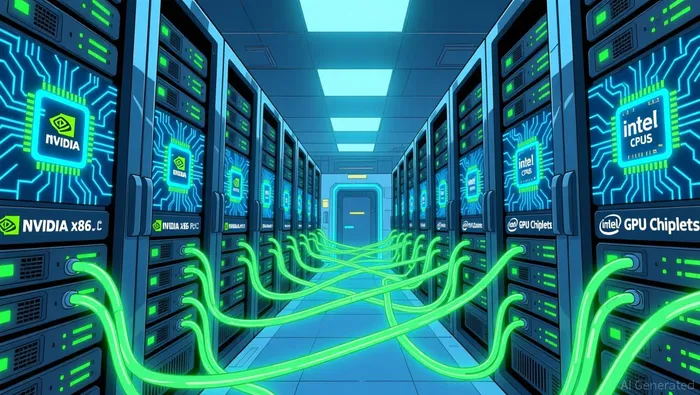 Nvidia, already a leader in this space, is doubling down on its dominance through strategic capital allocation.
The Intel deal complements Nvidia's recent $1 billion partnership with Nokia in the communications sector and its acquisitions of AI startups like Run:ai and OctoAI as reported by financial analysts. These moves underscore a dual strategy: (1) to expand Nvidia's hardware and software portfolio through innovation, and (2) to secure manufacturing and ecosystem partnerships that reduce bottlenecks. By investing in Intel, Nvidia is effectively insulating itself from potential supply chain disruptions while gaining a financial stake in a company that remains a linchpin of U.S. semiconductor manufacturing.
Financial Upside: A Lifeline for Intel, a Catalyst for Nvidia
For Intel, the $5 billion infusion is a lifeline. The chipmaker has struggled to transition to AI and cloud computing, with its financial metrics deteriorating amid capital-intensive manufacturing expansions and competition from ARM-based rivals as documented in market analysis. The partnership with Nvidia not only provides much-needed liquidity but also validates Intel's manufacturing capabilities, positioning it as a key player in the AI infrastructure market according to market observers.
From Nvidia's perspective, the investment offers a dual payoff. First, it gains a 4.4% equity stake in a company with a $114 billion market cap (as of December 2025), providing exposure to Intel's potential rebound. Second, the collaboration opens new revenue streams through co-developed products. For example, the integration of Intel's CPU cores with Nvidia's GPU chiplets could create a new category of hybrid SoCs tailored for AI workloads, capturing market share from competitors like AMD and Advanced Micro Devices.
Industry Implications: A New Era of Collaboration
The Nvidia-Intel alliance signals a shift in the semiconductor industry's competitive dynamics. Historically, these two companies were rivals in the x86 space, but the rise of AI has forced a realignment. As noted by Bank of America Securities, AI-related capital expenditures are projected to reach $1.2 trillion by 2030, with chip stocks like Nvidia poised to benefit disproportionately according to market research. By aligning with Intel, Nvidia is not only securing its own position in this growth cycle but also reshaping the industry's architecture to favor its technologies.
Moreover, the deal underscores the importance of vertical integration in the AI era. As AI workloads become more complex, the ability to optimize hardware-software ecosystems will determine market leadership.
Nvidia's partnership with Intel-coupled with its investments in communications infrastructure and AI startups-positions it to control multiple layers of the stack, from silicon design to cloud deployment.
Conclusion: A Win-Win in a Consolidating Sector
Nvidia's $5 billion stake in Intel is more than a financial transaction; it is a strategic maneuver to solidify its leadership in the AI semiconductor industry. By combining its AI expertise with Intel's manufacturing prowess, Nvidia is creating a new paradigm for computing that aligns with the sector's consolidation trends. For Intel, the partnership offers a path to relevance in the AI era, while for Nvidia, it represents a calculated bet on the future of computing. As the industry continues to consolidate, such alliances will likely become the norm-benefiting investors who recognize the value of strategic capital allocation in a rapidly evolving landscape.





Comentarios
Aún no hay comentarios