
Nvidia's $5 Billion Bet on Intel: A New Era in AI Chip Dominance
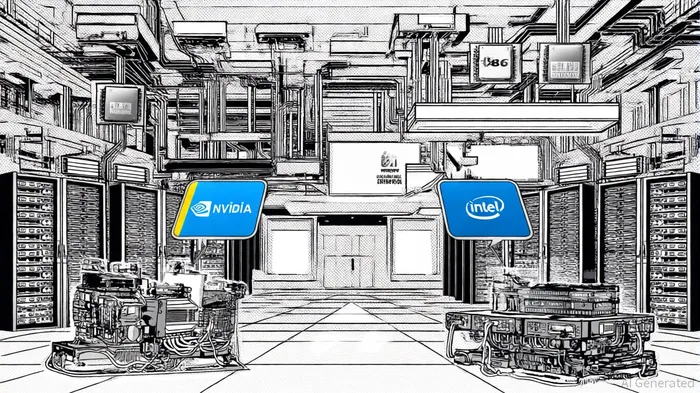
The semiconductor industry is witnessing a seismic shift as NvidiaNVDA-- and IntelINTC--, two titans with a history of rivalry, announce a $5 billion strategic partnership to co-develop AI infrastructure and personal computing products. This collaboration, unveiled on September 18, 2025, marks a pivotal moment in the AI chip market, where competition is giving way to specialization and mutual reinforcement. For investors, the implications are profound: the partnership not only reshapes the competitive landscape but also signals a broader industry trend toward strategic alliances in an era of escalating capital intensity and technological complexity.
Market Context: A $459 Billion Opportunity by 2032
The AI chip market is on an explosive growth trajectory. According to a report by CoherentCOHR-- Market Insights, the market size was valued at $83.80 billion in 2025 and is projected to surge to $459.00 billion by 2032, growing at a compound annual rate of 27.5% [1]. This expansion is driven by surging demand for AI-driven applications in hyperscale computing, edge devices, and enterprise solutions. NVIDIA, already a dominant force in AI GPUs, now seeks to extend its influence into Intel's stronghold—the x86 ecosystem—while Intel gains access to cutting-edge AI technologies to revitalize its foundry and design capabilities.
Key players in this space include AMDAMD--, Google, and Huawei, but NVIDIA's market share in AI GPUs remains unrivaled, fueled by its NVLink interconnect technology and CUDA ecosystem [2]. Meanwhile, Intel's CPU dominance in the x86 architecture provides a critical counterbalance. The partnership leverages these strengths: Intel will design custom data center CPUs with NVLink for AI infrastructure and integrate Nvidia RTX GPU chiplets into x86 SOCs for consumer PCs [3].
Strategic Implications: Collaboration Over Competition
The Nvidia-Intel allianceAENT-- reflects a strategic realignment in semiconductor leadership. For Intel, the partnership offers a lifeline during its corporate restructuring. By adopting NVLink for AI infrastructure, Intel is effectively ceding direct AI chip competition to focus on edge computing, x86 optimization, and cost efficiency [4]. For Nvidia, the collaboration expands its AI stack into Intel's vast server and PC ecosystems, enabling cross-platform integration without diverting resources from its core GPU innovations.
This shift underscores a broader industry trend: as chip fabrication costs soar (with 3nm and beyond requiring billions in R&D), pure competition is becoming unsustainable. Instead, firms are prioritizing specialization. As stated by Tim Bajarin in Forbes, “The Nvidia-Intel partnership signals a fundamental realignment in the semiconductor market, where collaboration will drive innovation in an increasingly capital-intensive landscape” [5].
Challenges and Opportunities
While the partnership is transformative, execution risks remain. Intel must rebuild its foundry credibility, having faced delays in advanced node production. Nvidia, meanwhile, must ensure seamless integration of its AI software stack with Intel's hardware. Additionally, geopolitical tensions—such as U.S.-China export controls and EU semiconductor sovereignty initiatives—could disrupt supply chains [1].
However, the potential rewards are immense. By 2030, the AI chip market is expected to reach $154 billion, with demand for energy-efficient, low-latency solutions accelerating in automotive, healthcare, and industrial sectors [2]. The partnership positions both firms to capture these opportunities, while forcing competitors like AMD and TSMCTSM-- to reassess their strategies.
Conclusion: A Win-Win for Investors
For investors, the Nvidia-Intel collaboration represents a dual opportunity. Nvidia's investment in Intel at $23.28 per share (valuing the stake at $5 billion) signals confidence in Intel's turnaround potential, while Intel gains access to Nvidia's AI roadmap. Together, they create a hybrid ecosystem that bridges the gap between AI infrastructure and personal computing. As the AI chip market matures, this partnership could set a precedent for industry-wide collaboration, redefining leadership in the semiconductor sector.
In an era where technological complexity and capital costs are soaring, the Nvidia-Intel alliance is not just a strategic move—it's a harbinger of the future.





Comentarios
Aún no hay comentarios