
Nvidia's $20B Groq Licensing Deal: A Strategic Power Move in the AI Inference Era
The $20 billion licensing agreement between NvidiaNVDA-- and Groq, announced in late 2025, is more than a transaction-it is a calculated, aggressive maneuver to cement Nvidia's dominance in the AI inference market. According to market analysis, the global economy is pivoting from AI training to real-time inference, and this deal positions Nvidia to capitalize on a sector projected to grow from $106.15 billion in 2025 to $254.98 billion by 2030, with a compound annual growth rate (CAGR) of 19.2%. By acquiring Groq's proprietary language processing unit (LPU) technology and key personnel, including founder Jonathan Ross and president Sunny Madra, Nvidia has not only neutralized a potential competitor but also fortified its position as the de facto infrastructure provider for the next phase of AI.
Strategic Rationale: Licensing Over Acquisition
Nvidia's decision to structure the deal as a non-exclusive license rather than a traditional acquisition is a masterstroke. It avoids antitrust scrutiny while enabling rapid integration of Groq's high-speed, energy-efficient LPU technology, which is optimized for low-latency applications like chatbots, robotics, and autonomous vehicles. This approach also allows Groq to remain an independent entity under new CEO Simon Edwards, preserving the illusion of competition while ensuring Nvidia gains exclusive access to Groq's intellectual property and talent. Analysts at Bernstein and Cantor have praised the move, noting that it "maintains the fiction of competition while securing critical assets."
Market Dynamics: Inference as the New Frontier
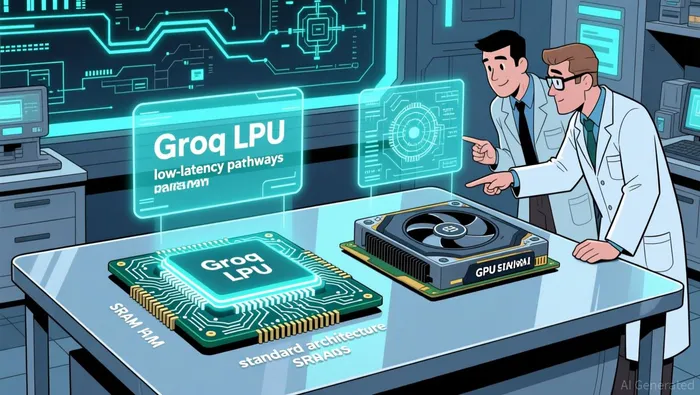
The shift from AI training to inference is reshaping the semiconductor industry. While training models like GPT-4 and Llama 3 requires massive computational power, inference-the deployment of these models in real-world applications-is where the money lies. By 2025, inference revenue already outpaces training revenue, and this trend is accelerating. Groq's LPU, with its on-chip SRAM architecture, addresses a critical bottleneck: the latency and energy inefficiency of GPU-based inference. Nvidia's integration of this technology into its product suite ensures it remains the go-to provider for enterprises demanding real-time decision-making, from healthcare diagnostics to fraud detection.
Financial Strength and Analyst Confidence
Nvidia's financials underscore the prudence of this deal. In Q3 2025, the company generated $22.1 billion in free cash flow, providing ample liquidity to fund the $20 billion transaction without straining its balance sheet. Wall Street analysts have responded with enthusiasm, with an average price target of $253.02 for Nvidia shares and 97% of analysts maintaining a "Buy" rating. Notably, Bernstein's Stacy Rasgon set a $275 price target, citing the deal as a "warning shot to AI rivals". Cantor and BofA Securities echoed this optimism, setting price targets of $300 and $275, respectively. These projections reflect confidence in Nvidia's ability to leverage Groq's technology to dominate the inference market, where it already holds a 46.5% share despite growing competition from application-specific integrated circuits (ASICs).
Competitive Positioning: Neutralizing Rivals
The Groq deal also serves as a strategic countermove against rivals like AMD, Cerebras, and hyperscalers such as Google and AWS, which are developing custom ASICs for inference. By acquiring Groq's IP and talent, Nvidia not only enhances its own offerings but also deprives competitors of a key player in the inference space. As Gavin Baker of StockTwits noted, the deal "is bad news for many AI chip firms," as it consolidates Nvidia's control over the supply chain. This is particularly significant given that Groq's LPU was designed to outperform traditional GPUs in agentic reasoning tasks-a niche where Nvidia now holds a decisive edge.
Conclusion: A Buy Rating Justified
For investors, the Groq deal is a clear signal of Nvidia's intent to dominate the AI inference era. The company's financial strength, strategic acumen, and alignment with market trends make it a compelling long-term play. While challenges like supply chain constraints and regulatory scrutiny persist, Nvidia's ability to innovate and scale-bolstered by Groq's technology-positions it to outperform peers. With a forward P/E ratio of 24.69 and a projected $65 billion in Q4 2025 revenue, the stock offers both growth and stability. In a world increasingly driven by real-time AI, Nvidia's $20 billion bet on Groq is not just a power move-it's a masterclass in strategic foresight.







Comentarios
Aún no hay comentarios